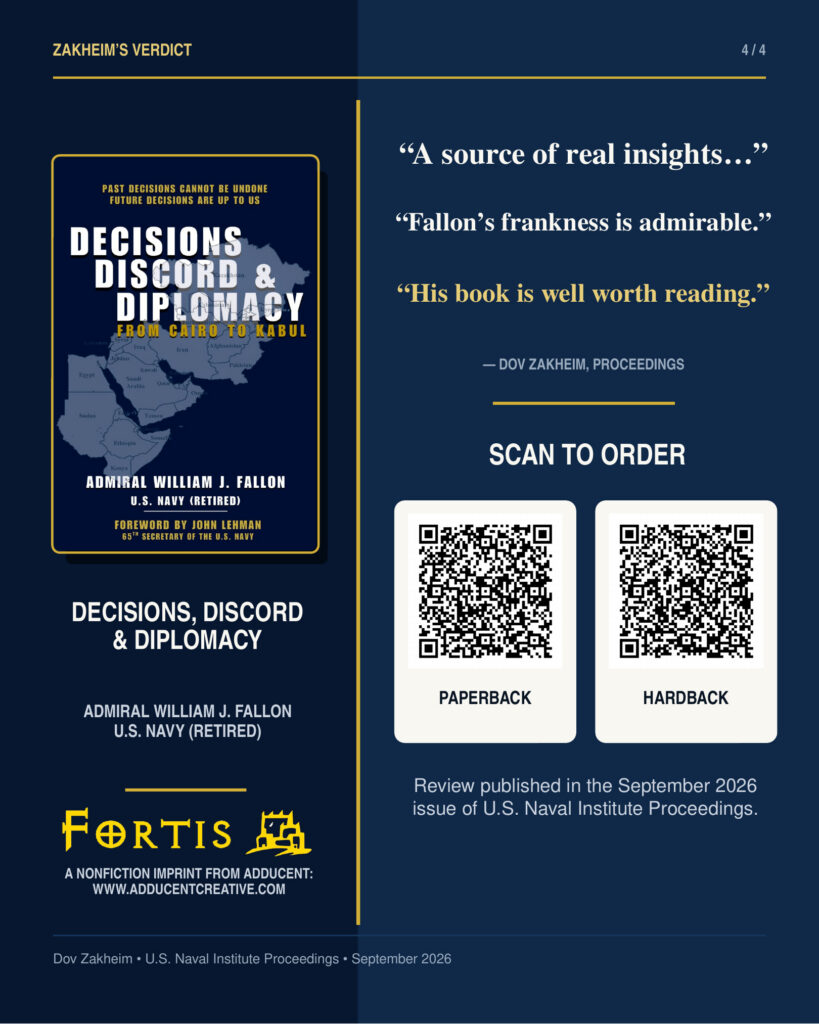
I had to smile at the first two sentences of Dov Zakheim’s review of Admiral Fallon’s memoir in the September issue of U.S. Naval Institute Proceedings:
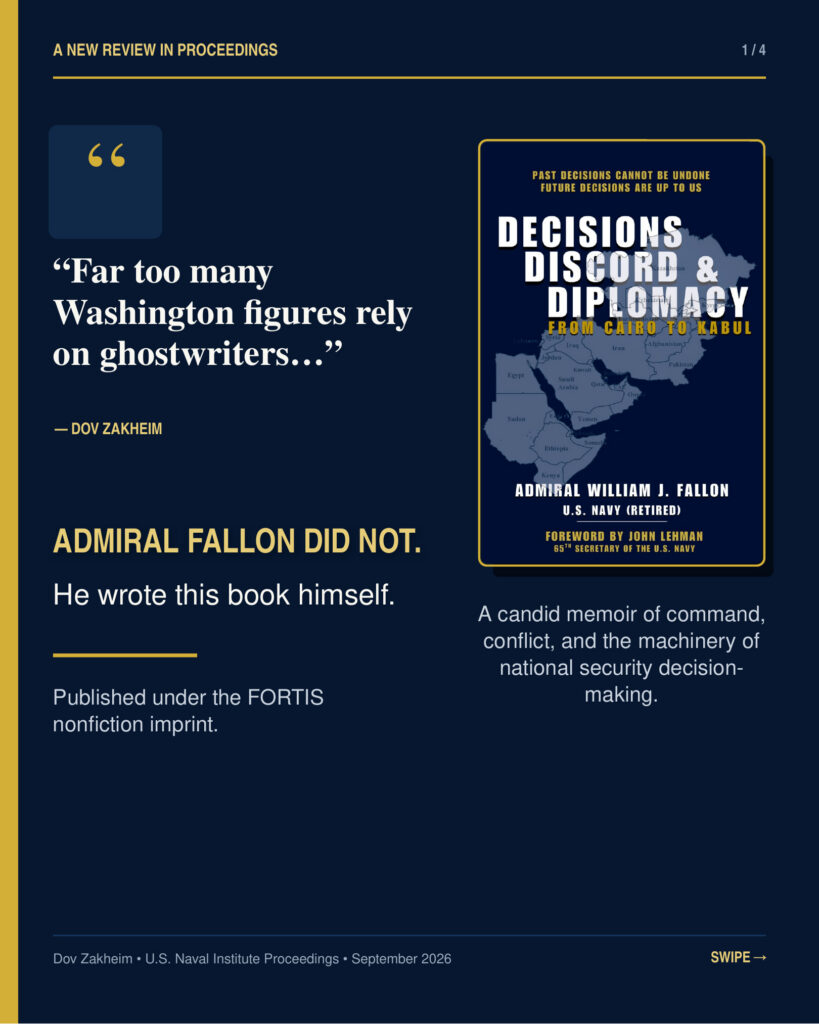
“Far too many Washington figures rely on ghostwriters for their memoirs. Retired Navy Admiral William (‘Fox’) Fallon is not one of them.”
He is exactly right on that point.
Decisions, Discord and Diplomacy was not ghostwritten. Admiral Fallon wrote it himself. We published it under our FORTIS nonfiction imprint.
I’ve ghostwritten 42 books. I’ve also spent 17 years publishing books by military leaders, nearly all of whom wrote their own books. So I’ll push back—slightly—on Zakheim’s broader premise.
Using a ghostwriter isn’t the problem. Losing the author’s voice is.
A good military memoir should sound like the person who lived it. And it should preserve that person’s judgment: what they saw, what they believed, where they disagreed, what they got right or wrong, and how decisions actually looked from inside the room rather than decades later from the outside.
Zakheim is well positioned to judge whether Fallon’s does. He was Under Secretary of Defense (Comptroller) and, from 2002 to 2004, DoD’s coordinator of civilian programs in Afghanistan—during the opening years of the period Fallon argues Afghanistan was neglected for Iraq. He has known Fallon for decades.
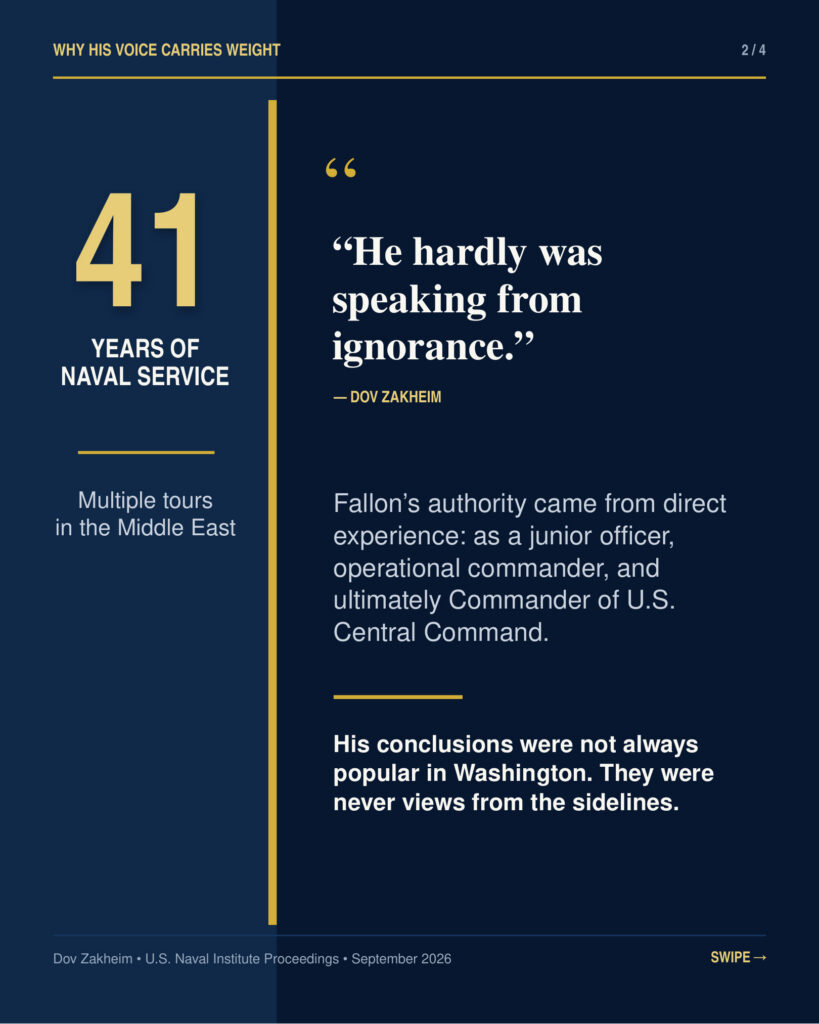
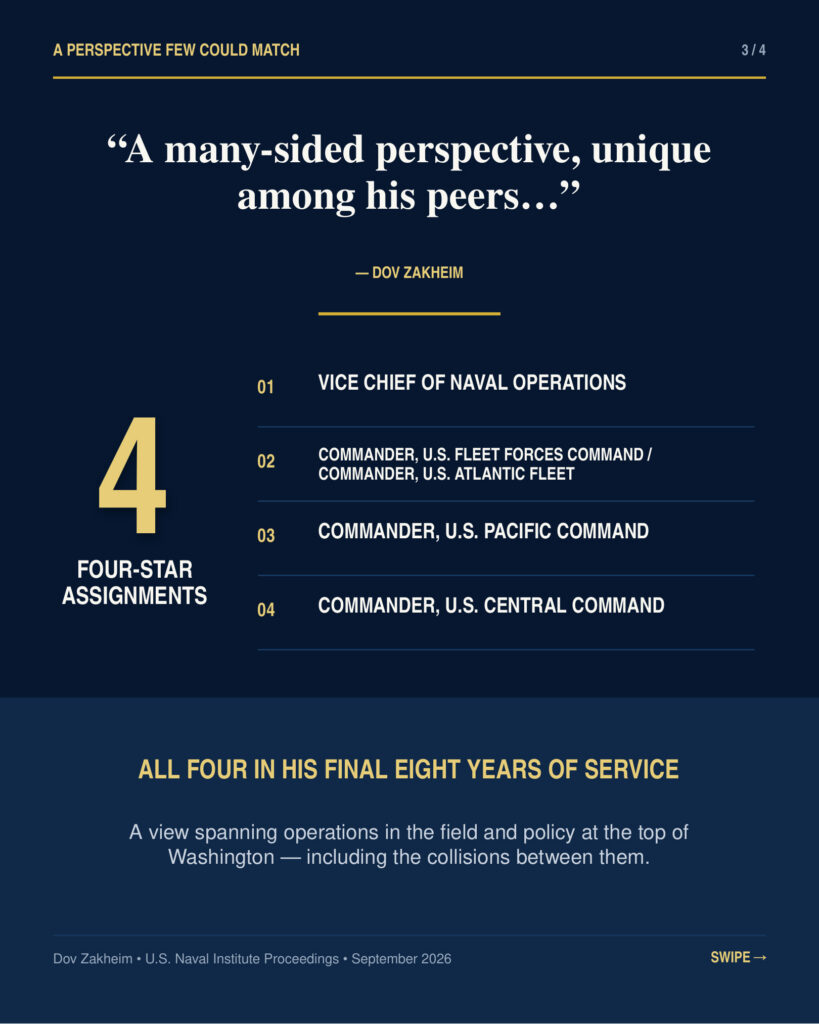
Fallon’s own perspective is unusually broad. During 41 years of naval service, his final eight included four four-star assignments: Vice Chief of Naval Operations; Commander, U.S. Fleet Forces Command/Commander, U.S. Atlantic Fleet; Commander, U.S. Pacific Command; and Commander, U.S. Central Command.
His view spanned operational command and policymaking at the highest levels in Washington—and, at times, the collision between the two.
Fallon does not conceal those collisions.
Vieques. Iraq. Afghanistan. The surge. Iran. His disagreements with senior civilian leaders and General David Petraeus. His eventual departure from CENTCOM.
Whatever a reader thinks of Fallon’s judgments, he puts them on the record.
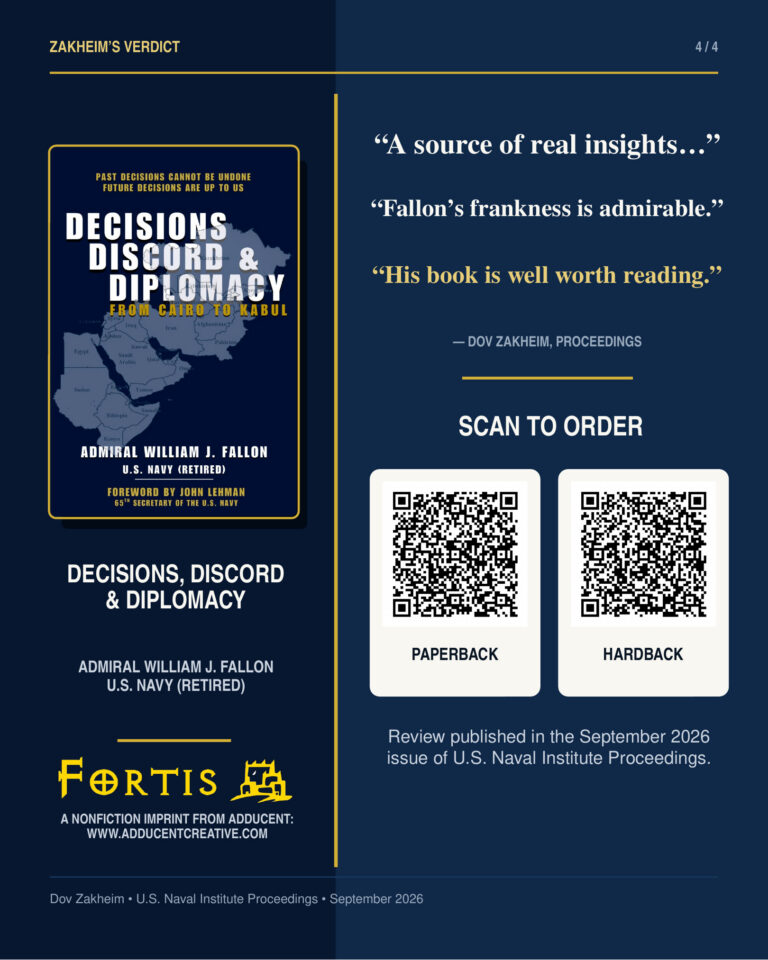
Zakheim finds in the book “real insights into the inner workings and bureaucratic intrigue that is endemic to government,” and calls Fallon’s frankness admirable. He closes by saying the book is “well worth reading.”
Decisions, Discord and Diplomacy: From Cairo to Kabul by Admiral William J. Fallon, USN (Ret.)
Published under the FORTIS nonfiction imprint.
Review by Dov Zakheim, U.S. Naval Institute Proceedings, September 2026.
About Us
Adducent, founded July 5, 2000, is a story and book development firm based in Jacksonville, Florida. Founder and Creative Director Dennis Lowery is a U.S. Navy veteran who spent the 1990s in aerospace manufacturing and more than eight years in business consulting with M&A attorneys and investment bankers before the company shifted its focus to writing and publishing in 2009.
Adducent has published 114 titles under its imprints — FORTIS (nonfiction and memoir), BOOKNOLOGY (business and educational nonfiction), ESCRIRE (fiction), and STANDFAST, established in 2026 for titles from the special-operations and intelligence communities. Every one was developed, edited, and produced under Dennis Lowery’s direct editorial direction. Fourteen arrived as standard nonfiction and were rebuilt as creative nonfiction.
Read about our Editorial and Publishing direction (and a subset list of client endorsements) here.
Read about ‘Who We Publish’ here.
Read about ‘Who’s Endorsed Books We’ve Published’ here.
Two have been selected for United States military professional reading lists: Fortune Favors Boldness, by Vice Admiral Barry M. Costello, on the U.S. Navy, Chief of Naval Operations Professional Reading Program; and What Now, Lieutenant?, General Richard ‘Butch’ Neal’s memoir, on the U.S. Marine Corps Commandant’s Professional Reading List.
Distribution is global print-on-demand through Ingram, a network that, by Ingram’s account, reaches 50% of the world’s population. Clients own all rights to their work. Dennis, who also ghostwrites for clients and other publishers, is a member of the Authors Guild, the United States’ oldest and largest professional organization for writers.