MOST AI TRANSFORMATIONS FAIL.
NOT BECAUSE THE ALGORITHMS ARE INADEQUATE.
BECAUSE THE ORGANIZATIONS DEPLOYING THEM ARE.
Available at: Amazon and Barnes & Noble
Or order direct links, follow (at a lower price):
ABOUT THE BOOK
Looking at over 200 implementations from 2019 to 2024, it’s clear that 73% of AI transformation failures are due to human factors like leadership, talent systems, and culture, not the technology itself. This pattern warrants further investigation. Interestingly, organizations tend to spend about $10 on AI technology for every $1 they invest in preparing their people, which significantly influences whether the tech succeeds. The numbers tell the story: when the ratio is above 8:1, success drops below 30%, but at 4:1 or better, success soars above 70%.
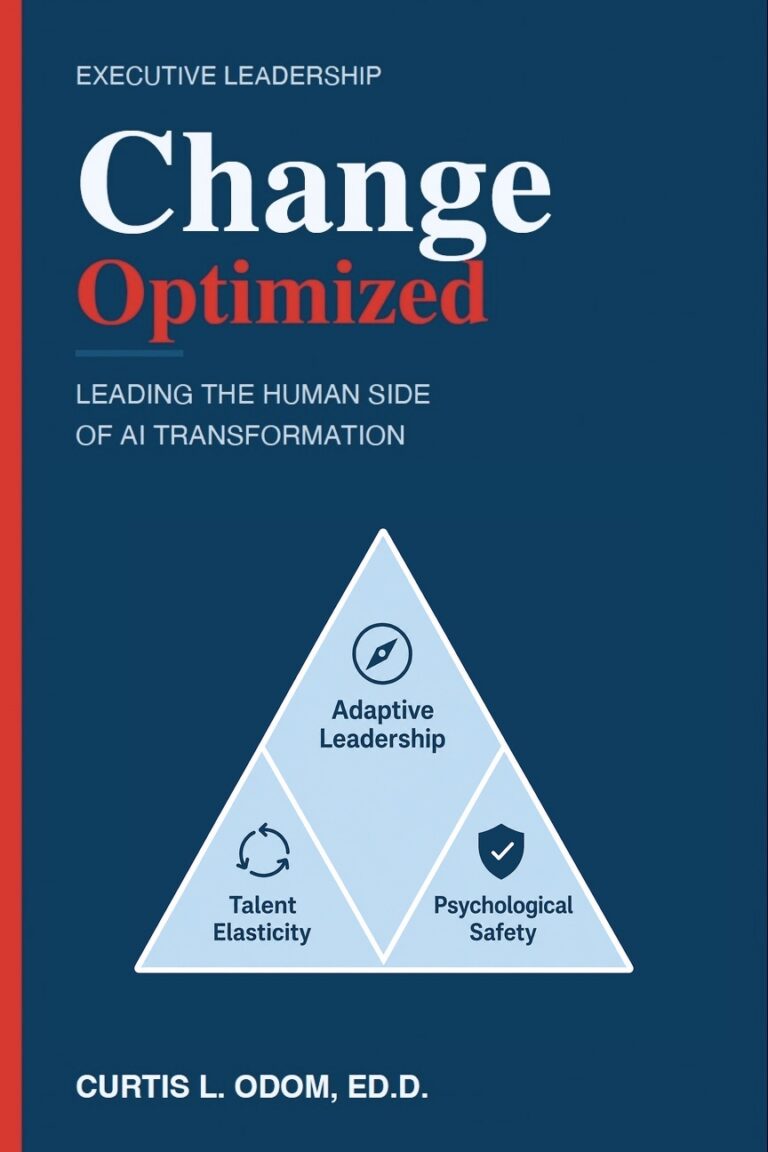
At the heart of the book is the Human-Centered Future of Work Framework, which highlights three interconnected organizational capabilities: Adaptive Leadership, Talent Elasticity, and Psychological Safety. These are the essential human elements that enable AI to deliver the results organizations are investing in. Each pillar is supported by a chapter of evidence and a chapter of practical guidance, along with helpful tools like diagnostic assessments, governance structures, and a step-by-step implementation plan.
The book showcases three inspiring case studies that highlight how the framework truly comes to life: Mountain View Regional Health, a robust 2,400-bed system that managed to delay its deployment by six months yet still surpassed all the performance targets set by its board; First National Bank, which successfully rebuilt its trading-floor leadership amid active regulatory oversight; and Precision Manufacturing Group, which retained its most experienced technicians by involving them directly in the AI deployment process rather than sidelining them.
In Change Optimized, Curtis L. Odom, Ed.D., draws on twenty-five years of Fortune 100 transformation work combined with ten years of qualitative research as a faculty member at Northeastern University to specify what the missing investment is, what it costs, and how to build it. Change Optimized is his eighth book. His writing on AI, leadership, and organizational transformation appears regularly in Harvard Business Review and Forbes.
Change Optimized is for CHROs, CIOs, transformation leaders, and boards who have figured out that the algorithm is the easy part—and that their next AI investment isn’t another algorithm.
ABOUT THE AUTHOR
Dr. Curtis Odom is an Executive Professor of Management and Organizational Development at Northeastern University’s D’Amore-McKim School of Business, where he teaches courses in management consulting, global talent management, organizational transformation, and leadership development.
Twenty-five years of Fortune 100 senior leadership experience ground his teaching in the judgment demands of executive practice, and his doctoral research at Pepperdine University shaped that practitioner knowledge into experience-driven frameworks rigorous enough to withstand scholarly scrutiny.
He is Managing Partner of Prescient Strategists, an international management consulting firm that helps organizations build the human readiness capabilities that determine whether AI investments generate lasting value. The firm’s proprietary frameworks are deployed across healthcare, financial services, manufacturing, and professional services organizations worldwide. Learn more at PrescientStrategists.com
Curtis holds a Doctor of Education from Pepperdine University and served on active duty in the United States Navy during Operation Desert Storm. A Professional Certified Coach credentialed by the International Coaching Federation, he regularly contributes to Harvard Business Review and Forbes, where his insights on organizational transformation, leadership, and the human dimensions of AI adoption have influenced thinking across industries. He sits on the Harvard Business Review Advisory Council. Change Optimized is his eighth book.
About Us
Adducent, founded July 5, 2000, is a story and book development firm based in Jacksonville, Florida. Founder and Creative Director Dennis Lowery is a U.S. Navy veteran who spent the 1990s in aerospace manufacturing and more than eight years in business consulting with M&A attorneys and investment bankers before the company shifted its focus to writing and publishing in 2009.
Adducent has published 114 titles under its imprints — FORTIS (nonfiction and memoir), BOOKNOLOGY (business and educational nonfiction), ESCRIRE (fiction), and STANDFAST, established in 2026 for titles from the special-operations and intelligence communities. Every one was developed, edited, and produced under Dennis Lowery’s direct editorial direction. Fourteen arrived as standard nonfiction and were rebuilt as creative nonfiction.
Read about our Editorial and Publishing direction (and a subset list of client endorsements) here.
Read about ‘Who We Publish’ here.
Read about ‘Who’s Endorsed Books We’ve Published’ here.
Two have been selected for United States military professional reading lists: Fortune Favors Boldness, by Vice Admiral Barry M. Costello, on the U.S. Navy, Chief of Naval Operations Professional Reading Program; and What Now, Lieutenant?, General Richard ‘Butch’ Neal’s memoir, on the U.S. Marine Corps Commandant’s Professional Reading List.
Distribution is global print-on-demand through Ingram, a network that, by Ingram’s account, reaches 50% of the world’s population. Clients own all rights to their work. Dennis, who also ghostwrites for clients and other publishers, is a member of the Authors Guild, the United States’ oldest and largest professional organization for writers.