In 1895, a forgotten novelist imagined getting one — a wise, incorruptible ruler with the power to fix everything. His perfect commonwealth is the warning.
“In every American city are rising the castles of the plutocracy in the shape of great armories for the militia.”
A man wrote that about the country he lived in.
He had watched a decade of strikes put down by force. He looked at the railroads and saw the medieval baron’s castle rebuilt at every mountain pass and river ford, taking its toll on everyone who had to move.
He saw great wealth gathering at one end of the country and a swelling crowd of the dispossessed at the other. He believed the crowd had begun to feel its doom: strikes, riots, the wave of fire and blood rising a little higher each time. The republic that was supposed to be the escape from Europe was turning back into Europe, and he thought it might end up worse.
Almost no one reads him now.
The lines open a novel, and the country they describe is the one its author stood in: a hundred and nineteen years after the Declaration of Independence, and already, in his telling, a failure.
We are coming up on the country’s two hundred and fiftieth year, with plenty of argument about how the country reached this moment — and Holford’s question, whether the trouble was built in or chosen, is exactly why it is worth meeting him now.
The Man and the Book
Castello Holford fought through the Civil War with a Wisconsin regiment — Vicksburg, the Red River, Nashville, Mobile — and afterward wrote a thick, serious History of Grant County, Wisconsin. He was not a crank. He was a veteran and a working historian who had spent his life close to how states get built and how they fall apart.
In 1895, he published Aristopia: A Romance-History of the New World, one of the earliest English-language alternate-history novels. The premise: A young settler named Ralph Morton lands at Jamestown in the brutal winter of 1607 — the real Jamestown, with the real John Smith, the real starving colony — and on an ordinary hunting walk, he sits down to rest on a quartz dike and finds it veined with nearly solid gold. Everything else follows from that one nugget. Morton keeps the secret, converts it into ships, charters, and political weight, and builds a commonwealth designed from the ground up to prevent every evil Holford watched corrode his own century.
A do-over of the founding, written by a man certain the Founders had gotten it incompletely right. And its underlying diagnosis is sharp.
The Diagnosis (That Still Stands)
Read Holford’s commonwealth as a list of grievances, and you could be reading the present. He abolishes private ownership of land, waters, forests, and mines because he has watched land monopoly turn free men into tenants and seen what a single owner can do to a future city. He puts wholesale trade and the great water-powered factories in public hands, because he can see industrial machinery becoming the thing a few men use to own the many. He kills primogeniture and caps any inheritance at ten thousand dollars, because dynastic money is how a republic grows an aristocracy in two generations without admitting it. He rewrites the criminal law to treat punishment as protection rather than revenge, ends the era’s burnings and mutilations, and quietly drops witchcraft, blasphemy, and sorcery from the list of things a person can be put to death for.
Concentrated wealth hardening into inherited power, public institutions captured by private owners, monopoly outrunning the law meant to govern it — these are his anxieties, and they are not anachronistic. A reader in 2026 nods along as the man describes the machine we are still inside.
Having seen the disease this clearly, Holford reaches for a cure.
The Cure is a King:
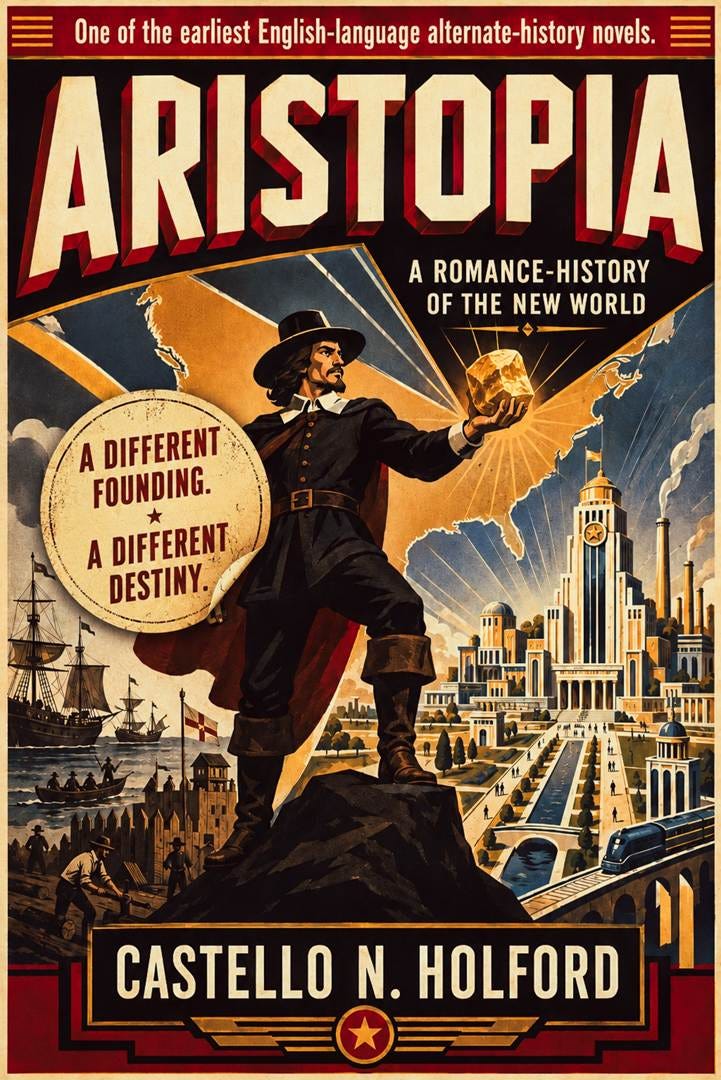
The whole Aristopian commonwealth is funded by one man’s secret gold and governed by that same man. Ralph Morton is named governor for life. No amendment to its constitution can take effect during his lifetime without his approval. He appoints the trade bureau, the storekeepers, and the code of laws. The participatory machinery is all there on paper — an elected congress, a veto subject to override, popular initiative, referenda on fundamental questions — and all of it sits beneath a wealthy patriarch whose authority cannot be voted out.
The man who saw the concentration of power most clearly could only imagine fixing it by concentrating power further.
And the system works — inside the book — for exactly one reason: Morton is good. Holford writes him wise, selfless, almost incorruptible, and the story rests its entire weight on that stipulation. There is no machinery for the day a bad man holds the office. There is no answer to the ordinary question of succession beyond hoping the next Morton is as fine as the first. The reformer who refused to trust a single railroad baron with a stretch of track turns around and crafts a single man he trusts with the entire experiment, forever, because he made that man virtuous.
What the Refounding Kept
It would be easier to file Holford as a flawed progressive ahead of his time. The book will not let you, because the sins he set out to remove survived his refounding, wearing new clothes.
He abolishes slavery in the constitution — a real and early reform — and in the same motion describes Indigenous people as children. The colony buys their land for what “the savage thought the skin worth,” reasons that this is fair because they cannot judge true value, and writes into the criminal code that selling them a firearm is a banishable crime. The reform improves the terms of colonization. It never once questions colonization itself, and the commonwealth’s whole future runs on taking the continent.
Then there is the passage that settles the matter. In the very paragraph where Holford abolishes private commerce — his anti-monopoly centerpiece — he pauses to call trade the special delight of “that strange vampire race, the Hebrews.” The slur is not an aside. It is welded into his economic argument, load-bearing, sitting inside the reform itself. His ‘human brotherhood’ had a wall around it, and he built the wall out of the same material as the brotherhood.
The book ends with Aristopia conquering British Canada during the American Revolution. To secure the vote for union in Ontario, where the population leans the wrong way, the commonwealth ships ten thousand loyal families north to swamp the majority and manufacture the result. Then the conquered provinces vote, freely, for annexation. The final sentence raises the banner: liberty, equality, and fraternity — directly on top of a continental conquest that has just engineered its own consent.
The Part That Travels
None of this is a 2026 reader feeling superior to a dead man. It is the opposite. Strip the period costume, and Holford’s mistake is one of the most familiar moves in our own politics.
We have his diagnosis everywhere: concentrated wealth, captured institutions, a rigged game. And we have his cure everywhere too, in current dress: the leader handed unchecked control because his intentions are right and oversight only slows the mission; the strongman who claims he will personally break the oligarchy; the vanguard that needs total power, briefly, just until things are fixed. Watch how often the pitch arrives the same way Holford’s did — give one good actor a free hand and trust their goodness to hold.
That is the tell.
Holford’s leader works only because the book stipulates his virtue; the fiction must write it in. We are asked to do the same, and it is tempting to say we do it at the ballot box. We don’t. Hoping a leader is good, and keeping the power to remove him, is democracy working exactly as designed. Holford’s real heir is the figure who makes the next move: not trust this good man, but stop being able to check him. Gut the watchdogs. End the override. Make the office unloseable. That is where the wish hardens into a throne.
The danger was never a bad king instead of a good one. It’s that the conceit makes virtue load-bearing at all. The point of a sound structure is to make virtue unnecessary, not to guarantee it. Good design divides power, exposes what it does, and keeps decisions reversible, so that a bad man in the office is something the system survives rather than something it can’t. The moment everything rides on auditing one man’s character, the design has already lost — not because the audit comes back wrong, but because no answer to it holds. Character isn’t fixed, it isn’t inherited, and it can’t be voted back once it curdles. A structure that’s safe only when the right man holds power isn’t safe. It’s lucky.
Every era supplies its own candidate for the throne, and ours is not short of them. You can fill in the name; I don’t need to. The point is older and worse than any single one of them.
The problem Holford saw is real and still demands an answer. The answer cannot be a wise king.
The throne doesn’t make a man dangerous. It makes him untouchable.
The Virtue of Distrust
The Founders were not better men than Holford, and they did not solve the sins he hated. They wrote some of them into the document; they left the worst for later generations to bleed over.
Aristopia is in many ways a more humane program than the Constitution the Founders wrote in 1787.
But the Founders did one thing Holford could not bring himself to do, and they did it on purpose. They refused to vest the experiment in any single virtuous man. Having just fought a king and watched a weak confederation fail, they built distrust into the design — separated powers, fixed terms, a way to amend, a way to remove — on the assumption that the people running it would not always be good enough. Holford looked at that messy, distrustful arrangement and found it inadequate. So in his fiction, he reached for the gold and the crown and built something cleaner… and far more dangerous.
He wrote in 1895, a hundred and nineteen years into the experiment, certain it had already failed. We are now at two hundred and fifty, and the republic he eulogized is still here, still arguing with itself, still amendable. It was never the machine alone that saved it: the sins Holford’s design would have frozen in place were pried loose by war and mass movements, by the people the original system shut out. But they had something his commonwealth never offered: a structure that could be forced to change instead of a throne that couldn’t. That capacity is what his perfect colony threw away, and it is the most optimistic fact in the whole exercise. Self-correction. It’s uglier than perfection, but it outlasts it.