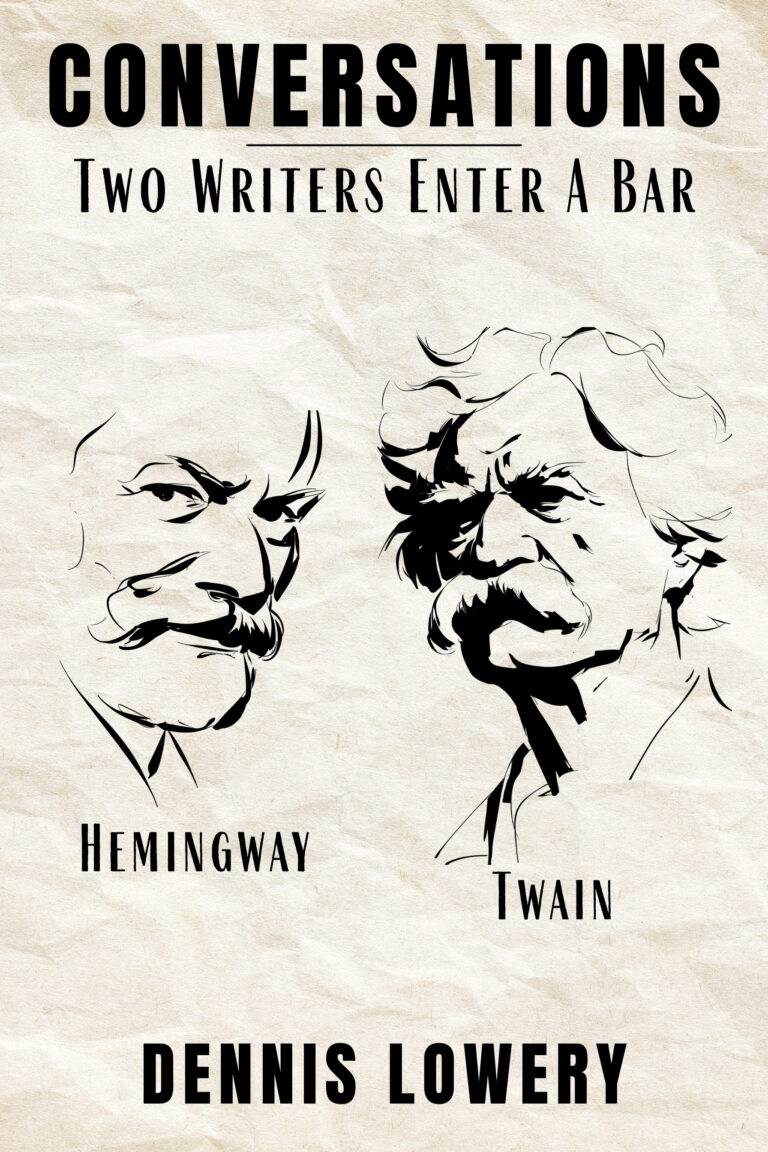
Two of America’s greatest writers meet in a bar to argue about whether human writing can survive AI and the age of machines.
Key Takeaways
- Twain and Hemingway discuss the nature of writing and the impact of AI on literature.
- They reflect on the challenges of being a writer in a digital age, emphasizing the need for authenticity and visibility.
- Twain believes that AI can produce passable content, and one day, you might not be able to tell the difference between it and human writing.
- Hemingway argues that true writing has emotional depth and should connect with the reader’s experiences.
- Their conversation concludes with a wager on whether readers will discern the difference between human- and machine-generated writing by next year.
The bar was the kind neither man would have chosen sober. Fluorescent lights. A television no one watched. Peanuts in a bowl that had seen better decades.
Twain ordered bourbon. Hemingway ordered the same but didn’t say so—he just pointed at Twain’s glass and held up a finger.
• • •
TWAIN: You know what cheated us, Ernest?
HEMINGWAY: Dying.
Twain looked at him, a considered moment.
TWAIN: Timing. We had the misfortune of dying before a writer could reach his readers without first going through a man in a top hat who called himself a publisher. And I’m told—and I have this on what I consider reasonable authority, which is to say a dead man’s intuition—that a person can now write a book without a single publisher being involved in the transaction. Just hurl the thing out into the electrical bazaar and wait for strangers to pay you. It is the most American arrangement I have ever heard of, and I include the Louisiana Purchase.
HEMINGWAY: Most of what’s out there isn’t writing. It’s typing.
TWAIN: That was Capote’s line.
HEMINGWAY: He got it from me. I’m taking it back.
TWAIN: (swirling his glass) Well, the point stands regardless. If a man wanted to come back—I mean, really come back, start fresh, hat in hand, make an honest go of it—when would he do it? Because I have been dead for some time now, and I confess the rest has not improved my patience.
HEMINGWAY: Not the past. The past is no good. Everyone there already knows the ending.
TWAIN: The future, then. But how far into it?
HEMINGWAY: Now (he glances at the screen with a newsbreak and the date). March 14, 2026.
TWAIN: That is remarkably specific for a man who once needed 28,000 words to say a fish got away.
HEMINGWAY: It’s the right year. The machines learned to write. Some writers stopped trying. The ones still doing it will stand out the way a man stands in a field after everyone else has gone inside.
TWAIN: And you think this is good news, the opportunity rather than the catastrophe?
HEMINGWAY: The machine writes the way a man writes who hasn’t lived anything. The sentences are clean. The grammar works. But there’s nothing behind them. No cost. A man who writes a true sentence about loss has to have lost something. He has to sit down and bleed it out. The machine just read about it and regurgitates.
TWAIN: Now, I am not entirely sure I share your confidence on that score. I have read some of what these machines produce, and I’ll confess—reluctantly, mind you, and I’d deny it in the presence of a journalist—that some of it is passable. Some of it sounds more like me than I would care to admit, which is troubling for reasons I’d rather not examine on a full stomach.
HEMINGWAY: Passable. That’s the word. Nobody ever remembers a story that was passable. Passable is what kills you. It always was. But the worst thing is this: most people won’t know why. They’ll read something the machine made and feel almost something. Close to something. And they’ll think that’s what writing is, because they’ve never been hit by the real thing.
TWAIN: Or they have been struck by the real thing and simply can’t remember when.
Neither of them spoke for a moment. Hemingway drank.
TWAIN: (leaning back) All right. So we’re here in 2026. What is the play? I assume you are not suggesting we simply write a novel and sit by the mailbox like a pair of hopeful spinsters waiting on Valentine cards.
HEMINGWAY: No mailbox. You’d have to be visible. Not famous. Visible. They’re different. Famous means they know the name. Visible means they trust what you see that turns into writing they enjoy… that moves them.
TWAIN: You mean put yourself out there. Write in the open where they can find you—short pieces, opinions, the odd observation that might start a fight.
HEMINGWAY: Yes. But only things you’d stand behind if someone hit you for saying them.
TWAIN: I was once physically confronted over something I wrote about a local dignitary’s wife in the Territorial Enterprise. The dignitary in question was six-foot-four and had hands like saddlebags. I can assure you the experience did not sharpen my prose in any way I could measure, though it did improve the speed at which I could exit a building. The lesson I took from it was not about courage but about geography—specifically, the distance between him, me, and the nearest door.
HEMINGWAY: It worked differently for me.
TWAIN: (pause) Yes. I expect it did.
HEMINGWAY: In Paris, I wrote sketches. Small pieces for small magazines nobody remembers now. But the people who read them remembered me. By the time the novel came, they already knew what and how I could write. I didn’t have to convince them. I just had to show up with the longer work. But you have to be careful. Visibility has a cost. It worked for me until it didn’t. The fame came, and then the writing got harder because everyone was looking at the man instead of the page.
TWAIN: And the other part? Because with you, Ernest, there is always a second part you are saving like a card up your sleeve, except you have no sleeves because you are wearing one of those dreadful safari shirts.
HEMINGWAY: The other part is knowing what not to write.
TWAIN: Oh?
HEMINGWAY: Everyone now writes about themselves. Their feelings. Their mornings. What they ate. What made them sad about what they ate. The man who writes about the world—the real world, the one outside—he’ll have the field to himself.
TWAIN: Now that I take real exception to. I wrote about myself constantly and with great enthusiasm. Half of my travel books are nothing but me being baffled in foreign countries—baffled by the food, baffled by the customs, baffled by my own luggage. And they sold beautifully. The Innocents Abroad made me more money than anything a modest and upstanding man should earn from being confused in Italy.
HEMINGWAY: You wrote about yourself running into things. The river. The people. The territory. You were the window, not the view. You showed people what was on the other side. That’s different. Most people now, they stand in front of the window and describe the glass.
TWAIN: (long pause, then slowly) That is… a better distinction than I would have given you credit for. I will not say it again, so if you would like to savor it, now is the time.
HEMINGWAY: I don’t need to savor it. I know when I’m right.
TWAIN: And there it is. The modesty that made you so beloved at dinner parties.
HEMINGWAY: I was fine at dinner parties.
TWAIN: But I’ll tell you something, Ernest, because I have been thinking about it while you were busy being right. All those people writing about themselves—their mornings, their moods, their small indignities—I don’t think that’s vanity. I think it’s loneliness. They are writing at the window because they want someone on the other side to see them standing there.
HEMINGWAY: That’s their business.
TWAIN: It is. But here’s the thing. You wrote a story once—a whole story, mind you—about a waiter who didn’t want to go home at night. An old man drinking alone in a cafe. Another waiter who wanted to close up. That’s all that happens. Nothing happens. It is, on its face, a story about as eventful as watching someone else’s coffee get cold.
HEMINGWAY: It was about more than that.
TWAIN: I know it was about more than that. That is my point. You wrote about a cafe and a lightbulb and an old man’s empty glass, and somehow every lonely person who ever read it felt less alone for having read it. You didn’t write about yourself. You didn’t tell the reader you understood their loneliness. You just described the clean, well-lighted place where a man could sit with it. And that did more for every solitary reader than a thousand people writing about what made them sad about what they ate.
Hemingway said nothing. He turned his glass slowly on the bar.
TWAIN: That is what writing about the world does when it’s done by someone who has earned the right to see it clearly. It finds the loneliness without naming it. And the reader thinks, this man has been where I am, even though you never said so. (pause) I would not have done it that way. I would have needed more words and a riverboat and probably a funeral. But I recognize the thing when I see it.
HEMINGWAY: You would have made it funny.
TWAIN: I would have made it funny and then made them cry on the way home. It would have taken me twice as many words—and that riverboat—but they’d have ended up in the same place.
Hemingway almost smiled.
TWAIN: What about this business of platforms? There are newsletters now, social feeds, the whole howling carnival. A man has to pick his stage. I toured the lecture circuit for years, and I can tell you that picking the wrong stage is worse than having no stage at all. I once delivered a perfectly good lecture on the Sandwich Islands to an audience in Cleveland that had been promised a magician. The confusion was total. A woman in the front row kept waiting for me to produce a rabbit, and I could see in her eyes the precise moment she realized no rabbit was forthcoming. That is what the wrong platform feels like.
HEMINGWAY: Pick the one where people read. Not scroll. Read. There are one or two left. Write there until they know you. Then build your own room. A thousand people who chose you is worth more than a million who fell past you on the way to something else.
TWAIN: A thousand. I like that number. You can picture a thousand people in a room, which is to say you can picture yourself disappointing them individually, which I find keeps a man honest.
HEMINGWAY: You don’t need to picture them. You just write it like the person reading might not be here tomorrow.
TWAIN: Good Lord, Ernest. You could depress a brass band.
The bartender brought two more without being asked. On the television, a man was trying to sell something neither of them understood.
TWAIN: So let me gather up the pieces of your grand strategy and lay them out in order, because contrary to your philosophy, not every reader navigates by instinct, and some of us believe that a little signposting is a courtesy and not a failure of nerve. One: write short, write where they can see you. Two: write about the world, not about your breakfast. Three: build a small audience of people who chose you before you ask them to buy a single thing. Four: Do not try to write like the machines. Write what they can’t.
HEMINGWAY: Five.
TWAIN: Five?
HEMINGWAY: Don’t summarize. People who were paying attention don’t need it.
TWAIN: And people who were not paying attention deserve a second chance, Ernest. That is democracy. And good manners. Not every reader is you. Half the people who loved my books were twelve years old. A twelve-year-old requires the occasional guidepost, and he is no worse a reader for it—he is simply a reader who has not yet had the pleasure of your instruction.
HEMINGWAY: Huck on the raft. Deciding to go to hell rather than turn Jim in. You didn’t explain it. You let the boy say it, and you got out of the way.
TWAIN: (quietly) That was a good moment.
HEMINGWAY: It was good because you didn’t touch it. You put it down, and you walked away from it.
They drank. The television changed to a woman pointing at a weather map. Neither of them looked.
TWAIN: There is one more thing, though. Something you are leaving out, and I suspect you’re leaving it out because saying it would require you to admit that something other than talent matters, which has always given you indigestion.
HEMINGWAY: Say it.
TWAIN: Persistence. Just plain showing up. The willingness to be rotten on a Tuesday so that you can be less rotten on a Wednesday and maybe, if the creek don’t rise, actually good by Thursday. I have written entire books that were not worth the paper they were printed on, and I knew it at the time, and I wrote the next one anyway. That is not a strategy. I know you’ll say that. But it’s the thing underneath the strategy that makes the strategy go.
HEMINGWAY: That’s a temperament, not a plan.
TWAIN: Then I suppose you had better have the right temperament. Because in 2026 or 1876 or any year you care to name, the writer who keeps writing is the one who is still standing when the others have wandered off to sell insurance.
HEMINGWAY: On that, we agree.
TWAIN: Mark the occasion.
HEMINGWAY: Already did.
Twain emptied his glass and set it down with the care of a man who respects the ritual of a last drink. Then he looked at Hemingway the way a man looks at a poker hand he hasn’t decided whether to show.
TWAIN: One more thing before we settle up. A wager.
HEMINGWAY: Go ahead.
TWAIN: You believe the cost shows. That a year from now, a man who has lived something and written it down will produce something so different from what the machine assembles that anybody with eyes will see the gap. That the readers will know. That they’ll feel it in their hands like the difference between a loaded gun and a drawing of one.
HEMINGWAY: I do.
TWAIN: Well, I am not so certain. And I say this not to be contrary but because I have spent a lifetime watching audiences, and I know something about them that you never liked to admit. They don’t care what a thing costs. They never did. They care what it’s worth to them in the moment they hold it. If a machine writes a story that moves a man on a Tuesday night when he is lonely and sitting in his own clean, well-lighted place—he will not ask who paid for the sentence. He will just be grateful he found it… or it found him.
Hemingway was quiet for a moment. He judged his glass the way he judged things when he was deciding whether they were true.
HEMINGWAY: Maybe.
TWAIN: Did you just say maybe?
HEMINGWAY: I said maybe they won’t ask. That doesn’t mean the answer doesn’t matter.
TWAIN: And that, Ernest, is a position I can respect while completely disagreeing with it. So. Same bar. One year from tonight. We come back, we look at what’s been written, who’s been reading it, and whether anyone can tell the difference between the man and the machine. Loser buys.
HEMINGWAY: The one who was wrong buys. He owes more.
TWAIN: That is what I said.
HEMINGWAY: No. You said loser. A man can lose and still be right.
TWAIN: (pause) Ernest, that may be the saddest thing you have said all evening, and the competition has been fierce. But fine. The one who was wrong buys.
HEMINGWAY: Done.
• • •
The bar closed at two. They left separately—Twain through the front, telling an anecdote to the bartender who had not asked for one, and Hemingway through a door that may or may not have existed.
The bartender wiped down the counter and found, folded under a glass, a napkin with two lines on it in handwriting he couldn’t place—it might have been one man’s, it might have been both.
The first line read: “Hemingway says they’ll know the difference. Twain says they won’t care.”
The second: “Same seat. March 13, 2027. Wrong man buys.”
About Dennis Lowery
Dennis Lowery is an author and writer. He has ghostwritten 41 books for clients (17 novels, 13 nonfiction, nine memoirs, and two creative nonfiction). He has also worked on dozens of titles, helping develop, improve, edit, and provide publishing assistance.