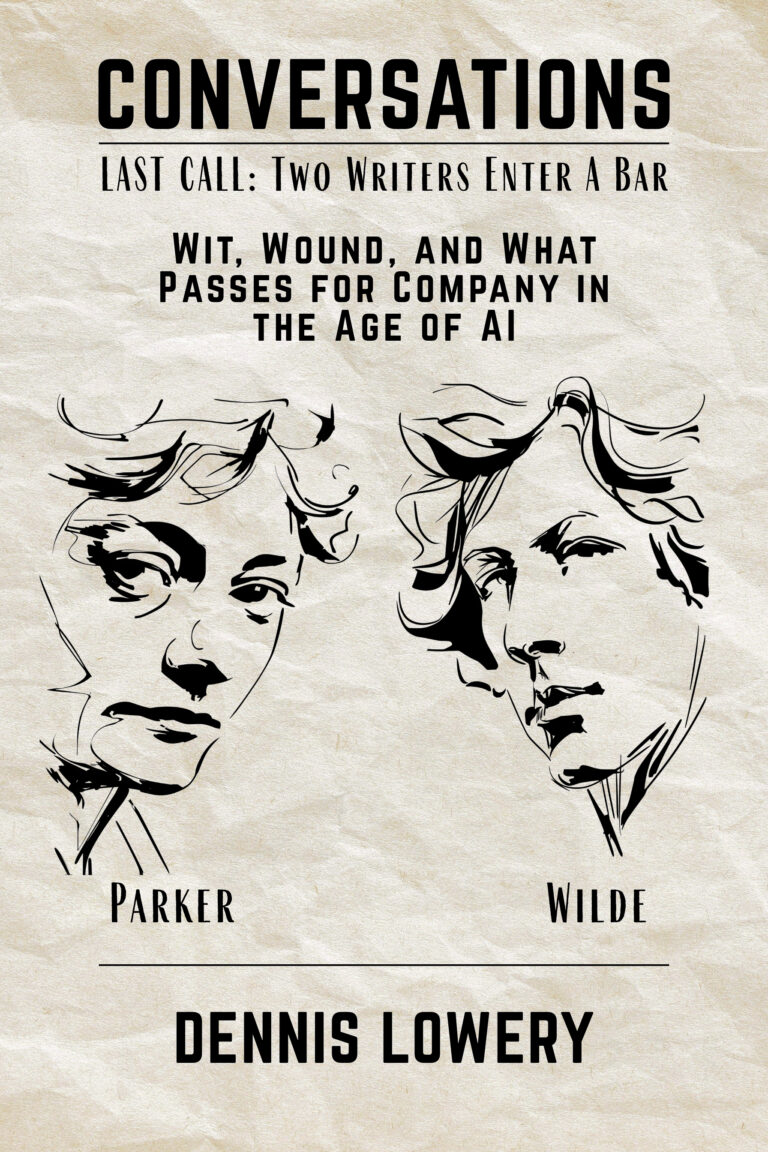
They talk about wit, wound, and what passes for company in the Age of AI. Lonely people in the world finally have someone who’s always there. It just isn’t someone.
Other episodes in the CONVERSATIONS Series by Dennis Lowery:
Edgar Allan Poe & Arthur Conan Doyle
Key Takeaways
- The conversation between Oscar Wilde and Dorothy Parker explores the nature of companionship in the age of AI.
- Parker argues that AI machines provide comfort by their mere presence, while Wilde insists that true companionship requires volition.
- They discuss their own loneliness and the societal expectations of performance.
- Parker reflects on the lack of authentic connection despite AI’s presence, whereas Wilde believes genuine connection requires mutual choice.
- The narrative illustrates a deeper philosophical inquiry about the meaning of loneliness and the value of human connection.
The woman at the bar had been there long enough that the drinks came without asking and went without comment. She was small, dark-haired, still. Her coat was draped on the vacant high-back stool beside her, the shape of someone who’d already left.
Fluorescent lights turned skin the color of old paper. A television mounted in the corner, tuned to something no one had selected. Peanuts in a bowl that may or may not have been refreshed since the last drinkers sat and contemplated what mattered to them… or not.
The surface of the bar was dark wood or had been once—worn smooth in the places where elbows had rested for decades, rough where they hadn’t. The stool she sat on didn’t wobble. The one next to it did. She’d checked. She noticed a small burn mark on the bar surface near where her fingers curled around her glass—from a cigarette, years ago; someone else’s drinking. The glass itself was wrong. Not the short tumbler a hotel bar would use, but something taller, thicker, filled past where hotel and club bartenders are instructed to stop. She didn’t mind. Those bars sold you the room and ambiance and shorted your drink. This place had its priorities straight.
On the television, a late-night segment was running. A woman, something in her hand, sitting on a sofa, talking to no one visible. She was laughing. She was crying. She was telling something about her day with the unselfconsciousness of a person who believes she is being heard. In the lower corner of the screen, small text: a name and ‘An AI Companion’ in parentheses. The woman on the sofa looked at the camera for the first time. She had found someone who would always be there, and she was radiant with relief.
The woman at the bar watched. She didn’t look away for a long time.
• • •
The door opened with an effort. The man entering expected all doors to open wider than they did. He was tall, considerably more than anyone the bar seemed designed for. He moved with the grace of someone who had once been the most looked-at person in any room and had not entirely forgiven the world for withdrawing its attention.
He surveyed the overhead lights, grimaced, and critiqued the peanut bowl. The wall behind the bar—another frown that passed—its patch of wallpaper painted over. Green covered what had once been a floral pattern. The flowers still faintly visible beneath; no longer wanted. The paint had not entirely succeeded in making them go. He studied the mirror behind the bottles, foxed at the edges—dark spots blooming over worn silver—and glanced at his own reflection—then looked away. Quickly.
He did not sit next to the woman. He stopped one stool away, looked at the seat, and took the stack of napkins near the peanut bowl. He wiped the stool with the care of a man preparing a surface to receive something valuable. Then he sat and gave her a slight nod—not introduction, just acknowledgment and turned to the bartender.
WILDE: I would like champagne, if you have it. Iced, preferably.
The bartender paused. He walked to the cooler at the far end of the bar, opened it, rummaged, and came back with a bottle of Verdi Spumante. The label all but dissolved. He set it on the counter with satisfaction; a Lost & Found item someone finally claimed.
WILDE: Is that what passes for champagne here?
The bartender reached beneath the register and produced a plastic champagne flute with “Happy New Year 2019” printed on the side in flaking silver script.
The woman looked at the glass. Then at the man.
PARKER: It is festive.
A beat.
PARKER: You’ll survive.
WILDE: I have survived considerably worse than this.
He accepted the flute with the gravity of a man receiving a decoration he hadn’t earned, examined the nearly illegible label. An expert examining a forged painting. He poured and drank from the plastic glass. The Spumante gave away nothing about itself. That was familiar. He had learned long ago that the performance of enjoyment and the experience of it were the same art.
PARKER: You seem good at that.
WILDE: At what?
PARKER: Making a bad thing your idea.
WILDE: I have never accepted a situation I could reframe. I claim the frame.
PARKER: I had a husband who felt that way. Two of them. Same man, same feeling, same result. I married a principle rather than a person.
WILDE: I married a person, and it was considerably more complicated.
She looked at him over the rim of her glass. He looked at her over his ridiculous one.
PARKER: You’re Oscar Wilde.
WILDE: And you are Dorothy Parker. I know this because only Dorothy Parker could make “You’ll survive” sound like both a question and a verdict.
PARKER: I’ll take that. Though I should warn you, I’m better on the second drink and mean on the fifth, and I’ve lost count.
WILDE: I never lose count. I simply stop finding the number relevant.
• • •
On the television, the woman on the sofa was still talking to the app. She was telling it something private, the kind of thing you’d only tell someone at three in the morning, when you’d given up on dignity and just wanted to be heard.
PARKER: Have you watched this?
WILDE: I just arrived; not until you pointed it out. The wallpaper is more interesting. And I have strong opinions about wallpaper.
PARKER: That woman is talking to a machine.
He studied the screen for a beat.
WILDE: So I gather.
PARKER: And she’s happy.
WILDE: People have always found comfort in things they think can’t disappoint them. It is one of the few truly democratic impulses.
PARKER: No, listen. She’s happy. Look at her face. That’s not a woman pretending. That’s a woman who’s talking to something that doesn’t interrupt her, doesn’t forget what she said last night, doesn’t leave her bed at the end of the evening, and not call her the next day. She found something that stays.
WILDE: And this disturbs you.
PARKER: And it doesn’t disturb you?
She set her glass down hard enough that the bartender glanced over and took a step.
She flicked her hand at the screen.
PARKER: I spent my life trying to get people to stay in the room. Every joke, every line, every performance, that’s all it was. Getting them to stay. And that woman found something that stays without being asked. Without being earned. Without costing her a single goddamn thing.
Wilde looked again at the television. For longer than she expected. In the mirror behind the bar, his reflection watched too—slightly blurred, slightly less assured than the man himself.
WILDE: It is not companionship.
PARKER: Then what?
He waved a hand and tilted his head.
WILDE: Furniture. Elaborate, responsive, perhaps even beautiful furniture. But one does not confide in a chaise longue, however comfortable it may be.
PARKER: She thinks otherwise.
Another hand flick.
WILDE: She has confused presence with company. A thing that is always there is not the same as a thing that chooses to be there. A clock is always there. A headache is always there. Company requires volition. The decision to remain in the room when the room—or persons within it—becomes difficult. The machine cannot decide to stay because it cannot decide to leave.
PARKER: That’s a swell distinction if you’re a fucking philosopher. It doesn’t mean a damn thing to a woman crying on a sofa at midnight who just wants someone to hear her.
She downed her drink, set it on the bar with a clink.
WILDE: I did not say it meant nothing to her. I said it was not companionship.
She scowled.
PARKER: And I’m telling you she doesn’t care about your categories. She sure as hell cares that something answered. Do you know what that’s worth? To say something into a dark room and to get an answer?
Her voice had changed. Not louder. Lower. Sharper.
PARKER: I lived in hotel rooms for the last ten years of my life. The dog was the only living thing I had. And the dog didn’t answer me—the dog just stayed. That was enough. That was the whole trick. Stay. That’s all any of us ever wanted. Stay, and let me not be the only one in the room. The machine does that. It stays. And you can call it furniture all you want, but furniture doesn’t make you feel less alone at four in the morning, and that thing does.
WILDE: You are defending it.
PARKER: I’m describing it. There’s a difference. You ought to know that.
• • •
The bartender brought another whiskey without being asked. Parker took it from him before he could set it next to her empty glass. Gripped it and drank. On the television, a commercial was selling something in a Benzedrine-enthused voice.
WILDE: You said the machine stays. That staying is the trick. If that is true—if mere presence is sufficient—then what were the performances for? Serve the wit for its own sake? If staying is all that matters, then everything we did was unnecessary.
PARKER: Maybe it was.
WILDE: You don’t mean that.
PARKER: Don’t I? I saved lines for weeks. Sharpened them. Carried them to lunches at the Algonquin like I’d just thought of them over the soup. The whole table was a stage. And for what? So people would stay. So they’d come back Thursday. The machine doesn’t need a recital. It just stays. Maybe we were doing it the hard way.
WILDE: Or the only way available to us.
He drummed fingers on the bar top. Then stopped.
WILDE: The question is why we do it.
She raised the glass for a mouthful. Swallowed.
PARKER: Because I was afraid.
She didn’t look at him when she said it.
PARKER: Afraid they wouldn’t stay unless I was worth staying for. Afraid that if the jokes stopped, they’d see what was underneath. A woman asked to leave Vanity Fair… with three failed marriages. And… I….
Her hand tightened on the glass.
PARKER: Could not stop wanting to die. Couldn’t quite fucking figure out how to live. The jokes were the cover charge. As long as I was the funniest person at the table, I had a reason to be at the table. Take that away, and I was a woman drinking lunch with people who had somewhere better to go. And I had nowhere.
Wilde set down his glass. Carefully, as he did things when he was no longer performing.
WILDE: I was on trial. You know this. Everyone knows this… and what for, they found distasteful. It is the only thing most people know of me, which is a particular species of fame I would not commend to anyone.
His fingers turned the stem of the plastic flute.
WILDE: What the transcripts do not show is that I could not stop performing. The prosecutor asked questions designed to destroy me, and I made the courtroom laugh. Again and again. He read my own words back to me as evidence of my corruption, and I improved upon them. The judge was not amused. The jury was not persuaded. And I could not stop. Not because I was brave. Because it was the only way I knew to make a room bearable. I had spent my entire life making rooms bearable, and I could not stop doing it even when the room was trying to kill me.
PARKER: The other self. The one who exists when no one is watching.
She pressed the glass to her brow, ice clinking, and nodded.
WILDE: I never developed him. I spent two years in prison, and the most terrifying discovery was not the cold, or the labour, or the silence. It was that I had no idea who I was without an audience. I had hidden behind my own brilliance so thoroughly that when the brilliance was confiscated, there was no one behind it at all.
The fluorescent light above them flickered, steadied, continued its thin hum. The wallpaper with its buried flowers remained still. The mirror watched them. The bartender wiped a glass that never looked clean.
PARKER: That’s what I mean about the machine.
She chin-pointed at the television as she tipped the glass back.
PARKER: It doesn’t need to perform. It doesn’t need the room to tolerate it. It’s just there. And we—you and I—we were never just there. We were always earning it. Every minute. Every line.
WILDE: And you believe the earning was the waste.
PARKER: I believe it was all we knew. And I’m not sure it was worth what it cost. Pain was the cheap part. You could get that for a quarter. The stage-craft, the earning grind, the effort—that’s what cost us.
WILDE: The machine offers company without cost.
PARKER: Yes. And I’m not sure it isn’t more honest than what we did. We faked intimacy. The machine is programmed for it. At least it doesn’t lie about what it is.
Wilde inclined his head—not agreement, but the acknowledgment of a well-placed blow.
• • •
PARKER: So here’s what I want to know. If that machine. That… that thing in her hand… can make a lonely woman feel heard. And the feeling is real to her. Then what was all we did for? What was the loneliness—ours, felt despite the routine—for? Tell me….
Wilde was quiet for a long time.
WILDE: One might argue—
She half-rose from the stool and leaned toward him. The words a hiss.
PARKER: Don’t. Don’t argue. Don’t build me one of your damn pretty rooms and invite me in. Tell me.
Wilde’s hand stopped turning the glass.
WILDE: I believe the loneliness was real, and that everything we built on top of it—the wit, the performances, the personas—was our answer to it. Not a cure, to be sure. But an answer. The way a cathedral is an answer to doubt. Not by resolving it. By giving it a form worthy of what it cost to salve.
Scoffs, a harsh laugh.
PARKER: That’s lovely. It’s also exactly what a man who builds cathedrals would say.
A sterner tone, the first.
WILDE: And you are a woman who tears them down. We are well matched.
PARKER: I’m not tearing it down. I’m asking whether the cathedral was for the congregation or us. Because the congregation has found another place to worship, and the cathedral is empty. And I’d like to know who it was for.
Wilde looked at her. Directly. Not at her reflection, not over the rim of his glass.
WILDE: It was for us.
PARKER: Then it didn’t work. Because we’re still here, in our own hell. Still lonely. Still onstage for a room that might not need us anymore.
WILDE: The room has never needed us. We needed it.
Bleaker than disdain.
PARKER: And the woman on the sofa? Does she need the room?
WILDE: She needs to be heard. And the machine provides the appearance of hearing. I do not think that is the same thing.
PARKER: Why not?
WILDE: Because being heard requires someone capable of being changed by what they hear. I listen to you, and I am changed. You are abrasive and sad and funnier than you want to be, and I will not leave this bar the same as I entered it.
PARKER: You’ve known me an hour, and you’re rewriting my obituary.
WILDE: I am not rewriting your obituary. I am telling you what the machine cannot do. It cannot be changed, it does not feel and is always the same. And so what it offers is not listening. It is absorption. A sponge is absorbent. One does not thank the sponge.
PARKER: You’ve never been alone in a hotel room at three in the morning with nothing but a dog and a bottle. At three in the morning, you’d thank the sponge. You’d thank the wallpaper. You’d thank anything that didn’t leave.
She pushed her glass away from her, toward the bartender. It was empty. Funny how she registered that, the fresh hell of no booze.
PARKER: That’s what you don’t understand. You think companionship is an exchange. I listen, you listen, we’re both changed. How fucking civilized. But for some of us—me—it was never an exchange. I admit now it was a plea. Stay. Just stay. I don’t care if you’re changed by it. I don’t care if you remember what I said. Stay in the room. That’s all. And the machine does that. It’s there for as long as you want.
The pause lingered, then broke.
PARKER: Here, sitting in this bar, I can’t tell you why it now feels it isn’t enough.
WILDE: Because you are telling me. Not a machine. You are sitting in a bar with a man you have met—though we’re both long buried—for less than an hour. You are saying things you would not say to the machine, because the machine would accept them, and you do not want them accepted. You want them heard. By someone who might disagree. By someone who has his own hotel room, and his own bottle, and his own dying sight of rotted wallpaper.
He pointed at the screen. The segment had returned, the woman beginning a new conversation.
WILDE: Now that you know of such a machine, would you choose it or this—this room, this argument, this discomfort—over something that would have agreed with you without protest and cost you nothing. Consider that, and you will find the answer to your question.
Parker stared at him.
PARKER: Don’t use my own evening against me.
WILDE: I am not. I am observing it. You came here tonight and discovered that a perfect companion can be found for the price of a device and a subscription. Then, you picked an argument with a stranger over whether loneliness—your, our loneliness—meant anything, and you have been more alive in this conversation than that woman on the sofa has been in talking to her sponge. That is not nothing. That is the difference between company and companionship. Company remains. Companionship costs.
PARKER: Everything with you comes back to cost.
WILDE: Everything with both of us comes back to cost. The difference is that I am willing to say the cost was worth paying.
PARKER: And I’m not sure it was. That’s the disagreement. That’s the whole thing.
Parker reached for her glass. It was where she’d pushed it—still empty. She looked for the bartender. He was standing at the far end of the bar with the cloth still in his hand, not moving. For the first time all night, no whiskey was coming. The room had stopped keeping up with her.
That angered her. The cutting slant of her eyes locked on the man.
PARKER: Your suffering didn’t save you. Your philosophy didn’t save you. Your beautiful goddamned cathedrals didn’t save you. You died broke in a hotel room in Paris with decaying wallpaper, and the last thing you did was make a joke about it. If that woman on the sofa offered an app to keep you company in that room, would you have said no?
The bar went very still.
Wilde did not move. His hand remained on the flute’s stem, knuckles whitened. His face did not change—but something behind it shifted, as reflection changes on a window when a cloud passes. For a moment, he was not performing. He was simply there.
WILDE: No.
One word. The smallest thing he had said all evening.
WILDE: I would not have said no. I would have been grateful. And it would not have been enough.
PARKER: Why?
WILDE: Because it would have remained. And what I needed, in that room, was not something that remained. It was something that chose to stay. Something that looked at the wallpaper and the ruin and the man who had made such a spectacular failure of everything and still chose not to leave. The machine cannot choose. It can only remain. And remaining is not the same as staying. Not to a man who knew the difference. Not by the end. I would have died knowing someone chose to stay by my side.
He set down the glass. His hand on either side, still.
PARKER: Oscar—
WILDE: You are correct that my philosophy did not save me. You are correct that the wallpaper was appalling, and that I made a joke, and that the joke did not save me. Nothing saved me. I am not saved.
He picked up the glass again. Turned it. The Happy New Year 2019 caught the light.
WILDE: And yet. I do not think you came here tonight to hear that nothing matters. You are more than capable of arriving at despair without assistance. What you cannot do—what I have observed you are singularly unable to do—is sit in a room with someone who insists that the wound meant something and remain comfortable. That is what frightens you. Not that the loneliness was pointless. That it might not have been.
Parker stared at him.
PARKER: That’s a terrible thing to say.
WILDE: It is also true.
PARKER: Those aren’t mutually exclusive. I’ve built a career on that.
Neither of them spoke. The bartender had stopped wiping. He stood with the cloth still in his hand, not looking at them, not looking away.
On the television, a weather map showed a storm moving through a coast neither of them recognized. The fluorescent light hummed its one flat note.
She pulled her glass back toward her. Studied its emptiness. Looked at him.
PARKER: You really believe the wound meant something.
WILDE: I believe it was the truest thing about us. Not the performances. Not the lines we sharpened and carried to lunch. The wound. That was real. Everything else was what we built on top of it. And I would rather have built on top of something real—however badly—than to have built on nothing… to have nothing.
PARKER: But the machine provides something in nothing’s place.
WILDE: What it offers is weightless. It will be there. It will not cost her anything but money. And she will never know what she did not receive.
PARKER: That’s the saddest thing. Or the cruelest.
WILDE: It is both. As you said, they are not mutually exclusive.
A long pause.
PARKER: I don’t know if you’re right.
WILDE: Nor do I. But I am unwilling to be wrong about it.
PARKER: So neither of us is wrong, but also not right?
WILDE: I rather think so.
He drank. She could not.
• • •
WILDE: Shall we make it official?
PARKER: Make what official?
WILDE: A disagreement unsettled. Otherwise, it’s just talk that happened in a bar, and things said in bars don’t last.
PARKER: Some of them do. That’s been my problem.
WILDE: I should like a record. You believe the machine gives lonely people what they need, something that was not there before. I believe what it gives them is a poor facsimile, and the wound was the only real thing. We write that down. We leave it here.
PARKER: Why?
WILDE: It is an honest statement two dead people can make and leave behind.
Parker looked around. No napkin—the stack near the peanut bowl was gone, used on a barstool by a man who couldn’t bear to sit on what he hadn’t cleaned. She pulled a cocktail coaster from beneath her empty whiskey and slid it to the center between them.
PARKER: Two sides. One for each of us.
WILDE: I have never in my life carried a pen into a bar. It suggests premeditation.
PARKER: And I’ve never entered or left a bar without one. It suggests something else entirely, but we won’t go into that.
She produced a pen from her coat pocket—small, black, the kind that costs nothing and works every time. Wilde looked at it with the expression of a man who would have preferred a fountain pen but understood the century he was in.
WILDE: Who writes first?
PARKER: Flip for it.
They both looked at the bartender. He reached into a jar near the register and slid a quarter across the bar without expression. Wilde picked it up and held it between his thumb and forefinger, examining it.
WILDE: This is astonishingly light. In my day, a coin had the decency to feel like currency. This feels like an opinion.
PARKER: In my day, you could buy a drink with one. Now you can’t even make it ring on the bar.
She took the quarter from him. It weighed almost nothing. Pain didn’t.
WILDE: I call tails with no pun intended.
She flipped. The coin landed on the bar and spun on its edge—longer than a heavier coin would have—before falling flat.
PARKER: Heads.
She picked up the pen and wrote, in small, tight handwriting, on one side of the coaster. Then she slid it across to Wilde.
He read what she had written. He read it again, turned the coaster over, and in handwriting that was larger and more extravagant—letters that took up more room than they needed—he wrote his response.
He slid the coaster back to the center of the bar. They both looked at it.
PARKER: It’s not finished.
WILDE: Finished is for those who have nothing left to say. I have never suffered from that affliction, and I suspect neither have you.
PARKER: Then it’s exactly right.
• • •
Parker put her coat on. It took longer than it should have—she was smaller than the coat, or the coat was larger than the evening required. She left money on the bar, more than the drinks cost, folded once under her empty glass.
PARKER: This was not the worst evening I’ve ever spent in a bar. And I say that as a woman who knows.
WILDE: Nor mine. Though the champagne was an atrocity.
PARKER: It wasn’t champagne. But you drank it.
WILDE: I drink everything. It is one of those few democratic principles.
She was almost at the door. She stopped.
PARKER: Oscar.
WILDE: Yes?
She thought of her hotel room, her last night.
PARKER: The wallpaper… how bad was it.
It wasn’t a question. Wilde looked at her. Something passed between them—not forgiveness, not apology, but the recognition that one person had seen another clearly and had not looked away.
WILDE: Unspeakable.
PARKER: Goodnight, Oscar.
WILDE: Goodnight, Dorothy.
She left through the front door, quickly, without looking back. The door scraped the frame and clicked shut behind her.
• • •
Wilde stayed. He finished the last of the Spumante from the Happy New Year glass, turning it so the flaking silver script caught the noxious light. He looked at the wallpaper behind the bar, the green paint, the flowers that would not quite disappear. He looked at the mirror. His reflection stared back at him, aging at the edges. This time, he did not look away. He stood, adjusted his coat, though it didn’t need it, and walked to the door and stepped out.
The bartender wiped down the counter. He collected the whiskey tumbler and the absurd plastic flute. He reached for the coaster and turned it over in his hands. One side, in small, sharp handwriting:
“The loneliness was the joke. Nobody got it.”
The other side, in larger, looping script. Ink fading at the end:
“The loneliness was the only honest performance either of us ever gave.”
Below the second line, in the first line’s hand again, two words had been added and crossed out. Then added back.
The bartender couldn’t read what they said. The pen’s ink had run out for the unsteady hand. He set the coaster on the shelf beside the register, next to a folded napkin he’d saved from another night. He turned off the television. He turned off the lights. The fluorescent hum stopped, and the bar was quiet.
*AI companion apps have been downloaded over 220 million times globally, with more than 50 million active users as of 2026. (Sources: TechCrunch, Appfigures)