Home Blog

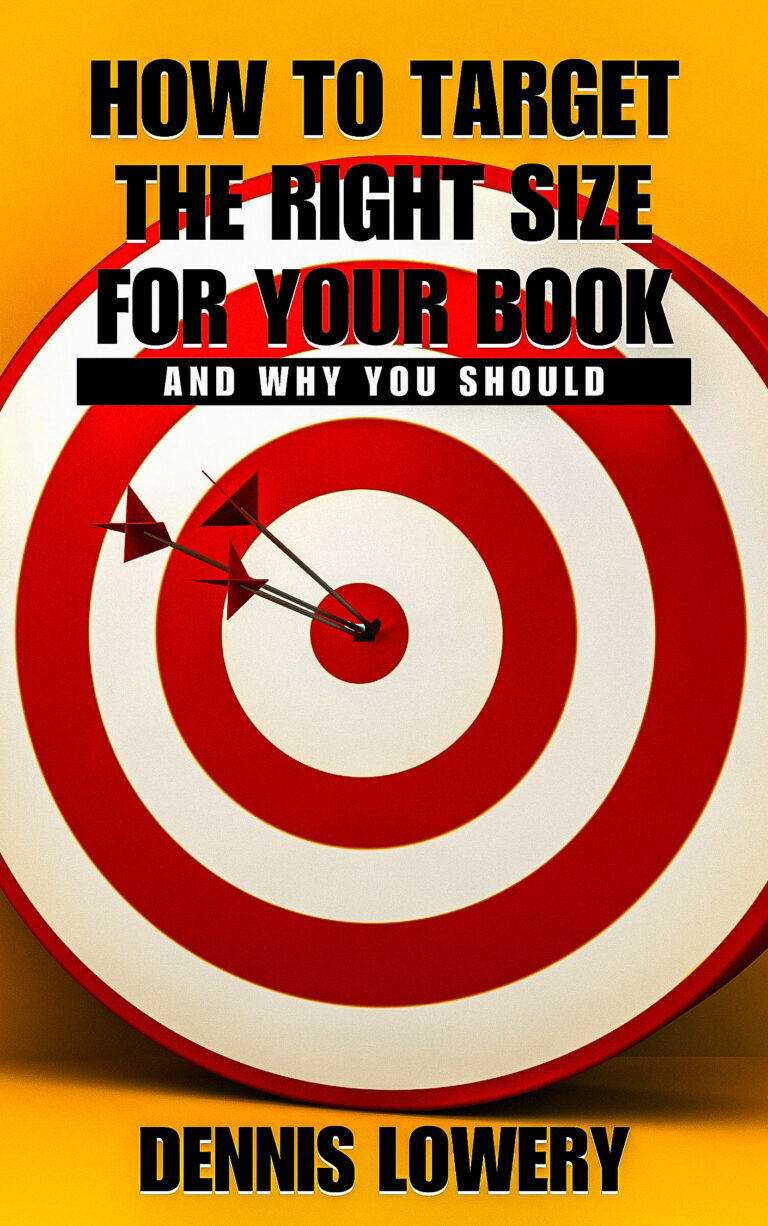
How to Target the Right Size for Your Book and Why You Should

Key Takeaways

  • Focus on the target book size by using word count rather than page count as your guide.
  • Professional writers gauge book length based on market standards, not just the number of pages.
  • Consider the average word counts for different genres when planning your book.
  • Use a target word count to set writing goals and establish milestones during the project.
  • Understanding the target book size helps in developing the story effectively.

Perhaps you want to write a book or have one written for you. And when it comes to size, you think about the number of pages. Non-professional writers often do. But you shouldn’t focus on page count. Instead, target the right size for your book.

I’ll explain.


The publishing world is competitive. Targeting specific genres and subgenres can enhance the commercial viability of your book. Write smart to sell big. Read why this strategic focus is so effective.


Writing clients often tell me they want their book to be ‘XXX’ hundred pages… 200, 400, etc. Usually a round number. Sometimes they’ll give an example. Something like this: “My story’s a bit like ‘Outlander,’ time travel and romance. Fictional but based on actual events in a different country and setting. It goes from the present to two centuries ago and back to the present. So, maybe my book should be about the same size.”

It takes experience to judge the right length for a story, and professional writers use the market to gauge the parameters. But page count shouldn’t guide your book planning. Instead, use a word count target. I’ll get into that further, but first, here is some context.

One of my past projects, a Historical Fiction series, averaged over 177,000 words per book. In a 6-inch by 9-inch format: Book One is 151,550 words at 422 pages. Book Two is 155,096 words at 436 pages. Book Three is 166,685 words at 478 pages. Book 4 (ending the epic saga), is 237,350 words and over 706 pages.

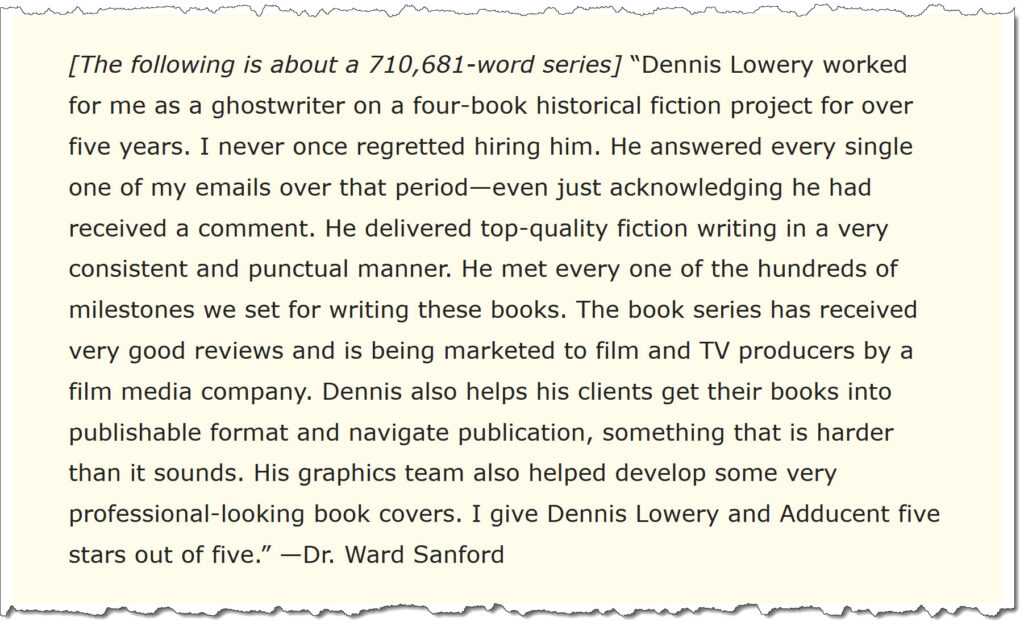
Ghostwriting client comments about 4-book Historical Fiction Series

Book One in the fiction series Outlander by Diana Gabaldon is 850 pages, 255,781 words (format: 6.11-inch width x 1.42 spine x 9.23 length). To provide a nonfiction example, ‘Who Moved My Cheese’ by Spencer Johnson is 25,504 words, comprising 96 pages in a 5 x 6.75 format. And ‘If You Tell: A True Story of Murder, Family Secrets, and the Unbreakable Bond of Sisterhood’ by Gregg Olsen is 115,391 words, 431 pages in 5.5 x 8.25 paperback format.

As with any published book, the page count includes all parts (not just the narrative). Front matter includes the Title Page, Copyright Notice, Table of Contents, and often an opening statement by the author or an epigraph (to set the story’s tone). It can also include other information the author and story might need to help the reader. The series project I mentioned above includes 6-8 maps per book, a historical setting preface, a recap of events in the preceding books, a Dramatis Personae (a guide to the cast of characters), and a book-specific opening epigraph. In the back (the back matter), the last page is the author’s bio. With some variation, all published books have front and back material that adds to the page count of the actual narrative.

So—and this is not uncommon—I often walk clients through how a print book’s page count is affected by its format. A 50,000-word book in a 5×8 Trade Paperback format will have more pages than the same number of words in a 6×9 book. The publisher or self-publisher will determine the book size/format they want to produce.

When discussing writing, co-writing, and ghostwriting projects, I focus on word—not page—count. I can then set precise writing goals using a target word count and establish the work’s time frame. When working with a client, those goals become a contractual milestone schedule of deliverables for their project. It includes the Planning & Development stage (the story outline, initial scene/chapter list, and writing plan), the Writing stage (number of words delivered each month), the Internal Edit stage (writer/client collaboration), and if included in the contract, a Post-Draft Edit period of writer collaboration with the client’s third-party editor.

ADDUCENT Book Page Calculator logo
HAVE A WORD COUNT AND WANT TO ESTIMATE THE NUMBER OF BOOK PAGES? TRY OUR BOOK PAGE CALCULATOR.

If you want to write a book, I recommend setting a word count target and using it to plan story development and the actual writing (your monthly word count goals). Below are average word counts or word count ranges for works of fiction and nonfiction. These matter because a book intended for commercial sale is a product, and the market has expectations. A professional writer or ghostwriter will know that market if you plan to have your book written for you. Still, you need to know it too.

Suppose the book you want to write (or have written) is complex, with multiple characters, story arcs, settings, and locations. [See what I mentioned above about the word count size of Outlander and the series I worked on for a client.] In that case, it will probably require a higher word count than the averages below.

Fiction

Based on an analysis of the top 15 sellers in the respective categories at Amazon:

  • Fantasy: 109,000
  • Historical: 102,000
  • Horror: 102,000
  • Literary: 98,000
  • Science Fiction: 98,000
  • Action/Adventure: 96,000
  • Contemporary: 96,000
  • Women’s Lit: 94,000
  • Mystery/Thriller/Suspense: 91,000
  • Romance: 91,000
  • Crime: 89,000
  • Religious: 75,000
  • Erotica: 58,000

Nonfiction

  • How-to / Self-Help, Career, and Education: 40,000–50,000 words
  • Standard Nonfiction: 70,000 to 80,000 words
  • Creative Nonfiction: 80,000 to 100,000 words
  • Memoir / Biography: 60,000 to 120,000+ words

Stories can and should find their natural length. Achieving that comes from professionally proofreading/developmentally editing drafts that follow the first. [The first draft should be used to work out the basic story, arcs, theme, and content.] Then refine all elements further, assess and sometimes adjust the flow and pace, and mark up for another round of editing/rewriting.

You can make the above process more efficient by using the average word count for your book type as a guide. Make your book’s optimal length an early consideration in the planning process. It matters to your story development.

About Us

Adducent, founded July 5, 2000, is a story and book development firm based in Jacksonville, Florida. Founder and Creative Director Dennis Lowery is a U.S. Navy veteran who spent the 1990s in aerospace manufacturing and more than eight years in business consulting with M&A attorneys and investment bankers before the company shifted its focus to writing and publishing in 2009.

Adducent has published 114 titles under its imprints — FORTIS (nonfiction and memoir), BOOKNOLOGY (business and educational nonfiction), ESCRIRE (fiction), and STANDFAST, established in 2026 for titles from the special-operations and intelligence communities. Every one was developed, edited, and produced under Dennis Lowery’s direct editorial direction. Fourteen arrived as standard nonfiction and were rebuilt as creative nonfiction.

Read about our Editorial and Publishing direction (and a subset list of client endorsements) here.

Read about ‘Who We Publish’ here.

Read about ‘Who’s Endorsed Books We’ve Published’ here.

Two have been selected for United States military professional reading lists: Fortune Favors Boldness, by Vice Admiral Barry M. Costello, on the U.S. Navy, Chief of Naval Operations Professional Reading Program; and What Now, Lieutenant?, General Richard ‘Butch’ Neal’s memoir, on the U.S Marine Corps Commandant’s Professional Reading List.

Distribution is global print-on-demand through Ingram, a network that, by Ingram’s account, reaches 50% of the world’s population. Clients own all rights to their work. Dennis, who also ghostwrites for clients and other publishers, is a member of the Authors Guild, the United States’ oldest and largest professional organization for writers.


ADDUCENT [ Writing-Creating-Publishing 260903
What we’ve done and what we do for clients.

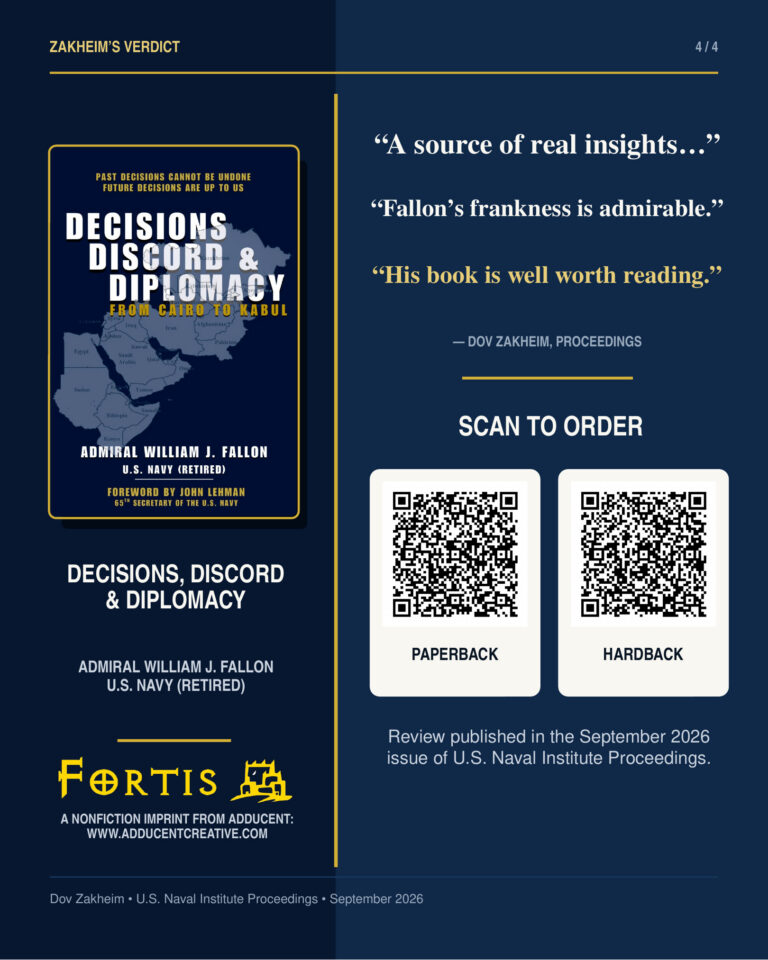
DECISIONS, DISCORD & DIPLOMACY | U.S. Naval Institute PROCEEDINGS Book Review

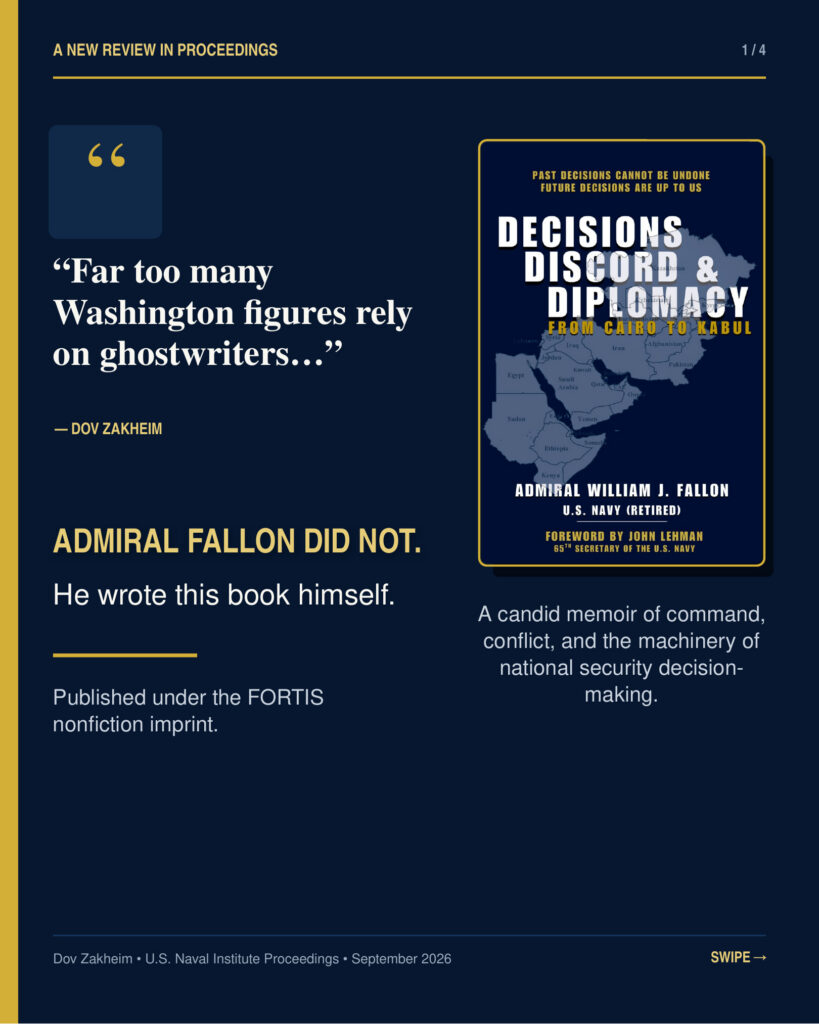
I had to smile at the first two sentences of Dov Zakheim’s review of Admiral Fallon’s memoir in the September issue of U.S. Naval Institute Proceedings:

“Far too many Washington figures rely on ghostwriters for their memoirs. Retired Navy Admiral William (‘Fox’) Fallon is not one of them.”

He is exactly right on that point.

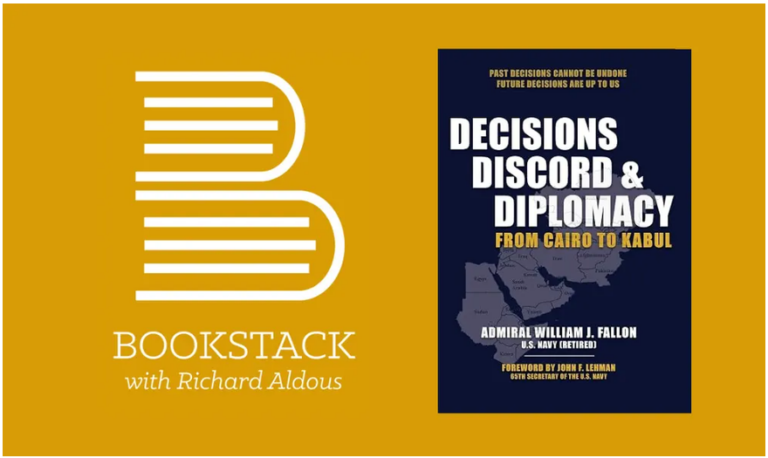
Decisions, Discord and Diplomacy was not ghostwritten. Admiral Fallon wrote it himself. We published it under our FORTIS nonfiction imprint.

I’ve ghostwritten 42 books. I’ve also spent 17 years publishing books by military leaders, nearly all of whom wrote their own books. So I’ll push back—slightly—on Zakheim’s broader premise.

Using a ghostwriter isn’t the problem. Losing the author’s voice is.

A good military memoir should sound like the person who lived it. And it should preserve that person’s judgment: what they saw, what they believed, where they disagreed, what they got right or wrong, and how decisions actually looked from inside the room rather than decades later from the outside.

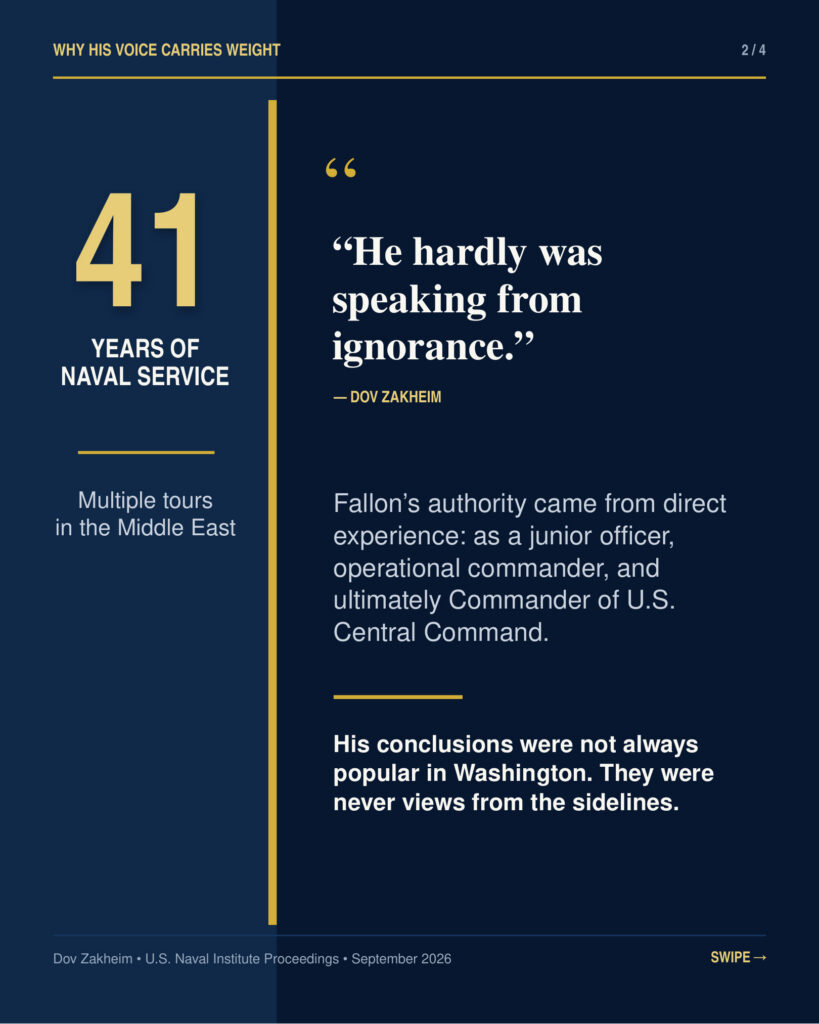
Zakheim is well positioned to judge whether Fallon’s does. He was Under Secretary of Defense (Comptroller) and, from 2002 to 2004, DoD’s coordinator of civilian programs in Afghanistan—during the opening years of the period Fallon argues Afghanistan was neglected for Iraq. He has known Fallon for decades.

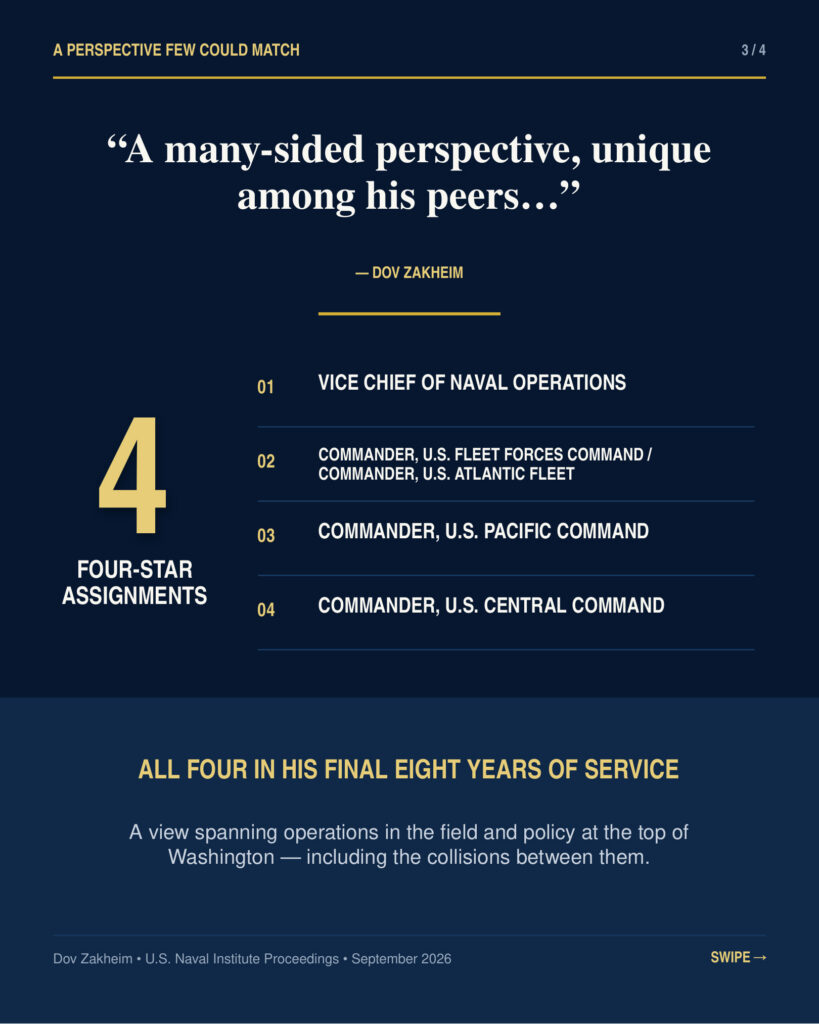
Fallon’s own perspective is unusually broad. During 41 years of naval service, his final eight included four four-star assignments: Vice Chief of Naval Operations; Commander, U.S. Fleet Forces Command/Commander, U.S. Atlantic Fleet; Commander, U.S. Pacific Command; and Commander, U.S. Central Command.

His view spanned operational command and policymaking at the highest levels in Washington—and, at times, the collision between the two.

Fallon does not conceal those collisions.

Vieques. Iraq. Afghanistan. The surge. Iran. His disagreements with senior civilian leaders and General David Petraeus. His eventual departure from CENTCOM.

Whatever a reader thinks of Fallon’s judgments, he puts them on the record.

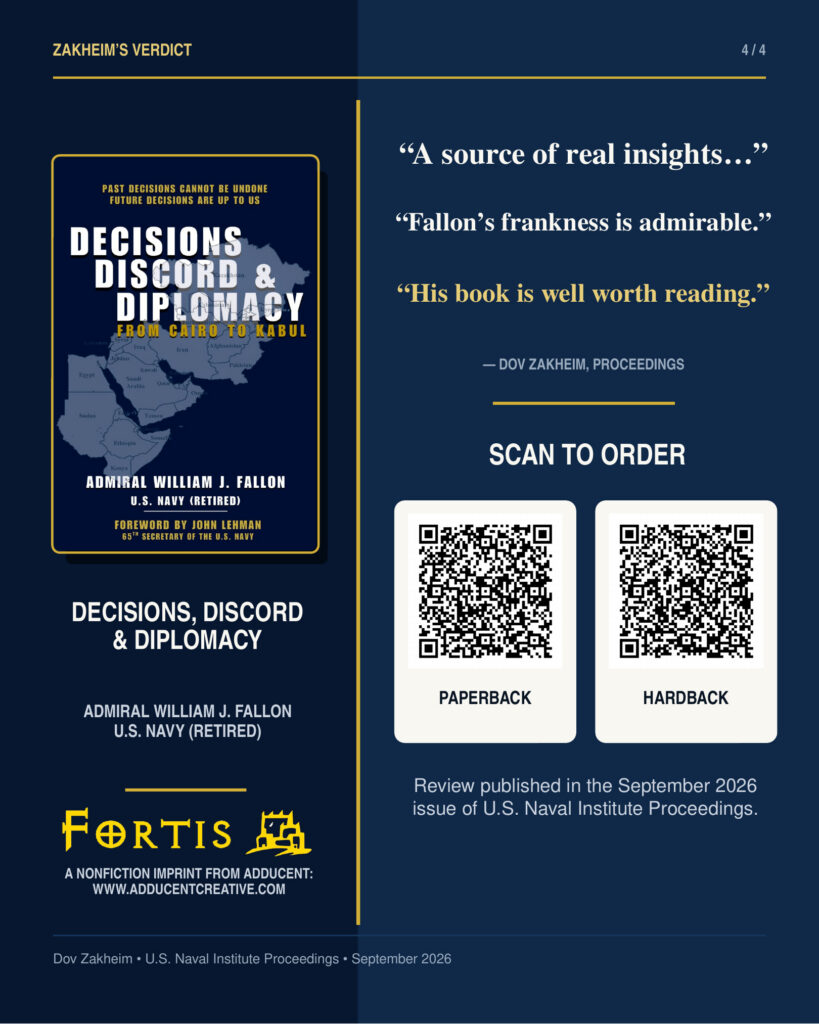
Zakheim finds in the book “real insights into the inner workings and bureaucratic intrigue that is endemic to government,” and calls Fallon’s frankness admirable. He closes by saying the book is “well worth reading.”

Decisions, Discord and Diplomacy: From Cairo to Kabul by Admiral William J. Fallon, USN (Ret.)

Published under the FORTIS nonfiction imprint.

Review by Dov Zakheim, U.S. Naval Institute Proceedings, September 2026.


About Us

Adducent, founded July 5, 2000, is a story and book development firm based in Jacksonville, Florida. Founder and Creative Director Dennis Lowery is a U.S. Navy veteran who spent the 1990s in aerospace manufacturing and more than eight years in business consulting with M&A attorneys and investment bankers before the company shifted its focus to writing and publishing in 2009.

Adducent has published 114 titles under its imprints — FORTIS (nonfiction and memoir), BOOKNOLOGY (business and educational nonfiction), ESCRIRE (fiction), and STANDFAST, established in 2026 for titles from the special-operations and intelligence communities. Every one was developed, edited, and produced under Dennis Lowery’s direct editorial direction. Fourteen arrived as standard nonfiction and were rebuilt as creative nonfiction.

Read about our Editorial and Publishing direction (and a subset list of client endorsements) here.

Read about ‘Who We Publish’ here.

Read about ‘Who’s Endorsed Books We’ve Published’ here.

Two have been selected for United States military professional reading lists: Fortune Favors Boldness, by Vice Admiral Barry M. Costello, on the U.S. Navy, Chief of Naval Operations Professional Reading Program; and What Now, Lieutenant?, General Richard ‘Butch’ Neal’s memoir, on the U.S Marine Corps Commandant’s Professional Reading List.

Distribution is global print-on-demand through Ingram, a network that, by Ingram’s account, reaches 50% of the world’s population. Clients own all rights to their work. Dennis, who also ghostwrites for clients and other publishers, is a member of the Authors Guild, the United States’ oldest and largest professional organization for writers.

What will you do before you die?

0

What will you do before you die?

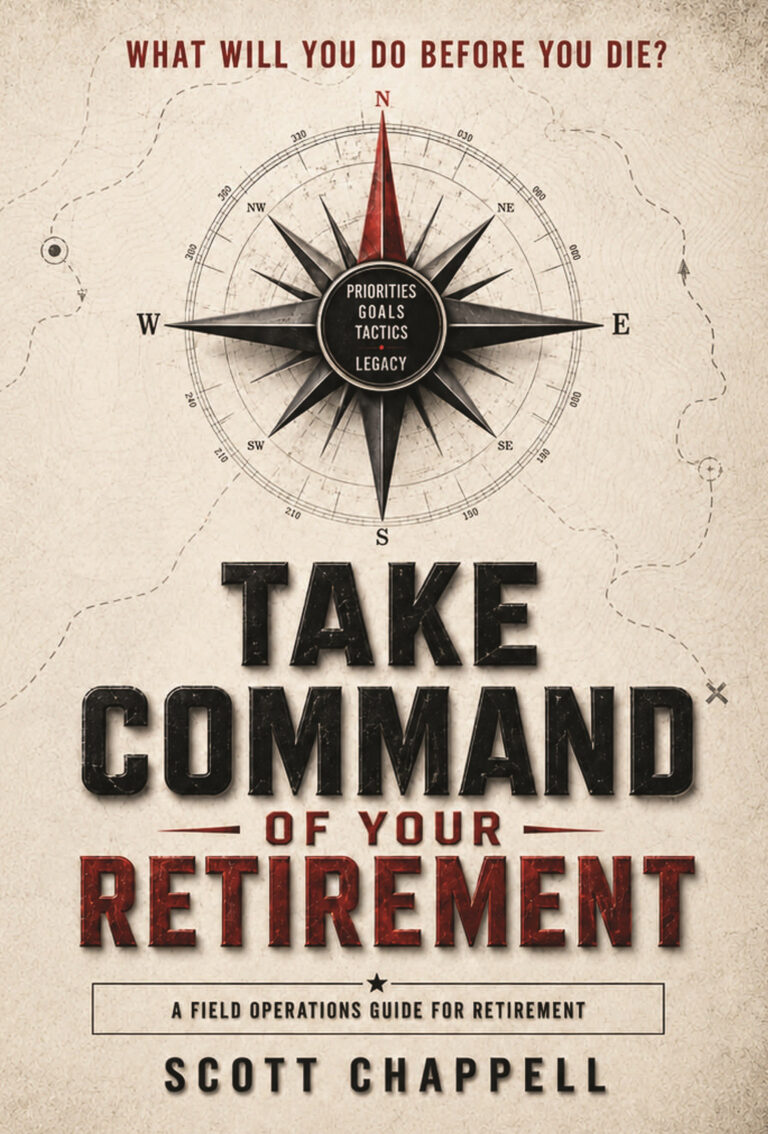
That question is on the cover of Scott Chappell’s TAKE COMMAND OF YOUR RETIREMENT.

We put it there on purpose.

Retirement books often sell comfort as the goal. Scott’s book asks a harder question first, and the cover shouldn’t soften it.

Scott didn’t approach retirement as a set of financial decisions.

During more than 30 years in public safety and emergency response—including fire service command, Urban Search & Rescue, HazMat, and disaster deployments—he spent much of his career assessing changing situations and making decisions with incomplete information.

In the book, the reader is the Incident Commander. Retirement planning becomes an Incident Action Plan. Pension and benefit decisions become intelligence requirements. Financial preparation becomes logistics.

Retirement isn’t just the point where the paycheck stops or the benefits begin. For someone who has spent decades answering the radio, deploying when needed, carrying responsibility, and knowing where they fit in the mission, leaving the job can remove much of the structure that organized their life.

Then what?

Scott treats that as part of the planning problem, too.

Not as therapy. Not as inspiration. As another operational question:

What is the next mission?

The compass on the cover names what you steer by: priorities, goals, tactics, legacy.

TAKE COMMAND OF YOUR RETIREMENT
A Field Operations Guide for Retirement
Scott Chappell

Coming this fall from BOOKNOLOGY, an Adducent nonfiction imprint.

BOOKNOLOGY ADDUCENT brand logo black (horiz)

About Us

Adducent, founded July 5, 2000, is a story and book development firm based in Jacksonville, Florida. Founder and Creative Director Dennis Lowery is a U.S. Navy veteran who spent the 1990s in aerospace manufacturing and more than eight years in business consulting with M&A attorneys and investment bankers before the company shifted its focus to writing and publishing in 2009.

Adducent has published 114 titles under its imprints — FORTIS (nonfiction and memoir), BOOKNOLOGY (business and educational nonfiction), ESCRIRE (fiction), and STANDFAST, established in 2026 for titles from the special-operations and intelligence communities. Every one was developed, edited, and produced under Dennis Lowery’s direct editorial direction. Fourteen arrived as standard nonfiction and were rebuilt as creative nonfiction.

Read about our Editorial and Publishing direction (and a subset list of client endorsements) here.

Read about ‘Who We Publish’ here.

Read about ‘Who’s Endorsed Books We’ve Published’ here.

Two have been selected for United States military professional reading lists: Fortune Favors Boldness, by Vice Admiral Barry M. Costello, on the U.S. Navy, Chief of Naval Operations Professional Reading Program; and What Now, Lieutenant?, General Richard ‘Butch’ Neal’s memoir, on the U.S Marine Corps Commandant’s Professional Reading List.

Distribution is global print-on-demand through Ingram, a network that, by Ingram’s account, reaches 50% of the world’s population. Clients own all rights to their work. Dennis, who also ghostwrites for clients and other publishers, is a member of the Authors Guild, the United States’ oldest and largest professional organization for writers.

Standard Nonfiction or Creative Nonfiction? The Decision Most Authors Never Know They Are Making

Two people sit down with similar material — similar career, broadly similar experiences, the same decades of life — and write two entirely different books.

And one book is distinctly better…

Not because one lived a better life, had better experiences… or writes better sentences. Because they made different structural decisions, and one of them knew they were making them.

Most nonfiction gets written the way it gets remembered: in order, from the beginning, explaining as it goes. That is a legitimate book, and sometimes it is the right one. But it is a choice, and most authors arrive at it by default rather than by decision — which means they never see the alternative, and never find out whether their material wanted–needed–something else.


Most nonfiction explains. Strong nonfiction stages.

A fifteen-year-old in a cargo van on a Texas highway, sweat running down his back, hand surfing out the window as a song he’s never heard comes through a crappy dashboard speaker.

You are there before anyone tells you why it matters.

That is the difference between information and narrative. Not decoration — architecture. The same tools fiction uses, applied to what actually happened: theme, conflict, setting, resolution, and the ordinary craft decisions about what the reader is shown and when.

Standard nonfiction is journalistic and linear. It reports the events of a life, or the facts of a subject, and its purpose is to give you information. It tells the reader the facts.

Creative nonfiction shows them — vividly, memorably, in action and in scenes.

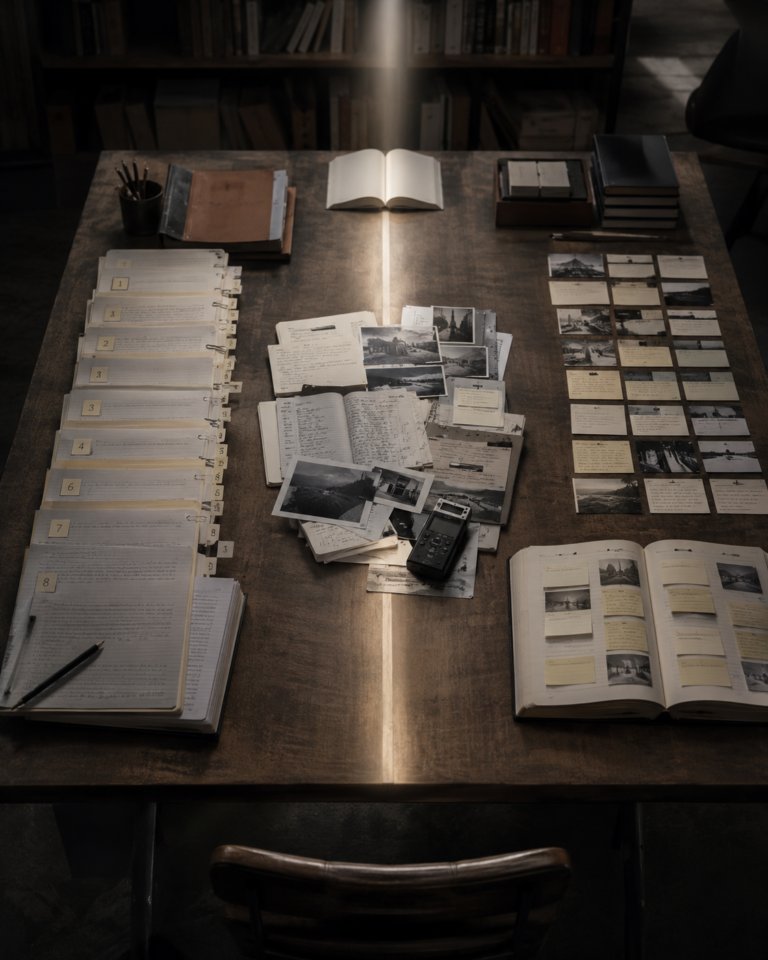
Real life already contains stakes, turning points, emotional consequence, and uncertainty. Those elements do not arrange themselves. They have to be shaped with intention — the narrative spine extracted, summary replaced with scene, momentum built through structure rather than volume.

Infographic comparing creative nonfiction and standard nonfiction across four points: both are based on fact; creative nonfiction uses literary technique to build factually accurate narrative while standard nonfiction's purpose is to give information; creative nonfiction uses theme, conflict, characters, setting, and resolution while standard nonfiction is journalistic and linear; creative nonfiction shows the facts in action and in scenes while standard nonfiction tells them. Full text in the table above.
Point of comparison Creative Nonfiction Standard Nonfiction
Factual basis Based on fact. Based on fact.
Purpose Uses literary styles and techniques to create factually accurate narratives. Its purpose is to give information.
Method Uses narrative elements such as theme, conflict, characters, setting, and resolution to fully engage the reader. Uses a journalistic, linear approach to report events of a person’s story and life, or facts and details of a place, topic, or subject.
Effect on the reader Shows the reader the facts about a subject, story, place, or person’s life — vividly, memorably, in action and in scenes. Tells the reader the facts about a subject, story, events, place, or person.

What creative nonfiction is not

This is the part worth being precise about, because the word “creative” does the material a disservice and costs this form readers who would benefit from it most.

Look at the first row of the comparison above. Both forms are based on fact. That is not a technicality placed there for balance — it is the whole of the distinction. What separates them is not how much is true. Everything is true in both. What separates them is what the writer does with the truth after establishing it.

Nothing is invented. Not a fact, not a date, not a line of dialogue, not a person. No composite characters. No conversations reconstructed from what someone probably said. Where a timeline is compressed or an order rearranged for the reader’s sake, the author knows it, and the reader is not misled about it.

The discipline is subtractive and structural. What to show and what to summarize. What order. Whose vantage point. Where to slow down and where to get out of the way. In The Black Orchid, a woman’s sudden disappearance unfolds beat by beat — no invention, just the careful sequencing of what was real.

It matters more when the material is official, not less. A memoir that touches operations, policy, command decisions, or privileged ground cannot afford a single invented detail, because the author’s credibility is the book’s entire foundation and a reader in that world will find the seam. Creative nonfiction, done properly, adds nothing that was not there. It finds what was already in the material and builds it with the discipline it deserves.

Truth does not need decoration. It needs craft.


How to tell which book you have

Six questions. They are diagnostic, not rhetorical — a “yes” is not a verdict, but three or four of them together usually are.

  1. Does your draft tell the reader what to think before it shows him what happened? Standard nonfiction leads with the conclusion. If your most affecting material keeps arriving as evidence for a point you already made, it is doing the wrong job.
  2. Are the moments you can still see clearly in your head the ones that read flattest on the page? This is the most common symptom by a wide margin. You compressed the thing you remember best, because you were there and it needed no explaining. The reader was not.
  3. Is your book organized by chronology? Chronology is a filing system, not a structure. It is the right structure only when the sequence of events is itself the argument.
  4. Could a reader tell you what the book is about, or only what it covers? Those are different, and the gap between them is usually where the real subject is hiding.
  5. Does the person on the page have an interior life? Standard nonfiction reports what you did. If the reader never learns what a decision cost you, he is reading a record rather than an account.
  6. Do you want to be understood, or do you want to be believed? Both are legitimate goals and they pull in different directions. Institutional and reference books earn trust through authority and apparatus. Narrative earns it through recognition — the reader concluding, on his own, that this is how it must have been.

When standard nonfiction is the right answer

Often. We tell authors so regularly, and it is worth saying plainly on a page that could easily read as an argument for the more expensive option.

Standard nonfiction is the correct form when the reader’s purpose is reference rather than experience — when he needs to find a section, apply a framework, or cite a chapter. It is correct when the authority of the material is the appeal, and narrative treatment would soften rather than sharpen it. It is correct when the book’s job is to establish a record, and a record wants clarity and completeness ahead of momentum. And it is correct when the author simply does not want the exposure narrative requires, which is a real answer and not a failure of nerve.

A well-built standard nonfiction book is not a lesser thing than a narrative one. It is a different instrument.


What a rebuild actually involves

Fourteen of our 114 published titles arrived as standard nonfiction and were rebuilt as creative nonfiction. It is the firm’s highest-craft editorial work, and it is not a pass over the prose.

The manuscript is taken apart and reassembled: the narrative spine identified, scene reconstructed from material that arrived as summary, sequence rebuilt around the book’s actual subject rather than the calendar, interiority restored to a narrator who wrote himself out of his own account. The facts do not move. Almost everything else does.

The author’s voice survives it, because the voice was never the problem. What changes is whether a reader can reach it.


The one on the Commandant’s reading list

General Richard “Butch” Neal, USMC (Ret.), former Assistant Commandant of the Marine Corps, wrote a memoir of Vietnam and command. It arrived as standard nonfiction. We rebuilt it as creative nonfiction, and What Now, Lieutenant? was subsequently selected for the Commandant of the Marine Corps Professional Reading List. A reading-list selection is not a review a client can arrange or a placement a publisher can buy. It is a service deciding its own officers should read the book — in this case, a book that existed in another form first.

The general’s own account of the decision:

“He [Dennis Lowery] introduced me to creative nonfiction and effortlessly guided me along a path that led to my first book.” — General Richard “Butch” Neal, USMC (Ret.)

Another client, Steve Bailey, after reading his full rewrite, said it was the first time he had been able to read his own manuscript in a single sitting. On one chapter he wrote a single word: brilliant. He said it had been given feeling and meaning, as though we had been there ourselves. We had not been. It was all in what he wrote. It was just not yet where a reader could find it. He had this to say when we finished his book:

“My book, We Were There: Vietnam, was just published. It would still be in my desk drawer, but for the guidance of Dennis Lowery and his company, Adducent. I had reached stagnation and knew that I needed someone to get me over my inaction. Dennis read the memoir, agreed to work with me, and devoted hours of his obvious intellect and years of experience. If you are considering an editor, publisher, a mentor, you need to contact him. His creative nonfiction model was perfect for me and may be for you as well.

Steve served as an infantry officer in Vietnam. Bronze Star. Purple Heart. Combat Infantryman’s Badge. Vietnamese Cross of Gallantry.


If you are not sure which one you have

Most authors are not, and it is not a question that answers itself from the outside.

Send the manuscript, or describe it if it is not finished. We will read it and tell you which book you have written, which one your material is actually asking for, and whether the distance between them is worth closing. Some of those conversations end with us saying the book is already the right shape.

Editorial & Publishing Direction — how a finished manuscript becomes a published book

What Editorial & Publishing Work Costs

Who We Publish (Senior Client Roster)

Reader & Client Comments
Why Do Some Stories Hit Harder Than Others?

0

Key Takeaways

  • The impact of stories comes from how they are told, not just the content.
  • Style, voice, tone, and structure define a story’s resonance.
  • Compelling storytelling builds trust, sparks emotion, and captures attention.
  • Focus on the delivery of your message, not just the message itself.
  • The art of storytelling is crucial for leaders, founders, and creatives.

Why do some stories hit harder than others?

It’s not just the plot or point. It’s the style.

Storytelling is powerful in every form—whether you’re writing a book, sharing an insight, leading a team, or building a brand.

But the way you tell the story?

That’s what makes it resonate.

The same message can land as:

– Raw or refined

– Poetic or plainspoken

– Urgent or timeless

Because storytelling isn’t just about information—it’s an art of expression.

– Voice and tone shape how it feels

– Structure and form shape how it flows

– Medium and format shape how it’s experienced

– Culture and context shape what connects

– And purpose shapes what truly lands

A well-told story doesn’t just inform—it moves people.

It builds trust, sparks emotion, and earns attention in a noisy world. So if you’re a leader, founder, communicator, or creative…

– Don’t just focus on what you’re saying.

– Focus on how you’re telling it.

That’s where the impact lives.


Read about our editorial and publishing direction.

Read about who we publish…

60 SECONDS RUN

0

’60 SECONDS RUN’ (from our StoryScoring) takes its title and its lyrics from “If—”, Rudyard Kipling‘s 1910 poem from Rewards and Fairies. Framed as a father’s counsel to his son, it sets out a code for holding your nerve: keeping your head when others lose theirs, treating triumph and disaster as the twin impostors they are, and starting again from nothing without a word of complaint. The final test gives the song its name — whether you can fill the unforgiving minute with sixty seconds’ worth of distance run.

A century on, the poem has escaped the era that made it. Voted Britain’s favorite poem in a BBC poll, it is inscribed above the players’ entrance to Center Court at Wimbledon, pinned to locker-room walls, read at graduations and funerals, and quoted by people who could not name another line of Kipling. Its grip is in the conditional: every promise it makes is contingent on what you do next.

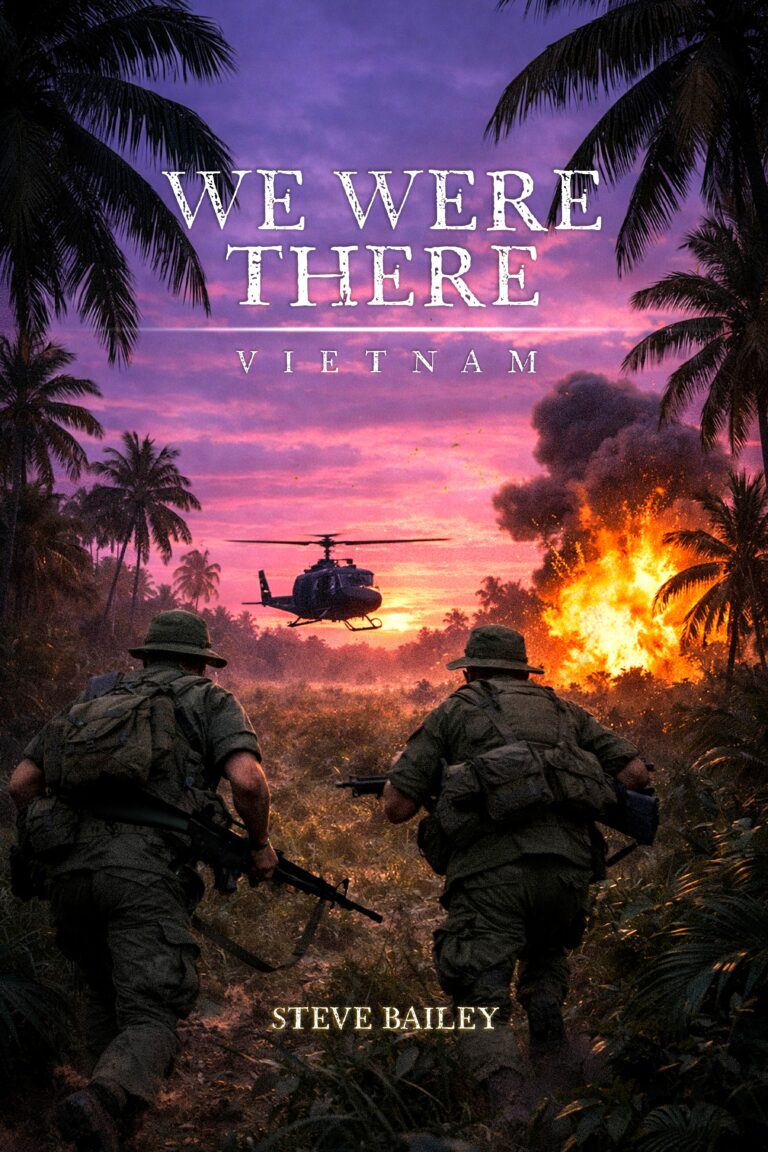
WE WERE THERE: Vietnam

0

From our FORTIS Non-Fiction Imprint

Available now at booksellers.

Buy for less directly from us/our distributor (Ingram):

Paperback: $14.95
Hardback (color interior with 70# paper): $34.95

Vietnam was a bloody and divisive war that shaped a generation.

In 1968, with the elimination of law school draft deferments, Steve Bailey’s door to academia slammed shut. Another door opened to two years of training through Louisiana’s swamps, Panama’s jungles, and Officer Candidate School. In May 1970, he arrived in Vietnam as a 24-year-old Army infantry lieutenant for his one-year tour.

After a brutal 72-hour firefight near the Iron Triangle and Cu Chi, Bailey searches the body of a fallen North Vietnamese soldier and finds the unexpected: a waterproof-wrapped art book of delicate sketches of palm trees, mountains, and portraits. The enemy soldier was an artist who carried his humanity into battle. That discovery haunts Bailey for fifty years.

He returns home to a divided nation where scorn pains as deeply as any battlefield wound.

We Were There confronts the moral weight and reality of combat, from a 14-year-old girl executed by the Viet Cong, to a friend killed during aerial reconnaissance, to memories that won’t fade. Bailey writes about what soldiers carry home: not just trauma, but the responsibility to honor the fallen. His decades-long quest to return the art book culminates in 2022, when he meets with the Vietnamese Ambassador in Washington, D.C., and formally returns the drawings to the Vietnamese people. It is an act of reconciliation that transcends the war.

This is an honest, unflinching memoir where brutality and compassion collide, where courage and doubt coexist. In war’s aftermath, duty remains: to honor the fallen and bear witness for those who can no longer speak.

Key Takeaways

  • The memoir details Steve Bailey’s experience as an Army infantry lieutenant in Vietnam during a tumultuous time in 1970.
  • He discovers an art book on a fallen enemy soldier, which highlights the humanity in war and haunts him for decades.
  • After decades of efforts, he returned the art book to the Vietnamese people in 2022 in a significant act of reconciliation, symbolizing healing beyond the war.
  • Bailey explores the moral complexities of combat, sharing personal stories of loss, trauma, and responsibility to honor the fallen.
  • Bailey’s background includes military honors and a career in law and real estate, showcasing his diverse life post-service.

About The Author

Steve Bailey was commissioned as a second lieutenant and Commandant’s List graduate of the Army Infantry Officer Candidate School, Fort Benning, Georgia.

Following jungle school in Panama in 1970, he was assigned to lead a five-man counterinsurgency team in the Republic of Vietnam. He was awarded the Combat Infantryman’s Badge, the Vietnamese Cross of Gallantry, a Bronze Star, and a Purple Heart.

Steve is a graduate of East Carolina University, Greenville, North Carolina, received his J.D. from Tulane University School of Law, New Orleans, Louisiana, and was a member of the New Mexico Bar Association. He was a successful entrepreneur and the owner/president of a large real estate company in Connecticut.

Steve and his wife, Mary, and their dog, Mia, live in Florida. They are the proud parents of three adult children and have six grandchildren. Steve is a hobbyist artist and boasts that his wife granted him permission to display one of his masterpieces in a guest bedroom.

The Only Quality-Control System I’ve Ever Fully Trusted

Vice Admiral Barry Costello told me why he’d called me: two other vice admirals had told him to.

He’d had a poor experience with another publisher. So he asked two friends who had published books about their own service. They vouched for me. He later wrote all of that down, by name, in a recommendation.

That is how most of our work arrives. Not from search or advertising — from someone who put his own standing behind an introduction.

I went back through the past nearly eighteen years of it recently and found the pattern was denser than I’d realized. Eleven flag and general officers across four services. Three authors who graduated from West Point in the same class. One client on his eighth book with us. Another on his sixth.

The full list is on our (my company, Adducent) site under About — Who We Publish. Names, ranks, and what each of them did before they wrote a book.

A referral in this community isn’t a favor. It costs the person making it something, because if the work is poor, that lands on them too. Which makes it the only quality-control system I’ve ever fully trusted. Nobody sends a friend or colleague to a publisher who let them down.

Creative Nonfiction Compared to Standard Nonfiction

“Just the facts, ma’am…” Los Angeles police detective Sergeant Joe Friday (actor Jack Webb) directed the witnesses he interviewed in the 50s/60s TV show Dragnet. They so often spun off into the realm of creative nonfiction, and he and his partner had no time for that. But those with compelling true stories should write their story in just that way and bring it to life for the reader.

Read: Standard Nonfiction or Creative Nonfiction? The Decision Most Authors Never Know They Are Making

ADDUCENT A Comparison of Standard Nonfiction to Creative Nonfiction

Do you have a writing project and can’t decide if it’s better told as creative nonfiction? Or do you need some help getting started?

If you choose not to hire a writer but need advice and guidance on writing, story development, and publishing or self-publishing, we offer consulting. We have extensive experience that you can benefit from at an affordable rate.

ADDUCENT [ Writing-Creating-Publishing 260903
What we’ve done and what we do for clients.

Author ADM William J. Fallon on ‘The Conservative Voice’

0

On The Conservative Voice, Philadelphia. Our author, Admiral William J. Fallon, U.S. Navy (Ret.), 40+ years of distinguished service & leadership, Former U.S. CENTCOM and U.S. Pacific Commander, Author of Decisions, Discord & Diplomacy.

Iran War raging again! What are America’s options now? What is in the U.S. Israel Defense Technology Coop. Initiative & what does it mean for military independence?

Listen to the discussion at: https://wwdbam.com/uploads/2026/07/CV072426-Part-2.mp3?_=2