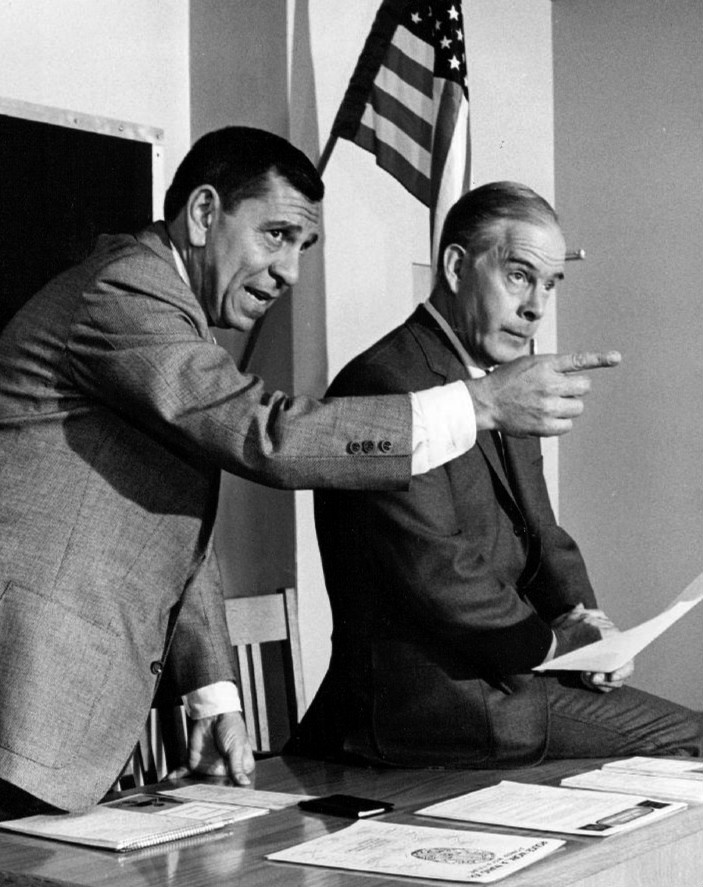
“Just the facts, ma’am…”Los Angeles police detective Sergeant Joe Friday (actor Jack Webb) directed the witnesses he interviewed in the 50s/60s TV show Dragnet. They so often spun off into the realm of creative nonfiction, and he and his partner had no time for that. But those with compelling true stories should write their story in just that way and bring it to life for the reader.
If you choose not to hire a writer but need advice and guidance on writing, story development, and publishing or self-publishing, we offer consulting. We have extensive experience that you can benefit from at an affordable rate.
On The Conservative Voice, Philadelphia. Our author, Admiral William J. Fallon, U.S. Navy (Ret.), 40+ years of distinguished service & leadership, Former U.S. CENTCOM and U.S. Pacific Commander, Author of Decisions, Discord & Diplomacy.
Iran War raging again! What are America’s options now? What is in the U.S. Israel Defense Technology Coop. Initiative & what does it mean for military independence?
The sky had darkened, and lightning struck just ahead of the downpour. The flash and crash of thunder almost on top of each other. Our lights flickered… dimmed… strengthened, and then went out. It was not quite sundown, and muted remnants of daylight came through the French doors and skylight over them. And—I don’t know why—I recalled thunderstorms when I was a kid in the 60s. And under dim, watery light, I wrote:
I remember watching dust clouds in the distance, coming off powder-dry dirt roads on hot summer days. The passing of mostly trucks in that back then, rural part of Texas. Sometimes I’d be on those roads, riding in the back of a truck, unrestrained. The maker of the plumes that would dust us as my father slowed or stopped. Gray-brown—the color of old bone—billows of dirt pulled along by the draft settled forward like pulling a blanket up and over my head. The coolness of the ride-created breeze would end, replaced with stifling dirt grit-in-your-teeth heat. The ride was much sweeter at night, soothing on the planes of your upturned, sunburned face, especially if a brief shower had dampened the road. I’d sit on the fender well, look up, and pretend to race the moon. To where I don’t know, but the moon always won. I didn’t mind. The thought I’d someday win made me smile at it above.
I remember summer afternoons somewhere off playing and then running far and fast to get home before the sun went down. Just in time to finish chores and wash up for dinner before my shows. Crushed if I missed the beginning of Lost in Space or The Time Tunnel. This was long ago, when life and the things you enjoyed were in real-time. No recording to watch or replay later. You had to be there.
If one of my shows wasn’t on, I’d slip out to the backyard after dinner. I loved the night sounds, the music of crickets, the hum, and the buzz of birds, animals, and insects that stir at twilight. I’d sit on the steps and drink it all in, enjoying the evening wind as it arranged clouds for the night. My child-mind, empty of worries, held thoughts only of the next chapter in A Princess of Mars, I’d read before bedtime. I’d bought an old, used copy of the book for five cents at Mr. Petersen’s general store. [He had a barrel of them next to the counter. As my mother did her shopping, I’d sift through them.] The joy of discovering that story and the other adventures of John Carter is still fresh in my mind.
If the metal had cooled enough, I’d move to sit astride the long natural gas tank, shaped (so I thought) like a miniature submarine or spaceship, and look over my world. Sometimes, with the breeze right, I could catch the smell of Henrietta’s tortillas and tamales from her house, the closest nearby. Oh, how that aroma filled the air. She made them by hand, ground her meal fresh every day, and they were delicious. An always-hungry boy, my mouth watered though I’d just eaten my fill.
In the late summer, evening storms would roll in. Often just heat lightning, but sometimes the darkening sky’s rumor would turn true with flash and crash seconds ahead of the rain. My mother always said the rumble of thunder was “The Devil moving his furniture.” I never thought to question, shouldn’t that sound come from below and not above….
On those evenings, in the stillness, the backyard would grow thick with fireflies, dozens of points of light. I’d sit on the steps and watch the little gold sparks wink in and out of the shorter grass close to the house as they moved toward the taller, thicker growth further back. As I watched, I didn’t recall wishes or dreams of other things. There was no looking at the sky with longing—no hurt to deal with—decisions or questions to ponder. Only the simple moment and pleasure of watching the dance of fireflies.
After a while, from the screen door, under the single bulb above and in its small pool of light, my mother would step out, and I’d hear her call: “Time to come in….” Most times, I didn’t want to… like the evening that stands out in bringing forth this memory. But the night before, Sola had saved Dejah Thoris, and John Carter had fallen. Before I went in, I gave the fireflies a last lingering look—they still danced—and wondered for how long and how far it went on. I didn’t dwell on that, though. Once inside, I hurried through the bath-time routine. I had to find out what happened next on Barsoom!
Some of the reader comments:
“You really know how to invoke all the senses and draw the reader into your world. As the cover says, you had to be there. But this vignette comes a close second — you are pulled into the story, the senses drawing you in until you close your eyes, and you’re right there. Beautiful.” –Vicki Tyley
“Wonderful writing that brings back childhood memories! I can see the things dreams are made of. Quite a talent and a blessing for us to read!” —Susan Gabriel
“I love when you write because I can put myself in that moment and visualize it. As if I was living in the story. Life was so simple as a child.” —Tanya Freisen
“Time and tide wait for no man or in the now waits for woman either. Wonderful to have that snapshot in time we can look back on. Loved the post.” —Chris Black
“Love this story! Amazing descriptions!” —Leigh at Booktrack
“Wonderful. Love it!” —Sherry Thompson
“That’s an awesome piece of writing. It really does bring back memories, too, of me riding on the back of my father’s truck, helping throw hay for the cows, or simply going to check over the farm fences. All the memories of racing back so as not to miss Astro Boy, etc.! Those were very different times. Great to grow up in!” —Jennifer Phillips “This brought back great memories; being raised in S.C., as a child, it was the norm: to watch the fireflies, riding on the back of my dad’s truck with the wind blowing in my face, putting blankets on the back of that truck watching the stars and moon late at night, or watching a bird land on the second floor of my house to sing at my bedroom window… BACK THEN, it was the norm… NOW those are AMAZING MOMENTS. Thank you for taking me there, through your writing, for such a special walk down memory lane.” —Bernice Joe
Adducent introduces a new service, StoryScoring by Adducent, focused on story-driven music production.
The studio creates original soundtracks that enhance storytelling through atmosphere and emotion.
Music deepens moments and evokes characters, contributing to a more immersive experience for audiences.
This service allows stories to expand beyond words and images, incorporating music as a vital element.
Adducent Music Studio aims to merge narrative and sound, offering new creative possibilities.
At Adducent, we’ve long held that a story should live beyond the page. For years, we’ve created custom imagery—covers, illustrations, and visual concepts—that have given shape to our stories and our clients’ work. Now we’re extending that same creative approach into sound.
With the launch of StoryScoring byAdducent, we’re introducing story-driven music production as both an in-house capability and a service for our clients. Over the past several months, we’ve built and tested a studio process for composing original soundtracks tied directly to story scenes. The result isn’t background music—it’s another layer of storytelling, where atmosphere, tension, and emotion are carried through sound.
Music and sound effects have a particular force: a phrase of melody, a single rhythm, or a well-placed sound can deepen a moment, evoke a character’s state of mind, or carry the weight of a scene. Drawing from the beats of a narrative, we can now create an immersive experience that readers, viewers, and listeners hear and feel.
This also opens a new path for intellectual property. A novel can inspire a score, a screenplay can be paired with its own sonic world, and a story can live not only through words and images but also through music that extends its reach.
StoryScoring is where narrative and sound come together—giving creators and audiences another way to experience story.
Watch this space as we add more story-based song examples for various genres.
CLASSIC ROCK-STYLESOFT-ROCK BALLADA FUSION OF NATIVE AMERICAN AMBIANCE
About a third of businesses make it to ten years. Far fewer reach twenty-six. I understand now, in a way I didn’t in 2000, that longevity isn’t a milestone you arrive at — it’s the sum of a lot of ordinary days when you did the work, kept people posted, and delivered the thing you said you’d deliver. Then did it again the next day.
None of it happened alone.
Over 26 years, we’ve published 114 titles, edited many — including books we didn’t publish — and I’ve personally ghostwritten 42. Clients I’d never otherwise have met: first-time memoirists and novelists; professors, doctors, law partners, and business owners; national-security professionals; military officers—flag and general—among them two four-star officers, a former U.S. CENTCOM commander, and a former Assistant Commandant of the U.S. Marine Corps.
From New Haven to New Zealand, they trusted us with their stories; some with the ones they’d carried their whole lives.
So on our 26th birthday, to every client and author who trusted us with your ideas and stories and let us build your book alongside you — thank you.
You’ve got a story. A good one. The kind that only a few can tell. You’ve served. Seen things. Done things. You’ve got tales tucked away. It’s time to share them.
Enter STANDFAST, a story development service and publishing imprint from Adducent focused solely on veterans of the military, special operations, and intelligence community. Been in business since 2000; we know stories. More importantly, we know how to tell them or help others tell their story. You’re not a bystander in this… your experiences… they’re gold. You bring the story. We bring the expertise. Writing assistance or ghostwriting if needed, editing, publishing—we’ve got it all. And can put it to work for you.
Why? Because your stories aren’t just personal. They’re lessons, legacies, and a heck of an adventure. They’re about honor, sacrifice, and what it means to serve.
This is about more than just books. It’s about bringing your story to life. It’s about making sure your voice isn’t just heard—it’s felt.
So, if you’re ready to tell the world your story, STANDFAST is your means to make it a reality. Let’s do it.
In 1895, a forgotten novelist imagined getting one — a wise, incorruptible ruler with the power to fix everything. His perfect commonwealth is the warning.
“In every American city are rising the castles of the plutocracy in the shape of great armories for the militia.”
A man wrote that about the country he lived in.
He had watched a decade of strikes put down by force. He looked at the railroads and saw the medieval baron’s castle rebuilt at every mountain pass and river ford, taking its toll on everyone who had to move.
He saw great wealth gathering at one end of the country and a swelling crowd of the dispossessed at the other. He believed the crowd had begun to feel its doom: strikes, riots, the wave of fire and blood rising a little higher each time. The republic that was supposed to be the escape from Europe was turning back into Europe, and he thought it might end up worse.
Almost no one reads him now.
The lines open a novel, and the country they describe is the one its author stood in: a hundred and nineteen years after the Declaration of Independence, and already, in his telling, a failure.
We are coming up on the country’s two hundred and fiftieth year, with plenty of argument about how the country reached this moment — and Holford’s question, whether the trouble was built in or chosen, is exactly why it is worth meeting him now.
The Man and the Book
Castello Holford fought through the Civil War with a Wisconsin regiment — Vicksburg, the Red River, Nashville, Mobile — and afterward wrote a thick, serious History of Grant County, Wisconsin. He was not a crank. He was a veteran and a working historian who had spent his life close to how states get built and how they fall apart.
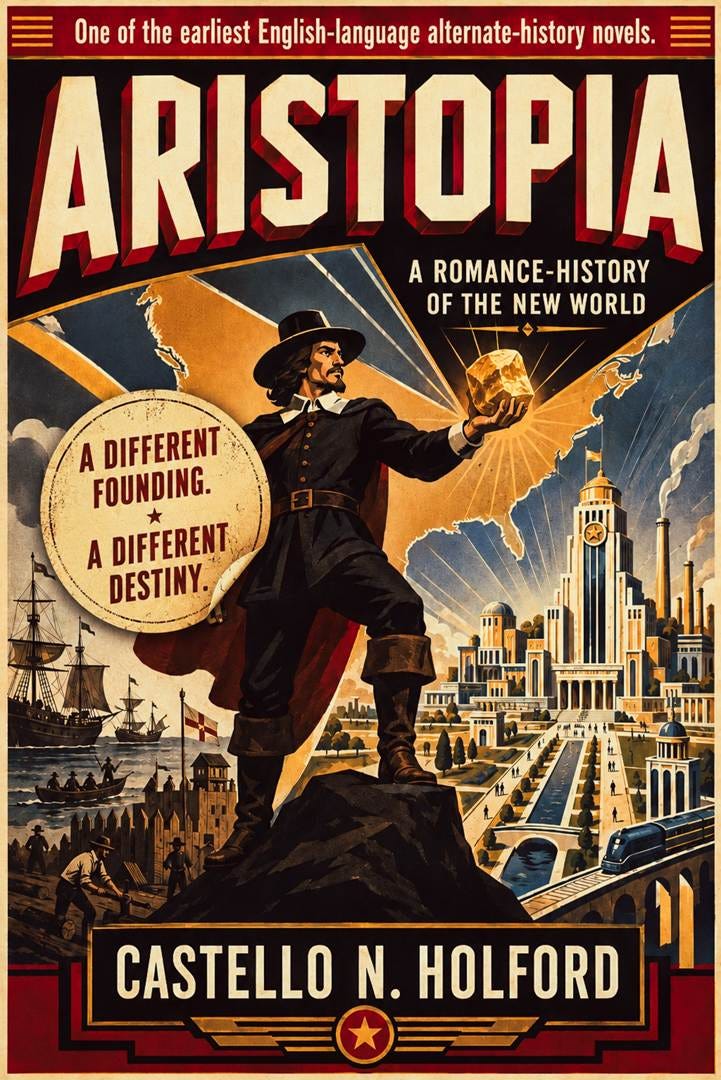
In 1895, he published Aristopia: A Romance-History of the New World, one of the earliest English-language alternate-history novels. The premise: A young settler named Ralph Morton lands at Jamestown in the brutal winter of 1607 — the real Jamestown, with the real John Smith, the real starving colony — and on an ordinary hunting walk, he sits down to rest on a quartz dike and finds it veined with nearly solid gold. Everything else follows from that one nugget. Morton keeps the secret, converts it into ships, charters, and political weight, and builds a commonwealth designed from the ground up to prevent every evil Holford watched corrode his own century.
A do-over of the founding, written by a man certain the Founders had gotten it incompletely right. And its underlying diagnosis is sharp.
The Diagnosis (That Still Stands)
Read Holford’s commonwealth as a list of grievances, and you could be reading the present. He abolishes private ownership of land, waters, forests, and mines because he has watched land monopoly turn free men into tenants and seen what a single owner can do to a future city. He puts wholesale trade and the great water-powered factories in public hands, because he can see industrial machinery becoming the thing a few men use to own the many. He kills primogeniture and caps any inheritance at ten thousand dollars, because dynastic money is how a republic grows an aristocracy in two generations without admitting it. He rewrites the criminal law to treat punishment as protection rather than revenge, ends the era’s burnings and mutilations, and quietly drops witchcraft, blasphemy, and sorcery from the list of things a person can be put to death for.
Concentrated wealth hardening into inherited power, public institutions captured by private owners, monopoly outrunning the law meant to govern it — these are his anxieties, and they are not anachronistic. A reader in 2026 nods along as the man describes the machine we are still inside.
Having seen the disease this clearly, Holford reaches for a cure.
The whole Aristopian commonwealth is funded by one man’s secret gold and governed by that same man. Ralph Morton is named governor for life. No amendment to its constitution can take effect during his lifetime without his approval. He appoints the trade bureau, the storekeepers, and the code of laws. The participatory machinery is all there on paper — an elected congress, a veto subject to override, popular initiative, referenda on fundamental questions — and all of it sits beneath a wealthy patriarch whose authority cannot be voted out.
The man who saw the concentration of power most clearly could only imagine fixing it by concentrating power further.
And the system works — inside the book — for exactly one reason: Morton is good. Holford writes him wise, selfless, almost incorruptible, and the story rests its entire weight on that stipulation. There is no machinery for the day a bad man holds the office. There is no answer to the ordinary question of succession beyond hoping the next Morton is as fine as the first. The reformer who refused to trust a single railroad baron with a stretch of track turns around and crafts a single man he trusts with the entire experiment, forever, because he made that man virtuous.
What the Refounding Kept
It would be easier to file Holford as a flawed progressive ahead of his time. The book will not let you, because the sins he set out to remove survived his refounding, wearing new clothes.
He abolishes slavery in the constitution — a real and early reform — and in the same motion describes Indigenous people as children. The colony buys their land for what “the savage thought the skin worth,” reasons that this is fair because they cannot judge true value, and writes into the criminal code that selling them a firearm is a banishable crime. The reform improves the terms of colonization. It never once questions colonization itself, and the commonwealth’s whole future runs on taking the continent.
Then there is the passage that settles the matter. In the very paragraph where Holford abolishes private commerce — his anti-monopoly centerpiece — he pauses to call trade the special delight of “that strange vampire race, the Hebrews.” The slur is not an aside. It is welded into his economic argument, load-bearing, sitting inside the reform itself. His ‘human brotherhood’ had a wall around it, and he built the wall out of the same material as the brotherhood.
The book ends with Aristopia conquering British Canada during the American Revolution. To secure the vote for union in Ontario, where the population leans the wrong way, the commonwealth ships ten thousand loyal families north to swamp the majority and manufacture the result. Then the conquered provinces vote, freely, for annexation. The final sentence raises the banner: liberty, equality, and fraternity — directly on top of a continental conquest that has just engineered its own consent.
The Part That Travels
None of this is a 2026 reader feeling superior to a dead man. It is the opposite. Strip the period costume, and Holford’s mistake is one of the most familiar moves in our own politics.
We have his diagnosis everywhere: concentrated wealth, captured institutions, a rigged game. And we have his cure everywhere too, in current dress: the leader handed unchecked control because his intentions are right and oversight only slows the mission; the strongman who claims he will personally break the oligarchy; the vanguard that needs total power, briefly, just until things are fixed. Watch how often the pitch arrives the same way Holford’s did — give one good actor a free hand and trust their goodness to hold.
That is the tell.
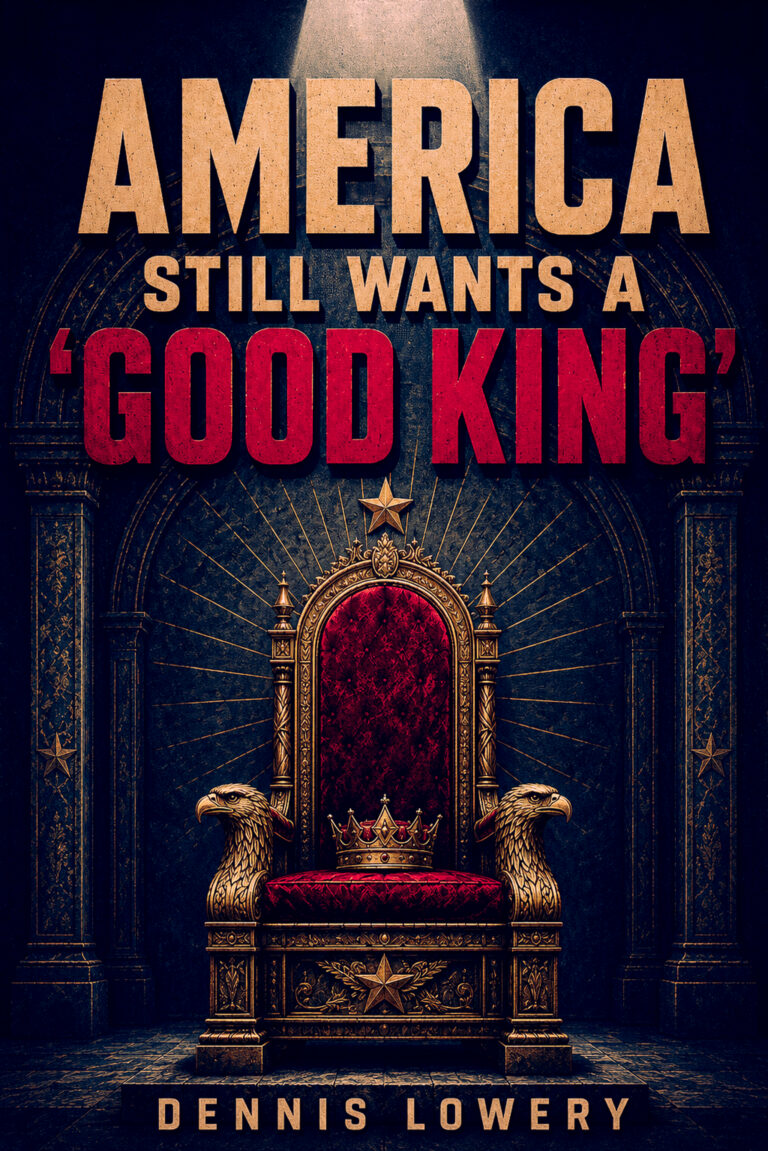
Holford’s leader works only because the book stipulates his virtue; the fiction must write it in. We are asked to do the same, and it is tempting to say we do it at the ballot box. We don’t. Hoping a leader is good, and keeping the power to remove him, is democracy working exactly as designed. Holford’s real heir is the figure who makes the next move: not trust this good man, but stop being able to check him. Gut the watchdogs. End the override. Make the office unloseable. That is where the wish hardens into a throne.
The danger was never a bad king instead of a good one. It’s that the conceit makes virtue load-bearing at all. The point of a sound structure is to make virtue unnecessary, not to guarantee it. Good design divides power, exposes what it does, and keeps decisions reversible, so that a bad man in the office is something the system survives rather than something it can’t. The moment everything rides on auditing one man’s character, the design has already lost — not because the audit comes back wrong, but because no answer to it holds. Character isn’t fixed, it isn’t inherited, and it can’t be voted back once it curdles. A structure that’s safe only when the right man holds power isn’t safe. It’s lucky.
Every era supplies its own candidate for the throne, and ours is not short of them. You can fill in the name; I don’t need to. The point is older and worse than any single one of them.
The problem Holford saw is real and still demands an answer. The answer cannot be a wise king.
The throne doesn’t make a man dangerous. It makes him untouchable.
The Virtue of Distrust
The Founders were not better men than Holford, and they did not solve the sins he hated. They wrote some of them into the document; they left the worst for later generations to bleed over.
Aristopia is in many ways a more humane program than the Constitution the Founders wrote in 1787.
But the Founders did one thing Holford could not bring himself to do, and they did it on purpose. They refused to vest the experiment in any single virtuous man. Having just fought a king and watched a weak confederation fail, they built distrust into the design — separated powers, fixed terms, a way to amend, a way to remove — on the assumption that the people running it would not always be good enough. Holford looked at that messy, distrustful arrangement and found it inadequate. So in his fiction, he reached for the gold and the crown and built something cleaner… and far more dangerous.
He wrote in 1895, a hundred and nineteen years into the experiment, certain it had already failed. We are now at two hundred and fifty, and the republic he eulogized is still here, still arguing with itself, still amendable. It was never the machine alone that saved it: the sins Holford’s design would have frozen in place were pried loose by war and mass movements, by the people the original system shut out. But they had something his commonwealth never offered: a structure that could be forced to change instead of a throne that couldn’t. That capacity is what his perfect colony threw away, and it is the most optimistic fact in the whole exercise. Self-correction. It’s uglier than perfection, but it outlasts it.
Looking at over 200 implementations from 2019 to 2024, it’s clear that 73% of AI transformation failures are due to human factors like leadership, talent systems, and culture, not the technology itself. This pattern warrants further investigation. Interestingly, organizations tend to spend about $10 on AI technology for every $1 they invest in preparing their people, which significantly influences whether the tech succeeds. The numbers tell the story: when the ratio is above 8:1, success drops below 30%, but at 4:1 or better, success soars above 70%.
At the heart of the book is the Human-Centered Future of Work Framework, which highlights three interconnected organizational capabilities: Adaptive Leadership, Talent Elasticity, and Psychological Safety. These are the essential human elements that enable AI to deliver the results organizations are investing in. Each of these pillars is supported by a chapter of evidence and a chapter of practical guidance, along with helpful tools like diagnostic assessments, governance structures, and a step-by-step implementation plan.
The book showcases three inspiring case studies that highlight how the framework truly comes to life: Mountain View Regional Health, a robust 2,400-bed system that managed to delay its deployment by six months yet still surpassed all the performance targets set by its board; First National Bank, which successfully rebuilt its trading-floor leadership amid active regulatory oversight; and Precision Manufacturing Group, which retained its most experienced technicians by involving them directly in the AI deployment process rather than sidelining them.
In Change Optimized, Curtis L. Odom, Ed.D., draws on twenty-five years of Fortune 100 transformation work combined with ten years of qualitative research as a faculty member at Northeastern University to specify what the missing investment is, what it costs, and how to build it. Change Optimized is his eighth book. His writing on AI, leadership, and organizational transformation appears regularly in Harvard Business Review and Forbes.
Change Optimized is for CHROs, CIOs, transformation leaders, and boards who have figured out that the algorithm is the easy part—and that their next AI investment isn’t another algorithm.
ABOUT THE AUTHOR
Dr. Curtis Odom is an Executive Professor of Management and Organizational Development at Northeastern University’s D’Amore-McKim School of Business, where he teaches courses in management consulting, global talent management, organizational transformation, and leadership development.
Twenty-five years of Fortune 100 senior leadership experience ground his teaching in the judgment demands of executive practice, and his doctoral research at Pepperdine University shaped that practitioner knowledge into experience-driven frameworks rigorous enough to withstand scholarly scrutiny.
He is Managing Partner of Prescient Strategists, an international management consulting firm that helps organizations build the human readiness capabilities that determine whether AI investments generate lasting value. The firm’s proprietary frameworks are deployed across healthcare, financial services, manufacturing, and professional services organizations worldwide. Learn more at PrescientStrategists.com
Curtis holds a Doctor of Education from Pepperdine University and served on active duty in the United States Navy during Operation Desert Storm. A Professional Certified Coach credentialed by the International Coaching Federation, he regularly contributes to Harvard Business Review and Forbes, where his insights on organizational transformation, leadership, and the human dimensions of AI adoption have influenced thinking across industries. He sits on the Harvard Business Review Advisory Council. Change Optimized is his eighth book.
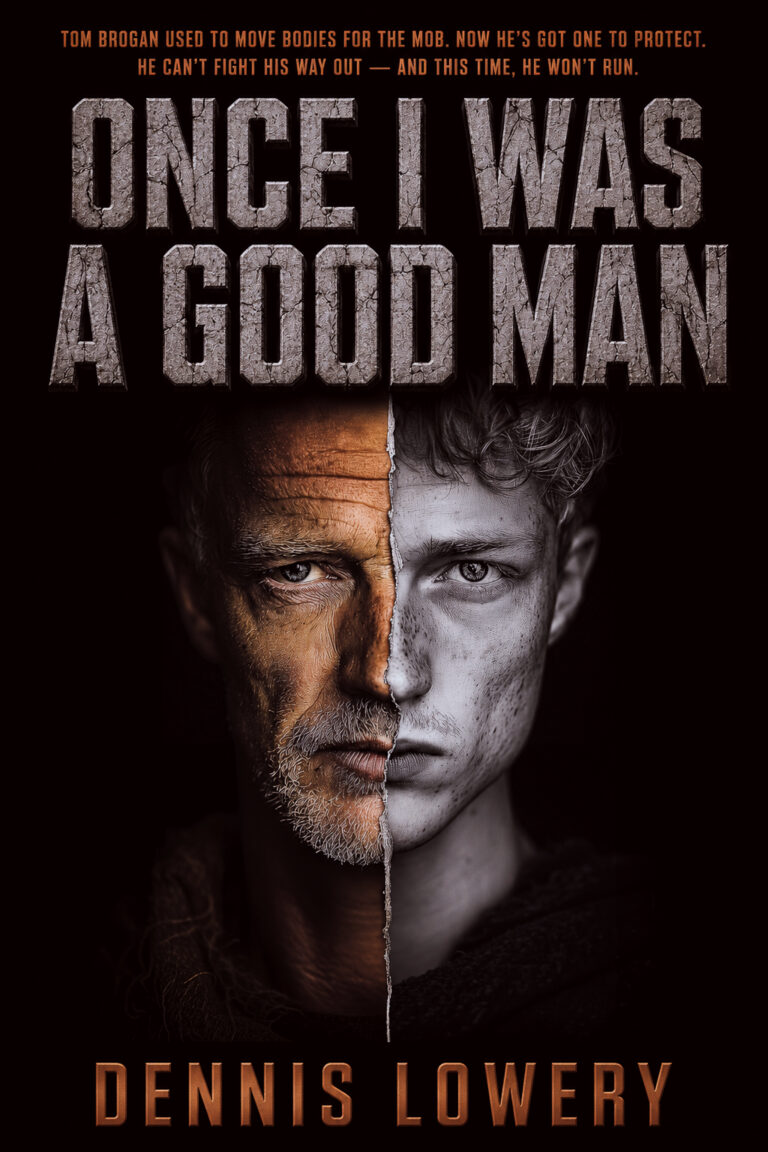
Tom Brogan wasn’t a killer. He wasn’t ‘made.’ Wasn’t feared. Just a foot soldier—a Drop Man—who did what he was told until the day he disappeared from the Irish mob.
An easy man to forget.
In an irony not lost on him, he found work tending graves in a small-town cemetery. Quiet years passed. He grew old, lived alone, and was buried in memory, haunted by the consequences of a violent life and the weight of bad choices.
But when he returns to Boston for his mother’s funeral and witnesses a mob hit gone wrong, he does the one thing he never did before: He remembers that once, he’d been a good man… and saves someone.
Now, with a boy in tow and the past closing in, Tom faces a fight he was never prepared for.
He wasn’t respected. Wasn’t feared. The mob forgot him. Until now.
He’s an old man standing between a kid and a bullet.
But redemption has a price. And the mob always collects.
By choosing a man who was never fully in—the forgotten cog in the machine, the disposable affiliate—the story positions Tom as someone readers can immediately relate to. He’s not a monster trying to become a man again. He’s a man who tried to survive in a monstrous world, escaped it, and never lost the awareness of his inadequacy. That humility, born from decades of regret and fear, becomes one of his most compelling traits.
He wasn’t respected, so he’s driven by the deep ache of never having been enough.
He wasn’t ambitious; he learned to stay small and survive by not fighting to climb the ladder or positioning himself to move higher in the Family.
He wasn’t brutal, so the violent world he once inhabited left scars instead of trophies.
This gives him depth and vulnerability, which make his eventual steps toward courage and protective violence earned and thus profoundly satisfying to the reader.
Subverting the ‘Former Killer‘ Trope
Crime and Thriller fiction is saturated with cold-eyed ex-assassins, bruised but deadly ex-cons, ex-cops, and stone-faced, flawed, or damaged ex-soldiers trying to live quiet lives. But a character who wasn’t that guy, yet must become a version of them out of desperation, is far more relatable and terrifying in his transformation.
Tom’s the one who slipped through, not the man who ruled the underworld, held a high place within it, or commanded its respect. He was barely acknowledged.
His unremarkable past becomes his only protection; nobody’s looking for him because nobody expected anything of him… or from him.
That anonymity saved him and condemned him to irrelevance… so it had been… so it was… until the day he acted to save someone else.
Echo and Inversion through the Boy
Having the protagonist see himself in the boy lends the narrative resonance and symmetry. The boy becomes both his second chance and his haunting mirror. Protecting the boy is not just an act of survival; it’s an act of atonement.
Tom doesn’t want the boy to become what he became: lost… only to turn the wrong way trying to find himself and his place in the world.
He knows what it’s like to have no one show up to save you.
He’s not saving the boy because he can, but because he must.
That distinction elevates the story from action thriller to moral fable.
Opportunity for Organic Growth and Tension
Since Tom isn’t a killer or fighter, every decision to act—every punch thrown, every gun picked up—feels earned. It injects real suspense because the reader knows he’s not well equipped to handle violence. When violence comes, it’s clumsy, desperate, messy–precisely what makes it authentic.
His journey isn’t about rediscovering past glory; there’s none to relive. It’s about becoming something he never believed he could be, not for status, but for someone else’s survival.
Narrative Devices to Support This Arc
To emphasize and deepen this character path, we’ll incorporate:
Flashbacks where real mobsters overlook or humiliate him show his insignificance.
Small moments of personal failure hint at why he never fit in; he couldn’t kill when ordered, hesitated, or helped someone, and was quietly punished.
Internal monologues rich in self-doubt, not cynicism, but honest reckoning.
Symbolic actions—digging graves that mirror his buried conscience or watching the boy sleep while remembering what it was like to be innocent… and unprotected.
ONCE I WAS A GOOD MAN is a story of buried sins and reluctant redemption. Tom Brogan, who was never meant to be a hero, is forced to become one for the only thing he found mattered: a young boy’s life. A gritty, emotional journey into the long shadow of crime, memories, regrets, and the quiet strength it takes to do what’s right… even when you’ve spent your life doing wrong.
Is It A Story Worth Telling?
Yes.
This approach gives the story moral gravity, a slow-burn character arc, and room for powerful emotional moments. Tom Brogan isn’t a lion in winter; he’s a beaten dog who suddenly turns to protect something, someone innocent. That is far more interesting and moving than a killer seeking redemption.
It also offers a fresh take on the true crime and noir tradition: a story not about the big names—the skilled, deadly, and feared men—but about the quiet ones in the margins. The ones who disappeared, not because they were too dangerous, but because they never mattered.
Central Themes: Redemption, moral ambiguity, confronting past sins, protecting innocence, and the inevitability of the past catching up.
Potential Strengths: Strong emotional depth, a relatable antihero protagonist, layered morality, and tension-driven narrative.
Character Potential: The old caretaker figure, embodying guilt, wisdom, and sorrow, is inherently fascinating. His internal struggle between regret and responsibility can provide excellent narrative depth.
Narrative Tension: Persistent threats from the Irish mob and suspenseful cat-and-mouse dynamics sustain reader engagement.
I was helping a client finish a book about building relationships that last — what you wish for in another person, and how to actually get there. The manuscript sat at ninety-five percent. The working title didn’t work, and his early readers had told him so.
I gave him my NGFS analogy. Naval Gunfire Support — a warship correcting its fire onto target, round by round. He’d commanded a guided-missile destroyer, and we’re both surface-warfare Navy, so he had it before I finished. “Titles work the same way. You fire long, you shoot short, you adjust — then you’re on target, and you fire for effect.” We’d get there by iterations.
Talking it through walked me back over the book’s central question, “What do you wish for?” And somewhere in there, a memory from long ago came back. I shared it with him.
* * *
When I was a boy, I’d spend the odd weekend with my great-grandmother. We were poor; she’d had it harder. She raised her kids and her grandkids through the Depression, and even by 1971, she had almost nothing you’d call a comfort now. No TV, just an old radio. Evenings, she’d sit and rock and chew tobacco with a Country-and-Western station turned low, and she’d read. Two things only: the Old Testament and the Montgomery Ward catalog.
The Bible was big, heavy; its black leather scuffed. It looked as old as she was — eighty-something then. I’d watch her from the couch that smelled of dog, though she’d never owned one, while I read my own book. After an hour or so, she’d cut a glance at the side table where the catalog sat. After the third glance, she’d close the Bible, set it aside — it went to bed with her, onto the small table by her head — and pick up the catalog.
My Big Granny (we called her that, though she stood barely five feet and might’ve gone a hundred pounds soaking wet) never smiled. She wasn’t mean. A hard life had just worn the gentle out of her. But when I stayed, she cooked my favorites: skillet-fried chicken, biscuits and gravy, apple cobbler. She cooked it all in a cast-iron pan bigger than a 1950s Cadillac hubcap; though it looked to weigh thirty pounds, she handled it like nothing. She’d produce a whole supper out of it alone. A good meal was how she said the things she didn’t say or show.
The first few times I watched her with the catalog, after a few slow pages, the set of her mouth eased into the barest curve. Sometimes she’d quit rocking and tip the pages under the lamp, that bone-thin finger tracing down a column. She’d squint… and the curve would grow.
Marginally.
Then a small shake of her head, and she’d settle back and turn the page.
I finally asked. “Big Granny, what’re you reading?”
“Not reading. Looking.” Her mouth went flat again. She wasn’t a talker; any conversation you wanted with her, you had to run down and catch.
“Looking at what?”
She stopped rocking. “Come here, boy.”
“Yes’m.” I was off the couch and beside her in three steps.
“This” — she laid her hand on the catalog in her lap — “is my wish book.”
I thought of Aladdin and the lamp, the genie I’d read about in One Thousand and One Nights earlier that summer. “What’s a wish book?”
She looked up, and for a second, I thought the smile might come. It didn’t take. “Everything I wish I had and never did…” A beat. “Never will.”
Her voice barely moved. It bent a little on never will.
That was a memory I’d lost, and the call had handed it back. As I trailed off, my client cut in.
“Back up. What’d you call it?”
“Her wish book.”
“Yeah,” he said. “That. That could be the title.”
* * *
After we hung up, I sat a while and thought, but not about the book. A wish of my own had surfaced. Big Granny’s decades gone, but I wished I’d put one thing from that catalog in her hands — whatever it was her finger kept finding, and her head kept shaking off. She lived alone for a long time. I never weighed that until I was a man with a four-decade marriage and four daughters of my own.
What I want for my girls isn’t in any catalog: it’s somebody to hold who holds you in return, somebody to grow old beside. All the things Big Granny wished for and never got.
I was just a boy then, with nothing in my pockets.
I’d give a lot to go back with something in them. Sit with her. Turn the pages of that wish book together.





![Dance of Fireflies [Creative Nonfiction]](https://adducentcreative.com/wp-content/uploads/DANCE-OF-FIREFLIES-A-Vignette-from-Dennis-Lowery-2026-2-768x1152.jpg "Dance of Fireflies [Creative Nonfiction]")









![Big Granny’s Wishbook [Creative Nonfiction]](https://adducentcreative.com/wp-content/uploads/BIG-GRANNYS-WISH-BOOK-by-Dennis-Lowery-260607-768x1154.png "Big Granny’s Wishbook [Creative Nonfiction]")