Home Blog Page 7

The Things We Carry [Creative Nonfiction]

*Beta moves slower than *Alpha. She’s always at the edge of being on time… or just past. And I have certain rules for chores and when to be at the breakfast table on school days. When you aren’t on time without good reason—not an excuse—there are consequences.

We had one of those mornings Beta couldn’t get it in gear. She was late to the table. I addressed it and meted out the penalty. Minutes later, angry at getting in trouble for being late, Beta lashed out at Alpha over some trivial thing. [Understand that they are twins—Alpha’s five minutes older—and friction arises.] Alpha did not take that quietly, so the breakfast table became a volleying ground for harsh words.

Now, I understand getting pissed off… when I’m pushed too far and go off, it’s epic… and not always productive. I know this and work hard to not let that happen. I try to teach my girls how to deal with anger. So, I did this:

“You girls want to hear a story?” They know to look at me when I’m talking to them. It broke up the punch-counterpunch of comments flying back and forth. I asked again, “Do you want to hear a story?” Both heads nodded. I told them:

Once there were two monks on a pilgrimage [I explained to them what that meant], an older one who had been on several and a young monk on his first. One day they came to the edge of a river. It was turbulent and roiling, with several days of rain in the mountains feeding it. It would prove difficult, but not impossible, to cross; they were both powerful men. They heard crying. Nearby, under a willow tree, a woman sat weeping. In her hands was a small bag she clutched to her chest. She heard them and looked up.

“Please help me… I’m afraid to cross.” She gestured at the river and gripped her bag tighter. “But I must get home soon.”

The young monk turned his back on her. Their order was forbidden to speak to or touch women. But the older monk picked up the woman and, without a word, forged the river. He put her down on the other side. With thanks he didn’t respond to, she turned to the right-hand path and hurriedly went on her way. The older monk continued straight ahead, and the younger came after him. They walked in silence for another mile. After crossing the river, the young monk fumed (I defined that word for them) in anger. He berated the older monk: “How could you do that — the woman… you’ve broken your vows.” He continued talking to him that way for another mile. Finally, the older monk stopped and turned to him.

“I only carried her across the river. Are you still carrying her?”

I waited for a beat so they’d realize that was the end. Then asked, “Do you understand what he—the older monk—meant?” I saw the wheels turning behind their eyes as a minute passed. Alpha raised her hand [yes, they usually do that with me in a straightforward question-and-answer situation]. I nodded at her.

“The young monk needs to stop being angry.” She looked at Beta.

Beta still looked edgy as I replied to Alpha, “That’s right. Sometimes we carry things too long… far past when we should put them down and move on without them.” I looked at Beta and said, “That’s something to think about,” and left it at that.

With things settled down, we finished breakfast, and soon they were off to school. I thought it another little teaching moment they hopefully took to heart.

Epilogue

The next day, Saturday morning, we had many chores to do. Beta and Alpha, angry at each other over something, had another incident. A minor one that could’ve grown larger. I gave Beta a stare, and she dropped the fight but was cold toward Alpha as they did their chores. About an hour later, when I was making some soon-to-be world-famous D’achos (Dad’s nachos) for them for lunch, Beta came up to me at the stove.

“Dad?”

“Yes, honey.”

She gestured for me to lean down so she could whisper something. “I put the woman down….” Beta had a smile on her face. A moment later, I heard her apologize to Alpha.


*About Alpha & Beta

I have four daughters. My oldest was born in October 1988 when I worked for others. My second-oldest was born 15 days after my resignation from my corporate job became effective on January 2, 1996. So, she’s seen my life as an entrepreneur and business owner from day one. Those early years in business were hard, as they often are, and I became like the father in ‘Cats in the Cradle’ (the Harry Chapin song). Always busy, too much to do and not enough time, eaten up with stress and worry about many things. Then, in 2008, I made some changes and pursued what I do today, writing and publishing. And that made a world of difference in having time for my family. The two youngest—unexpected twins I refer to as Alpha & Beta—have had more daily time with me as they grew up than their two older sisters. And much of it I’ve experienced through the ‘lens’ of a writer. So, our conversations and kitchen table discussions—several times—have turned into ‘stories.’
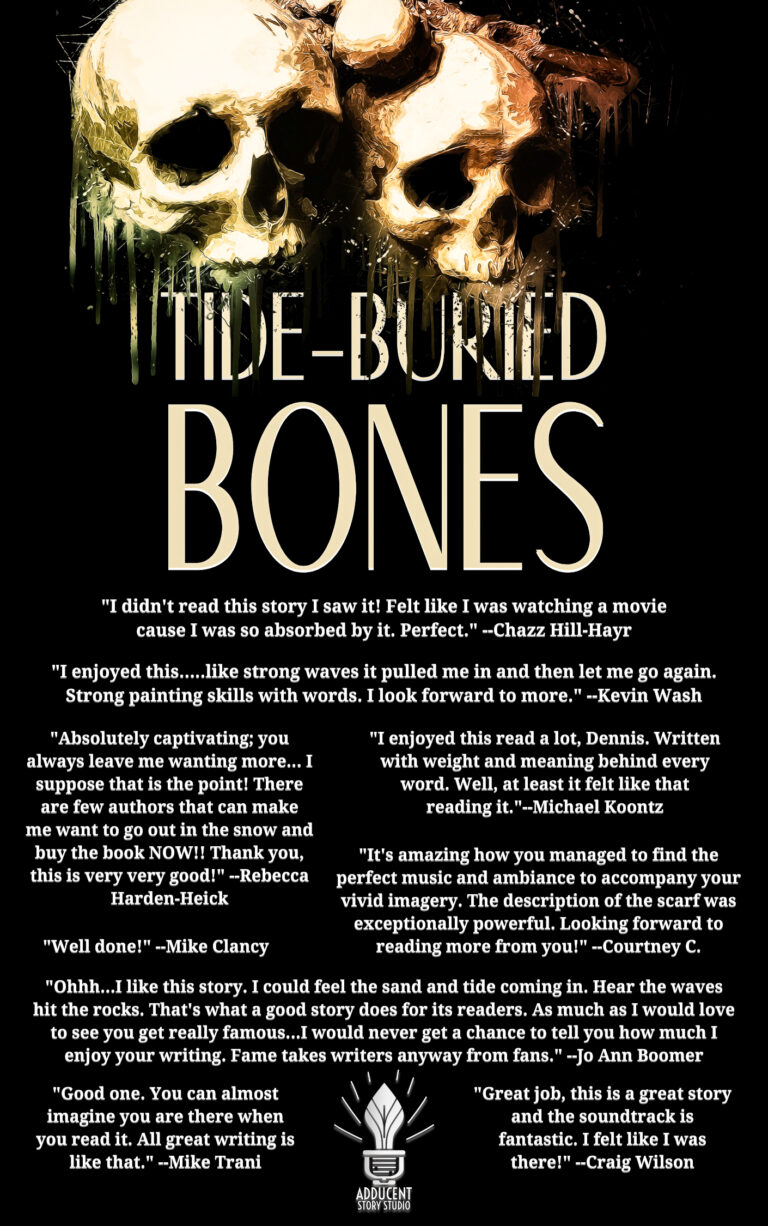
TIDE-BURIED BONES

Note: Two comments on the cover above reference a version with a soundtrack and sound effects accompanying the story. Regrettably, the company I produced that web-server version with switched their business model, and the enhanced version is no longer available.

About this flashfiction story:

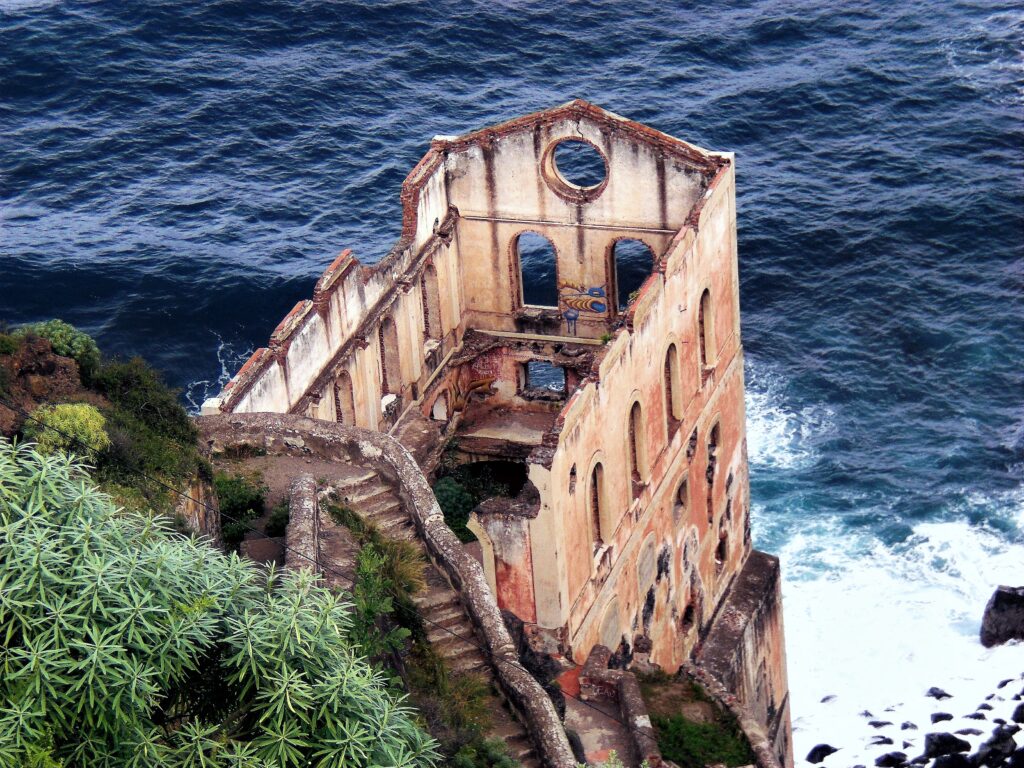
One day, I came across this photo of a decaying building sitting on a cliff over a sea, and, struck by it, wondered: ‘What’s its story?’ Here’s what it told me.

The photo that prompted writing the story.

THE STORY

The structure’s skeleton sat raw, crumbling with age from the ravage of seasons and weather on a point of land over the sea. In a ruined bedroom overlooking the water, what remained of a once beautiful woman mourned her lost love. Decades ago, more years than she knew, she had found his body on the sharp rocks below, among those teeth of the sea that grind daily until everything’s eaten away except the memories and regrets of what she’d done, what she had caused. They weighed heavily as she stepped off the balcony each night to join him. When the moonfall sky turned to signal the coming sun, she must leave to climb the worn stone steps to cry until moonrise when she could return to him.


The couple had walked the beach for more than a mile, their last day and outing before their return to the United States. Cameras in hand, the stark beauty of this part of the Ligurian coast struck them. Jutting cliffs rose over the sea, a jumble of rock and jagged stone amid patches of sand at their base.

Rounding a bend, they spotted the house. It had once been magnificent and offered a majestic view of the sea and coast. They made their way to almost directly underneath and, looking up, high above, were the remnants of what must have been a balcony. At their feet, chunks of masonry were buried in a bed of sand where the rocks that sat at the water’s edge sheltered them from the surf. Letting only swirls of water and the swash of seafoam spill over them. There were other things in the sand, too.

“Paul,” Angela swept the seawrack away with her foot and stepped back. “Look!”

Paul stared at the two sets of tide-buried bones in the silt and sand. Their upper torso just reached the surface. The more prominent one rose higher, spine arched, the contortion of a near-drowning man that had breasted, gasping for breath. The smaller skull rested on the shoulder bones of the larger set; a lighter-boned arm climbed from the sand to drape across its lower rib cage.

Angela knelt and brushed away some of the sand with the bright blue scarf she took from her head. A gust of seawind lifted the tops from the incoming waves and sprayed them as she leaned closer. What she’d cleared revealed more of the arm, something in its small skeletal fist. She nudged it with her scarf-wrapped hand. Shed of the sand, the circle of metal gleamed and came free. Angela touched the ring, and a stiffer blast came off the water with a keening sound through the rocks that made her grit her teeth. She picked it up; her hair whipped in the wind, and a tingle climbed her spine. The bad kind you get when you’ve done something you shouldn’t and got caught. She quickly rose. “I wonder who they were.” She looked above at the ruined house that loomed over them. “And what happened?”

Paul shrugged. “It’s getting dark. We need to go.” He took several quick pictures and snapped his lens cap in place. “We’ll report this to the police back in town.”

They retraced their way along the beach. There was a lull in the wind. In the dead stillness, Angela turned, looked back to where the bones lay, and canted her eyes and ears up to the house. “Listen….”

“To what?”

“That sound.” Angela took her eyes from the house and glanced at the blue cloth, the ring wrapped inside, still in her hand, then at Paul. “I hear crying.”


The Polizia di Stato officer had flirted with her until he realized she was on her honeymoon. He put down the pad of paper he’d made notes on.

“That palazzo is several centuries old. There are many reports of sounds, but no one has lived there for decades.”

“It was a woman crying. I know it,” Angela repeated.

The officer shrugged. “I’m sure it was just the wind.”

“What about the bones?” Paul asked.

“You gave clear directions where to find them.” The officer flashed his bright smile. “We’ll send a forensics team to investigate. They’ll be brought in to see if an identity can be determined.”

“What will happen to them and this?” She touched the ring she’d given him, now in a clear plastic evidence bag beside his paperwork.

“The Carabinieri will find and notify any next of kin if we identify them.”

“And if not… or if there’s no next of kin?”

“Then the ring and a sample of the bones will be kept with the file, and the remnants cremated.”


Angela and Paul returned home to their newlywed life. It matured and became well-seasoned with years of laughter, tears, sons and daughters, triumphs, and tragedies. But at different times, as the decades flew by, her thoughts returned to that day to that place thousands of miles away at the foot of a seacoast cliff beneath an ancient, ruined, and forgotten estate. Angela remembered what she’d heard and wondered if the woman still cried… and if she looked for her ring.

# # #

WRITE SMART, SELL BIG

The publishing world is competitive. Targeting specific genres and subgenres can enhance the commercial viability of your book. Write smart to sell big. Here’s why this strategic focus is so effective:

1. Meeting Reader Expectations

Genre Conventions:

  • Every genre has its own set of conventions and tropes that readers expect and enjoy. By adhering to these, you meet the expectations of genre enthusiasts, making your book more appealing to them.

Predictable Audience:

  • Targeting a specific genre helps you identify and understand your audience more clearly. You can tailor your marketing and promotional efforts to attract this well-defined group.

2. Niche Markets

Less Competition:

  • Subgenres often have less competition compared to broader genres. By focusing on a niche market, you can stand out more easily and attract readers looking for something specific.

Dedicated Fanbase:

  • Readers of niche genres are often dedicated and loyal. Once you capture their interest, they are more likely to become repeat customers and advocates for your work.

3. Effective Marketing

Targeted Advertising:

  • With a clear genre or subgenre focus, your advertising can be more precise. You can use targeted ads on platforms like Facebook, Amazon and Goodreads to reach the right readers.

Optimized Metadata:

  • When you know your specific genre, you can optimize your book’s metadata (title, keywords, categories) to improve discoverability on search engines and online bookstores.

4. Stronger Branding

Consistent Author Brand:

  • Writing within a specific genre or subgenre helps you build a consistent author brand. Readers know what to expect from you, strengthening your reputation and making cultivating a loyal following easier.

Series Potential:

  • Genres and subgenres often lend themselves well to series writing. A successful series can generate ongoing interest and sales as readers eagerly expect the next installment.

5. Community Engagement

Reader Communities:

  • Each genre has dedicated communities and fan groups. Engaging with these communities can provide valuable feedback, promote word-of-mouth marketing, and create a sense of connection with your readers.

Industry Events:

  • Genre-specific events, such as conventions and book fairs, offer opportunities to network, market your book, and connect with readers and other authors.

6. Higher Conversion Rates

Focused Efforts:

  • Concentrating your efforts on a specific genre makes your marketing and promotional activities more likely to convert into sales. You can craft compelling messages that resonate with your target audience’s desires and interests.

Enhanced Reader Engagement:

  • Books that align with genre expectations are likelier to keep readers engaged. Satisfied readers are more inclined to leave positive reviews, recommend your book, and look for more of your work.

7. Adaptive Strategy

Trend Monitoring:

  • Keeping a pulse on genre trends allows you to adapt and evolve your writing to align with changing reader preferences, ensuring that your work remains relevant and appealing.

Feedback Utilization:

  • Focusing on a specific genre makes gathering and using reader feedback easier to refine your writing and better meet market demands.

Conclusion

WRITE SMART SELL BIG by Adducent

Targeting specific genres and subgenres is a powerful strategy to enhance the commercial viability of your book. It allows you to meet reader expectations, tap into niche markets, optimize your marketing efforts, build a strong author brand, engage with dedicated communities, achieve higher conversion rates, and adapt to market trends. By understanding and leveraging the unique dynamics of your chosen genre, you can increase your chances of success.

WRITE SMART, SELL BIG How To Write-To-Market by Adducent.

Here’s more about the Write-To-Market approach:

‘Write to Market’ means understanding what readers crave and tailoring your writing to meet those desires. It’s about hitting that sweet spot where your creative idea is shaped to meet market demand.

There are specific things you should look at when evaluating your market. The information you glean can help you write a more commercially competitive book. Here’s what that information should comprise:

Comparative Title Analysis:

  • Revenue Assessment for the Top 20+ Selling Books in the Genre and Subgenres. See the revenue estimates for top sellers in your genre and subgenres (which show the market demand and potential).
  • Specific Title Strengths & Weaknesses Breakdown. Analysis of a title’s strengths and weaknesses, why readers bought it, and why some might not buy it.
  • Specific Title Discourse Breakdown. A comprehensive report on how language is used throughout the book, such as the choice of words, how sentences are structured, and the language and communication strategies used by the author to convey their message and engage with their audience.
  • Specific Title Thematic & Narrative Breakdown. A comprehensive and detailed thematic and narrative analysis of the story, examining the structure, content, and meaning. Analyzing patterns or themes, looking for commonalities and differences that can be used as writing guides.
  • Specific Title Structural Breakdown. A comprehensive and detailed structural narrative analysis highlights the structure’s benefits to the reader.

Genre / Subgenre Analysis:

  • Market Intelligence (Overview)
  • Market Trends
  • Reader Demographics & Psychographics
  • What Readers Need & Desire (Audience Feedback)
  • What Story Elements and Qualities Readers Look For
  • Critical Success Factors (for Fiction or Nonfiction)

These are the same Write-To-Market reports we generate and use for developing, planning, and writing our stories. The information comes from qualitative analysis, machine learning and predictive modeling using a combination of historical Amazon, Goodreads and Barnes & Noble reviews, historical customer reviews and ratings, market research, on-site analytics, key element analysis, social media insights and other historical insights to provide a deep understanding of the reader’s demographics, interests, psychographics and sentiment toward books in the genre and subgenre.

Contact us if you need help with a Write-To-Market approach to your book planning, writing and publishing or if you would like to request an example of our reports.

ADDUCENT [ Writing-Creating-Publishing 260903
What we’ve done and what we do for clients.

Don’t Blame Your F#ck Up On The Consultant

Key Takeaways

  • The book, titled ‘Don’t Blame Your F#ck Up On The Consultant’, aims to provoke thought and connect with readers about poor consulting experiences.
  • It focuses on how to be a better consulting client and build effective partnerships with consultants.
  • The authors emphasize understanding the client-consultant dynamic rather than only finding the right consultant.

How To Be A Better Consulting Client And Get Positive Results

By Dr. Curtis Odom and Sophia Barrett

Before we go too far, let’s address the elephant in the room: the title of our book, Don’t Blame Your F#ck Up On The Consultant.

The short answer is that we wanted a provocative title to grab your attention and convey our book’s central message boldly and unapologetically. The title’s adult humor aims to connect with you as a reader with firsthand experience with poor consulting engagement results, making the book relatable and genuine. Our book addresses criticisms and misconceptions about consultants, primarily that they serve as mere scapegoats for broader organizational failures.

This book discusses how to be the kind of client consultants dream of working with. We also explore what makes a better consulting client or even a good prospective client for those who have yet to work with a consultant. This flips the script. We often talk about finding the right consultant to hire, but what about being the right client? What we share in this book goes well beyond that. It’s all about understanding the dynamics of a true partnership and how to get the best from any collaboration.

We wanted to be bold, irreverent, and authentic. We believed that using profanity in our title would pique your curiosity enough to pick up this book and start reading.

Were we wrong?

AVAILABLE NOW AT BOOKSELLERS ONLINE

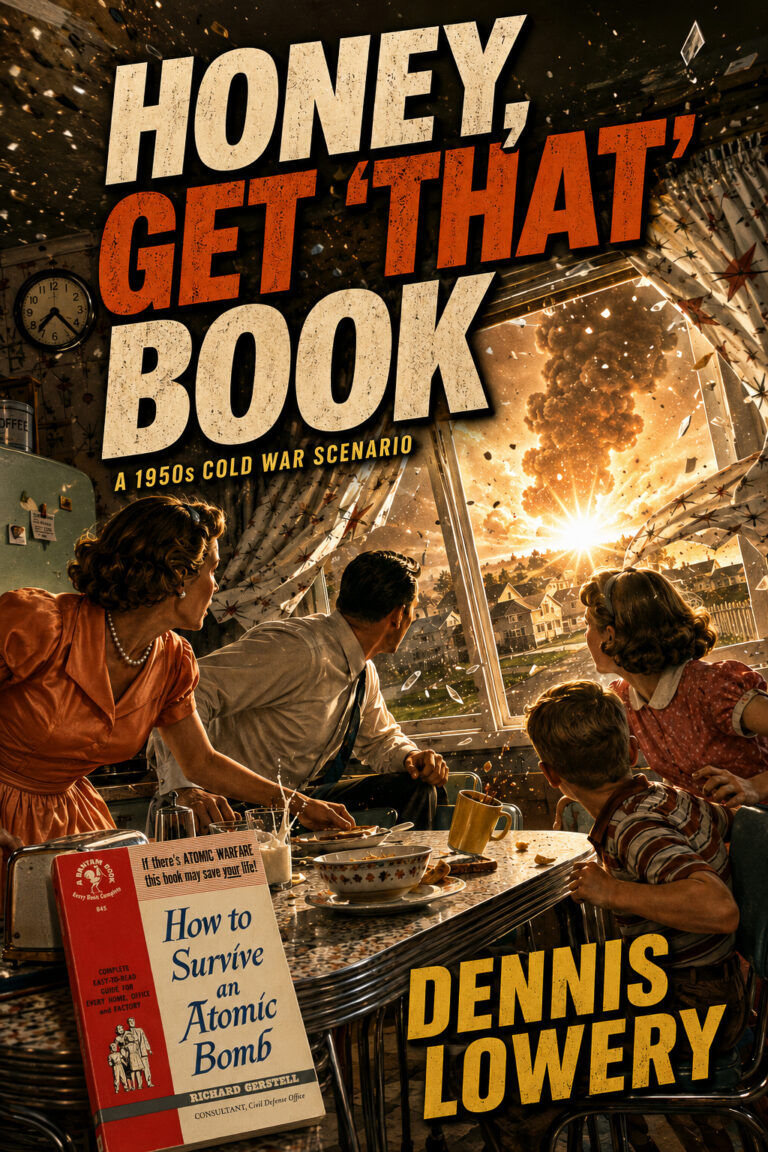
Honey, Get That Book

From our ‘Every Picture Tells A Story’ Series: A 1950s Cold-War-Era-warning inspired flashfiction piece.

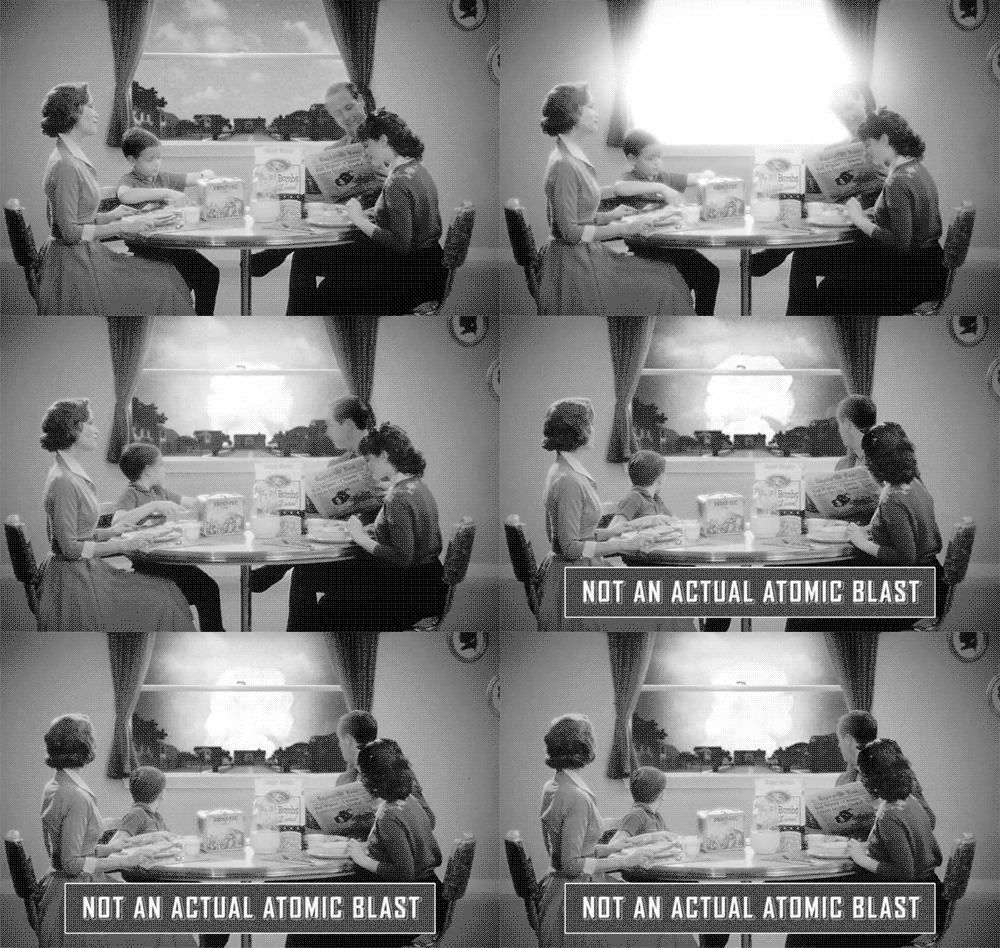
Inspiration for 'Honey, Get That Book'
Inspiration for ‘Honey, Get That Book’

First, an explanation. It is as Rod Stewart sang: “Every picture tells a story, don’t it.” An image or photo has often caught my attention and imagination and soon became one… a story. And I’ve had several people send me pictures and ask me to write something about them. I did; many stories have resulted. Have a photo or image you’d like to test for what story it holds? Contact me.


The Story

Bob and Jane sat at the table with Sandy and Timmy that Friday morning. When the workday and school day ended, the holiday weekend was beginning, and they had special plans.

Just the day before, Bob had picked up his new 1958-model Edsel from ‘Big Jim’ Axelrod’s Ford dealership in Union City. Jane knew he looked forward to the drive to the Poconos over the weekend. Bob wasn’t the kind—because of the ‘gaddam idiots’ driving through the neighborhood—to park his car on the street. He’d insisted on moving the Oldsmobile to get the new Ford under the carport. That he’d have to back the Olds out of the driveway each time to get to the Edsel hadn’t sunk in yet. But then, Bob wasn’t much for long-range planning.

Jane worried that bills—this new car added to them—were getting out of hand. She followed his admiring study of the new shiny-red debt through the kitchen’s carport-side windows. She wore a not-quite-latest-fashion-but-still-nice orange satin-sheen dress that complemented her hair, with a broad collar that perfectly framed her strong, lean neck and high-cheekboned face. Jane smelled of lilacs this morning. A fresh scent she’d found that Arturo, the pool boy at the club, liked a great deal. He called it ‘Lilicks…’ and would laugh as he burrowed his head between her—.

“Jane?”

She blinked away the memory of what she loved so much, but Bob wouldn’t do and looked at him. He had shifted his face around the edge of the newspaper to look at her. “Yes, dear?”

“Are you okay?” He almost seemed concerned.

She canted her head, felt her hand rise to her ear, and then stopped. She’d almost tugged at her right earlobe. Bob knew she only did that when she was nervous. He’d be on to her. Instead, she brushed a lock of hair—that hadn’t fallen out of place—back from her brow with the heel of her hand.

“I’m fine, dear.”

He grunted. His usual response when he didn’t quite believe something he’d heard someone say… or, more often, didn’t really care. But then added before ducking behind The Daily Courier, “You’re kinda flushed; you running a fever?”

“Really, dear… I’m all right.” She felt a catch in her voice and hoped he hadn’t heard it with Timmy and Sandy fighting over the last slice of buttered toast. Jane was meeting Arturo early that afternoon—between the Church Planning Committee luncheon and picking up the kids from school—at the Golden Pavilion motel where 6th Street ended at Highway 9. She felt the warmth rise again. But not on her face this time; she clenched her thighs. “Anything in the paper?” Getting him to talk about the news always worked.

“Hmmph… if someone—and I mean the gaddam president—doesn’t do something about them Russkies… they’re going to take over Europe.” Bob had fought in World War Two, serving in Patton’s 3rd Army, and was still pissed the US had let the Russians enter Berlin first. “And then they’ll be landing in New York.”

“Yes, dear.” It was automatic, coming out of Jane’s mouth without thinking, her mind still on Arturo singing ‘Return to Me’ last weekend. He looked so much like Dean Martin. Then he had put his mouth on her… and his tongue— “What’s that, dear?”

He had the paper down and surveyed her again. “What are you humming?”

Then, like God had taken their picture, a bright light whitened their faces.

Bob, Jane, Sandy, and Timmy turned toward the picture window onto the backyard; a thick, twisting column of smoke climbed and darkened the early morning sky.

“Honey, get that book, you know… the one about—” Bob started and stopped when the lights went out.

They felt the house shiver and groan. Just before the window blew in, Jane saw the frown on her husband’s face and knew Bob’s thoughts must be on the Edsel… and them ‘gaddam’ Commies.

# # #

NOTE FROM DENNIS

Someone who enjoyed this flashfiction story asked me if I planned to expand it because he wanted to know what happened to this family. I answered:

“Thanks, Damon; you never know. The saga of Bob, Jane, Sandy, and Timmy in the aftermath might continue. Does Jane leave to search for Arturo (her true love, so she believes)? Does Bob dig the Edsel out of the rubble to turn it into a shrine, memorializing what he’s lost? Does Sandy live long enough to get her braces off (or does their metal become radioactive through exposure to fallout)? Does Timmy ever tell his mom and dad what really happened to his pet hamster? So many loose ends to deal with, and we haven’t talked about survival yet.” 😉

You Never Even Called Me By My Name

“The girl came closer and touched, then stroked, my arm.

“Let me back up and give you the big picture.

“There I was.

“A short-haired military guy in a long-hair, redneck biker bar.

“This was back when those in service weren’t admired as much as they are today; the unfortunate legacy of the Vietnam War took years to fade. There was a nearby Army base, and it was like the scene in ‘An Officer and A Gentleman’. The locals didn’t care for service guys… especially—in this case—one singing to one of their women.”

Dennis Lowery

You can read this story at the author’s site: You Never Even Called Me By My Name

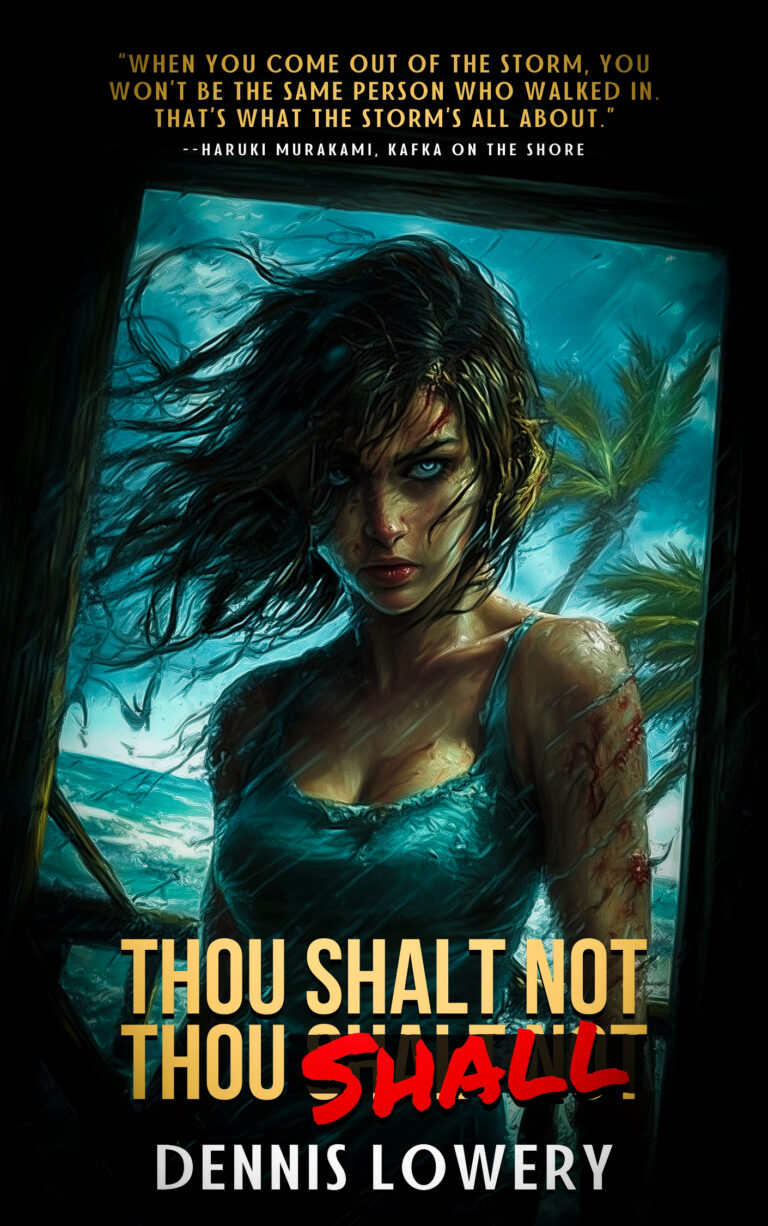
Thou Shalt Not… Thou Shall…

This evocative and psychologically charged short story from Dennis Lowery is a gripping exploration of the psychological impact of long-term abuse and the desperate measures one might take to escape it. The author masterfully intertwines the fury of a literal hurricane with the storm brewing within a woman trapped in an abusive relationship. With vivid atmospheric detail, deep character exploration, and powerful symbolism, this haunting portrayal of the breaking point where survival and revenge collide is thought-provoking and unforgettable. A compelling and intense read that lingers long after the final sentence.

You can read this story at the author’s site:

Thou Shalt Not Thou Shall (2025) Short Fiction by Dennis Lowery

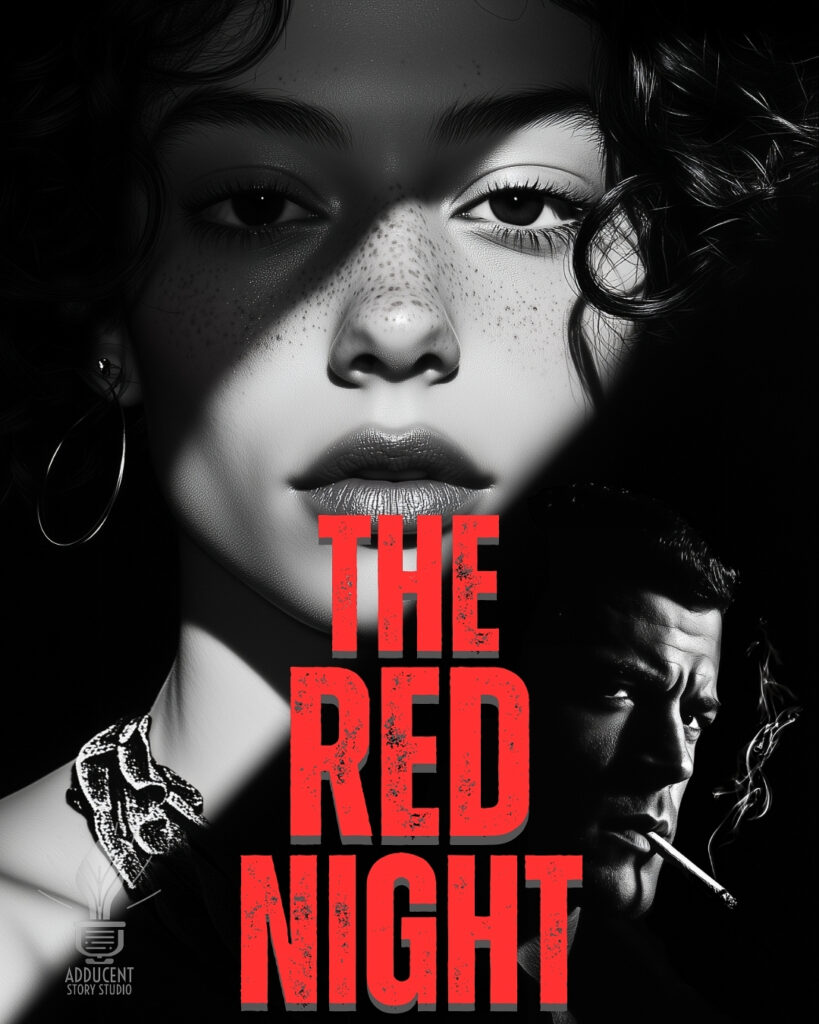
WHISPERS IN SMOKE

A Slow Jazz, Film-Noir-Style Song

Created for our story in development, THE RED NIGHT.

(c) 2025 Dennis M. Lowery

[Verse 1]
The smoke-thick room
reeks of bourbon sins.
In a country that jails
…for drinking gin.
The rough men eye him,
…a wary glance…
at his cane held firmly,
a lame knight’s lance.

[Verse 2]
A forlorn man
who met his call,
Ignoring whispers,
talk of the fall.
At the bar,
he leans in close,
a man whose life
he never chose.

[Chorus]
Whispers in the smoke,
shadows on the floor,
truth just a game
no one plays… no more.
Should I run…
should I hide,
Where can I go?
They won’t find.

[Verse 3]
His coat still smells
of city fire,
of blood, and ash…
and burned-out spires.
He grips his cane,
…I sense his ache,
Still, he offers
…his hand to take.

[Bridge]
Some men fled,
…some men fell,
some woke up
in a brand-new Hell.
Red washed over
…every street,
a night of silence,
a night of grief.

[Verse 4]
Nowhere’s safe;
…eyes everywhere.
How can I trust
he really cares?
The men I know
…all walk the line.
What makes him
not that kind?

[Verse 5]
I shake my head
and tell him… go.
I can’t give him
what he wants to know.
Resistance won’t last
too long…
The Red iron fist;
…just too strong.

[Chorus]
Whispers in the smoke,
shadows on the floor,
truth a deadly game
no one wins… no more.

[Outro]
A siren’s howl
…grows closer still,
government men
…with rights to kill.
I watch him limp
…into the night,
holding on …
to wrong …
…and right.

…holding on …
to wrong …
…and right.

Truths
a deadly game
no one wins…
no more….

no more….

no more….

DEEP OF NIGHT

A Slow Jazz, Film-Noir-Style Song

Created for our upcoming story, THE RED NIGHT (in development).

(c) 2025 Dennis M. Lowery

When the darkest night takes form,
I think of all that’s torn.
No faith in words, in what once believed.
No flag to follow … no heartfelt creed.

The only noise… my faint heartbeat,
deadly tired, I pray for sleep.
Then the wind-swept rain begins.
Wonder if it’ll ever en
d.

Will what hopes I have… last till dawn?
Or will I pay for what’s gone wrong?
The man outside says he’ll stay…
and drive the dark shadows away.

He says he’ll come when I call.
But will he stand, or will he fall?
All I’ve known are countless lies,
empty promises… and broken ties
.

Can I trust him? Can I believe?
Or, like the others, will he leave?
Can what hopes I have, last till dawn
Or will he pay for all my wrongs?

A howling wind-swept rain begins.
Wonder if it’ll ever end.
I wonder… if it’ll… ever end.
Wonder…
if it will…
ever end.

Wonder if it’ll ever end.
I wonder… if it’ll… ever end.
Wonder…
if it will…
ever end.

NEW AUTHOR/CLIENT (former four-star commander of CENTCOM)

0

We’re working with a new client/author, a former four-star commander of CENTCOM. More to come about their book and their author bio.

Several of our authors and clients are retired Admirals, Generals, and other high-ranking military personnel, as well as professionals with careers in Intelligence, Security, and Law Enforcement Agencies.

[Other clients are Senior Executives (including former CEOs, Chairmen, and SVPs of multibillion-dollar NYSE companies), retired members of Congress and government officials (within DOD), Foreign Policy & Defense Industry Professionals, University Professors, Scientists, Doctors, Surgeons, Attorneys, Entrepreneurs, and Business Professionals.]

SecDef Challenge Coin - Dennis Lowery - ADDUCENT Story and Book Development