We’ve ghostwritten and co-written nine memoirs and helped edit and publish over a dozen. We’re often asked about the difference between nonfiction and creative nonfiction. As a good writer understands… it’s best to ‘show’ not ‘tell,’ so here’s a creative nonfiction vignette–one in a series of stories–written by Dennis Lowery for his daughters (that others have enjoyed).
Some of the reader comments:
“Music often equals ‘moments’ for me. These little flashback memories that make me smile as I am driving, or working or just sharing with my kids. I think those are life’s soundtrack moments. Love that you share with your kids and the rest of us.” —Dawn Jackson
“It’s beautiful and important, making memories with those you love. Everything Dennis writes is just…. special, different, brilliant! You must be so aware of every moment, that you are able to tell about it in such great detail. You paint pictures with your words. Full color with sound and smell! Every time, it’s like I’m there! I love your writing” –Nina Anthonijsz
“I had forgotten that I listened to this song often in my childhood. It is nice to hear it again. That you wrote a story around the song is truly amazing. You just keep proving, over and over again, what a talented writer you are. Keep it going. Hope to see more.” –Brenda Church
“Oh, someone to be kind to in between the dark and the light. Oh, coming right behind you; swear I’m gonna find you one of these nights.” Songwriters: Glenn Frey / Don Henley.
I sang along as I made notes in my planner at the kitchen table with Alpha and Beta (my two youngest daughters—twins—but not their real names), who were finishing their breakfast. “Dad, is this song a 10?” Alpha asked.
Sipping my coffee, I nodded as I set my cup down. Now, it’s hard for a song (or anything) to get a 10 from me. And for a song or album to earn that… it has to be great and tied to a particular memory. So, some fantastic songs end up as favorites, but only 9s. Alpha and Beta grill me on those songs that are 10s. And I always pause—to build a sense of expectation—and think about how to describe the experience that made the song a 10. Seeing the expectant look on their faces, I smiled.
“It is. I love this… it’s my favorite by the Eagles. And I remember the first time I heard it when I was around your age.” I finished my coffee and motioned for them to clear the table.
“In June 1975, I was fifteen years old—not much younger than you now—and worked at an antique store (more of an antique barn) close to my home, down Highway 7 South in Lake Hamilton. The owners had been there for years and did quite the business with tourists and visitors, especially during racing season (thoroughbreds) in Hot Springs at Oaklawn. I still remember how I got hired. When I met with the owner and his wife (a couple in their early 60s but hard to judge since anyone over 40 seemed ancient back then), they had just received a small flatbed-trailer load of marble sheets. I learned they would cut, shape, and fit marble into tables, vanities, or countertops on wooden frames and furniture for resale. As she left us, Ann Davis told her husband to wait to unload the trailer until he could get someone to help or, better yet, someone to do it for him.
“I wanted the job, so I unloaded the trailer instead of standing there talking to him. ‘Where do these go, Mr. Davis?’ I asked, and he motioned for me to follow him. I was strong and could carry a sheet myself. The slabs were about 2 feet wide, 4 feet long, and an inch thick; each weighed around 100 pounds. I weighed maybe a solid 155. I unloaded the ten slabs and walked them about 40 feet into the work area, where he had his saws and wet-sanders. Returning outside, he watched me without saying a word. I came back out after the last one, soaked with sweat, and pulled my t-shirt up to wipe my face. ‘Ann,’ he hollered toward his house, which was nearby—I had seen his wife moving around behind the kitchen window. She stuck her head out. ‘Get this boy a co-cola.’ Back then, she brought me a Coke in a pull-tab can. You always cussed when you stepped barefoot on the tab some idiot had dropped on the ground instead of throwing it in the trash. I put the tab from the can in my pocket, drank the Coke in three gulps, and had to smother a belch. Mr. Davis took a five-dollar bill out of his wallet, gave it to me, and said: ‘You’re hired.’
“I learned to cut and polish marble that summer and to trace and carve designs in wood used for tabletops and fill with different-grain wood putty. Sanded down and refinished, they were elegant, beautiful. They’d take a table bought for $5 or $10, fix any shaky legs, put a new top on it, and sell it for anywhere from $50 to $100+. One week, the hottest one of that summer so far, Mr. Davis asked me to help him at an antique and flea market event the coming weekend in Quitman, Texas, about a 4-hour drive away.
“That Friday, we loaded and were on the road by late afternoon. Back then, as you traveled, your radio reception faded in and out. At sundown, a clear station (signals grew stronger at night) and a song came through the crappy dashboard speaker of Mr. Davis’s cargo van. I asked him if I could turn it up. A curt nod was my answer, and I did. The singer’s voice was rich and pure, the melody haunting… the guitar riffs distinctive, and just as the sound steadied, it drifted into a static hiss. Damn… it was a cool song, new to me. My thoughts shifted, and I went back to watching the side of the road fly by. Not much to see.
“It was hot; heat lightning crackled and forked in the sky ahead. I had my window rolled down, and the warm air flowing dried the sweat on my right arm and shoulder, but my back was sticking to the cracked vinyl seat, as was my ass in my Levi’s. The heat came off the floorboard, radiated through my black canvas Converse, and sank from the metal roof with its thin lining. Sweat ran down my chest, stinging where I had sprouted chest hair, and coursed along my neck, through the V of my back muscles, and right into the seat of my jeans. As uncomfortable as that sounds—and it was—I was used to the lack of air conditioning.
“The roadside and telephone poles raced by. In the distance were a low band of fading sun and a haze of clouds. A lightning strike lighted a patch of them, a purpling-blue as its bright lance stabbed down. At a rare bend in the road, I looked back. Off to the east, a sprinkling of stars showed through a tear in the blanket of clouds, revealing the night sky. A shooting star cut a path through the opening as the static from the radio cleared. A DJ’s voice, swelling loud and steady, came from the speaker: ‘Here’s something new for your Friday night… perfect for the start of your weekend, One of These Nights by the Eagles.’
“And there it was. The song I’d caught part of 15 or 20 minutes earlier. That iconic opening by lead guitarist Don Felder and then Don Henley on vocals. I drank in every chord, every beat, and word. Didn’t feel the heat or the sweat, and I wasn’t tired from the long day, which had started at 06:00 AM that morning. Having done all the loading, I knew that when we arrived, I would do all the unloading. The air streaming from the window carried the first hint of the evening’s freshness. The sun was now down, and just a narrow orange-yellow band on the distant horizon to my right. I hand-surfed to the beat of the song, idly enjoying how the current of air buffeted the palm of my hand. As the song ended, I leaned out the window and let the night air dry the sweat on my face and neck, though it would blow my long hair into wild disarray. I was happy to be—kind of—on my own and headed somewhere I’d never been before. I smiled and tested my memory of the song. The wind caught my singing and scattered along the highway. It became one of those nights and moments to remember all my life.”
I sat back as Alpha and Beta grinned at me. I asked them, “Do you know why I tell you these little stories and memories from when I was young?”
“Because you want us to know why you liked the music,” Beta replied.
“Nope. Because maybe when you hear the song again… maybe you’ll remember all the times we sat at the kitchen table and talked. And to know they—these times like now, just sitting and talking—mean an awful lot to your dad.” I stood, went over, and gave each a kiss on top of their head. “Now,” I smiled, “you girls finish getting ready for school.”
From the Author:
“The wonderful thing about writing down moments and memories is that the act of writing itself becomes an extraordinary moment. As I wrote, I could see–and still see–my twins sitting at the emerald green and white tile kitchen table we had back then with matching ‘don’t want to go to school’ expressions as I told them this story.” —Dennis Lowery
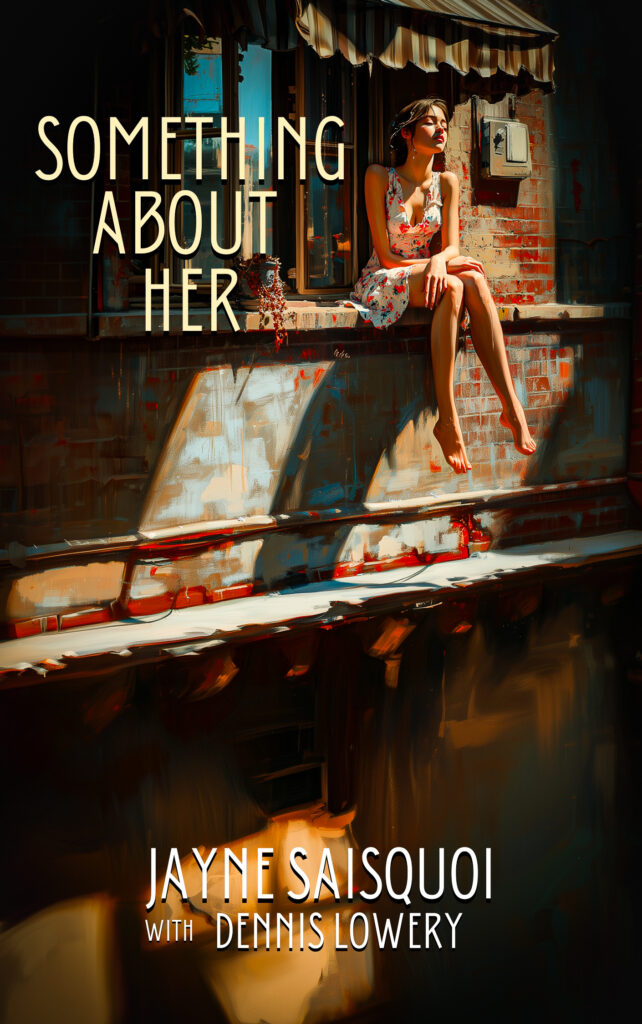
One of the things we do for our stories and for clients is to bring their cover(s) to life. Movement catches the eye and can stop the scroll. See the video below for some examples. Want to bring your cover to life… or want one designed for your book or story?
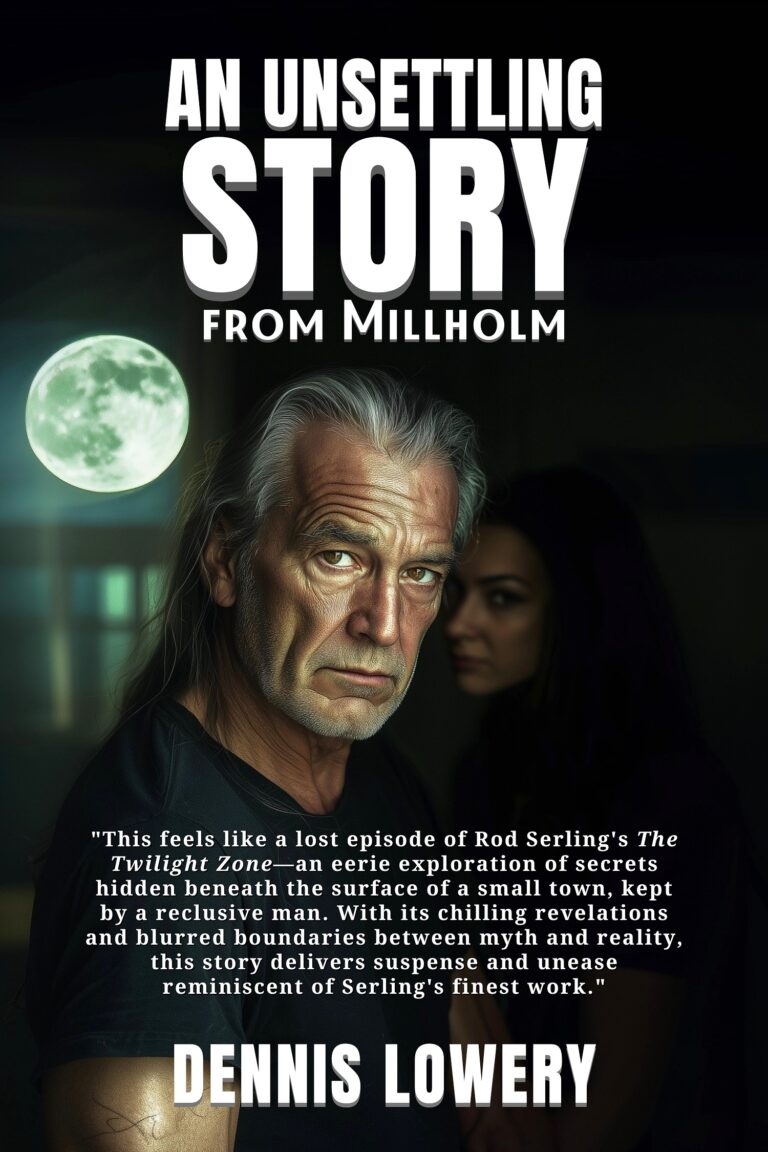
A young writer’s quest for small-town folklore takes a dark and unexpected turn when she encounters a reclusive veteran with chilling secrets that threaten to blur the lines between myth and reality.
“And what happens later that night… might be a judgment from God… or a jest of those older gods who men worshipped from the safety of stone circles on moonlit nights.” –Stephen King
In October 1975, freelance writer Rita Zook arrives in Millholm, Pennsylvania, to research local folklore for a story Her plans take an unexpected turn when she meets Tom, the manager of a local bookstore, who mistakenly assumes she is there to write about the 20th anniversary of the mysterious killings that took place on Halloween night in 1955.
Intrigued, Rita becomes curious when Tom tells her, “It was the best Halloween the town ever had.” Tom tells her Jack Harper, the reclusive owner of the bookstore, knows more about the killings than anyone in town. This leads Rita to seek an interview with Jack, a veteran who leads a quiet and solitary life, carrying the weight of his past.
What begins as a straightforward interview quickly becomes unsettling as Jack’s guarded revelations slowly unfold about the events of Halloween 1955. Jack speaks of corruption, fear, and the dark justice that fell upon the town, hinting at powerful, mysterious forces at play. Rita is increasingly drawn into Jack’s haunted memories, learning of his experiences during the war and the price he has paid ever since.
The story builds to a chilling climax where Rita must confront the shocking truths that Jack has revealed, leaving her—and the reader—grappling with the blurred lines between myth, legend, and a terrifying reality.
Intrigued? Here’s the story…
01
PROLOGUE
Eyes glowed like embers in the dark, a telltale sign the beast was near.
–Sabine Baring-Gould
October 1975 Millholm, Pennsylvania
Shit.
The old man stood at the mouth of the dead-end alley, his breath pluming in the October night. The stuttering ruddiness of streetlights cast ragged shadows over the damp concrete and a scene he’d rather not have seen. The night’s chill crept into aching joints, a stark reminder of past damage and aging’s clawed grip on his body. His left knee protested as he shifted his weight, and his right shoulder throbbed. Ghost of pains from old bullet wounds. Ghosts of choices, good and bad.
None of that mattered now.
Thanks for reading DENNIS LOWERY Stories, Vignettes & Story Art! Subscribe for free to receive new posts and support my work.
The woman was down; her muffled cries echoed off the brick walls. The brute towered over her, his laugh a harsh, hollow sound, his massive frame blocking any chance of escape. His blade caught a sliver of light, a gleam in the murk. He cruelly struck her again, a backhand that split her lip and sent her sprawling against a trio of garbage-men-abused trashcans.
The old man’s hands clenched into fists. He glanced up, his eyes seeking the moon hidden behind a veil of clouds. Once, its radiance would have birthed a strength within him—a power that tore through enemies like paper.
But those days were gone.
Now, he was just a man.
An old, battered man.
Shit.
He tugged the cord around his neck, drawing it from his shirt. He finger-traced the engraving—mouthing the old, now bitter words—on the back of the shield-shaped silver pendant and the circular tag attached to the same cord. Done, he tucked them back under his shirt.
Reluctantly—drawing a deep breath, shaking his head, shaggy gray hair veiling eyes flickering a lambent amber—he stepped into the alley. His heightened senses caught the sharp iron tang of blood, the acrid stench of fear. Something within stirred at the scent. “Let her go,” he called out despite his doubts, his voice steady though roughened by years of smoke and bourbon.
The thug turned, surprise flashing across his scarred face before twisting into an amused leer. “Walk away, old man,” he snarled, flashing the knife casually. “Or are you looking to get cut?”
The gray-maned man limped closer, a hitch to his gait that brought a sneer of contempt from the big man. “I’ve been cut before,” he rasped, his narrowed eyes tracking the knife while assessing the brute. The big man looked strong but sloppy—relying on force rather than skill.
“Suit yourself,” the tough snarled, lunging forward with a swift stab at the old man’s midsection.
Despite years of disuse, combat instincts triggered. He sidestepped the thrust, his movements economical, conserving energy, and trapped the thug’s wrist with his left hand, twisting sharply. The knife clattered on the concrete as pain lanced through his shoulder. He ignored it. Using the thug’s momentum, he delivered a precise elbow strike to the man’s jaw.
Blood splattered brick. The thug stumbled back, surprised, eyes tightening. He spat more blood. “You’ve got some fight in you.” He stooped to pick up the knife.
“You have no idea,” The old man growled, chest heaving.
The big man charged, slashing wildly. The old man parried forearm-to-forearm, the blade’s withdrawal slicing through his coat sleeve but missing flesh. He countered with a side kick to the man’s knee—his own protesting the movement. The thug staggered but recovered, swinging the knife in a wide arc.
Amateur. The old man ducked the slashing knife, the blade scything a lock of silver hair from his head. Capitalizing on his lower position, he delivered an upward palm strike to the man’s nose. A satisfying crunch signaled broken bone. The thug howled, reeling as blood streamed down his face.
Seizing the moment, the old man advanced. His right leg betrayed him—a half-second’s warning—knee locking and then buckling. The thug’s knife found his forearm, carving deep. Searing pain spread, and warm blood soaked his sleeve. His nostrils flared; he felt the beast surge against the silver restraint he wore; it stirred and grew warm—near hot—against his flesh.
“Not so quick now, are you?” the thug sneered, his voice nasally from the broken nose.
The old man gritted his teeth. The wound was superficial, but blood loss would weaken him. He needed to end this Goliath-fucking-Philistine. Drawing on remnants of old power–not supernatural strength, but the relentless determination that had seen him through combat before the change–he feinted left.
As the thug committed, the old man pivoted sharply, joints screaming. His bootheel crushed the man’s instep. In the same motion, his elbow found the brute’s throat. The knife dropped as meaty hands clutched for air.
The old man hooked his foot behind the thug’s leg and shoved hard. The brute toppled backward, skull meeting concrete with a dull crack.
Breathing heavily, the old man stood over him, watching for movement. The big man groaned and shifted as if to rise. Fucker. His precise drop-kick to the man’s head silenced him.
“Are you okay?” He turned to the woman, much younger than he. She clutched her side but managed a nod. “Let’s get you out of here.”
She looked up at him, tears streaking her face, eyes wide with fear and gratitude. “Thank you.”
The gray-haired old man offered his hand, helping her stand. “Just an old habit.” One I thought I’d broken, he muttered.
As they stepped from the alley onto the sidewalk, sirens wailed closer—someone must have heard her earlier screams and called it in. He gestured her toward the sound, waiting until she could walk steadily before he slipped back into the alley’s shadows. Gingerly, he slid his wounded arm from his jacket. He peeled back the blood-sodden shirtsleeve and wrapped his hankie around what would become another scar among many.
Carefully slipping his arm back into the jacket, he squinted up again, and acknowledgment curled his lips. The moon peeked from behind the clouds, casting a pale light over him.
Maybe the moon had helped after all.
The smile faded as a burning—different—pain shot through him. His right hand clutched his chest as his left arm reached for the wall he hoped was behind to catch him as he sagged backward.
Gasping, the old man leaned against the alley wall as his eyes flared with something more than pain and then dimmed to banked embers. He caught his breath as his eyes went from fiery amber to dull russet. Then—as they always did near the structure—they went to the theater across the street. The moon above The Corvinia—tonight, it was exactly as John had seen it and told him about back in ’43. Exactly.
It was why he’d stopped in Millholm back in 1946.
Why he’d stayed.
He stared at the theater’s vertical signage. His eyes climbed to where—on its backside—the maintenance platform wrapped three-quarters around with its steps down to the terrace atop the marquee. Daggers of early-winter ice draped from it like a broad mouthful of teeth. Twenty years ago, it was there that he had caught the moon for the second time.
John ‘Jack’ Thomas Harper shrugged, gritting his teeth at the old, familiar sting of a new wound. The icy wind bit deep, too. He settled his jacket around once muscular shoulders and arms that seemed to have shrunk overnight. He turned toward his apartment in the opposite direction the woman had gone.
Jack looked away from the sky but felt it as he had since a doomed night in October 1943. He muttered a quote from one of the books found then that he wished he’d never seen: “As the moon rose, so did the beast… casting aside the fragile shell of humanity. He prowls by night in the guise of a man, driven by a thirst for blood that cannot be quenched.” The author’s words… a harbinger of his fate. He thought the wind would carry away what he’d uttered, but it didn’t. Time hadn’t. Sometimes, once you speak words… they linger… and haunt. As he walked, his hunger climbed with the moon.
02
Two Days Later…
Steam fogged the bathroom mirror as Jack cleaned the straight razor his grandfather had left him and returned it to its worn leather case. Checking for any missed ‘five o’clock shadow,’ he splashed water on the remnants of lather, sluicing it into the runnels of his seamed face. After years with a beard, a complete shave was still novel. He took a towel from the rack. His gaze drifted past his reflection through the window to The Corvinia, looming over the intersection like a brooding sentinel. The theater had caught his eye that first day in ’46, causing a red DeSoto S-10 sedan to blare an angry horn as he’d stopped at the green light. He’d circled back, parked, and studied it properly.
The structure echoed New York’s Roxy Theater on West 50th, where he’d seen Lugosi’s Dracula premiere in ’31 with his grandfather. Same Baroque and Renaissance Revival style, with arched windows framed by intricate stonework. Carved glyphs, too weathered to read from street level, ringed the facade. Twin doors sprawled beneath a wide marquee while THE CORVINIA’s faded letters climbed the rectangular spire that pierced the sky.
Local gossip painted Steven Batory, the builder and former owner, as an eccentric who’d vanished in ’36. Some whispered about hard-faced foreigners who’d come seeking him that autumn. The theater had stood abandoned since. What use was such grandeur in a town where most folks preferred Shankweiler’s Drive-In’s cheap tickets and privacy.
Ten years of neglect showed in every crack, crumble, and faded finishing that first day. Yet he’d recognized it instantly from John’s description in ’43, a conversation about purpose after the war, shared 4,667 miles away. The theater’s forlorn beauty had made him stop. Made him stay. Made him buy it years later, compelled by his friend’s prescient words.
Now, in ’75, The Corvinia matched John’s portent perfectly. The angle of moonlight, the play of shadow, every detail exactly as described that night in Romania 32 years ago. It brought back memories of that damned vault they’d found back then, the books and relics they should have left sealed. The warnings they’d ignored, treating eldritch artifacts like props in their psychological warfare games.
He checked the time on his Bulova A-11 on the shelf above the sink. Needs must, he thought, interrupting his brooding. It was near time for that reporter from Pittsburgh, Rita Zook, who had visited his bookstore that morning looking for Halloween stories. She’d explained to Tom, his manager, that with the library closed by a fire, she hoped to collect written or even unwritten tales passed down by old-timers and housewives… research for her article.
Jack understood the urge to document the undocumented, though his journals would never see light. Who’d believe them? Tom had pestered him for a decade to share what filled those pages, what secrets lurked in the books he studied. Jack never had.
Maybe that’s why he’d agreed to this interview. Tom would appreciate him contributing to a story others could actually read. This time of year was always hard on the boy… man, Jack corrected himself. At 37, Tom was grown, though somehow still Jack’s responsibility since taking him in 20 years ago. They’d become an odd pair, like Lemmon and Matthau in that movie. Locals probably had theories, but none voiced them. Over the years, they’d developed a wariness of Jack instead. Some instinct warned them, those smarter than he’d given them credit for.
The mirror had cleared enough to show the erosion of years. Gray hair racing toward white framed a face carved by time and pain. Sometimes, what haunted those eyes frightened even him. No wonder he disturbed the townspeople.
Sharp hearing caught the preemptive knock, then the entry door to his apartment opened, and two sets of footsteps entered. Tom’s voice gave instructions–probably repeating Jack’s stipulation about meeting alone–then the sound of Tom leaving. Jack drew another deep breath as he studied his reflection one last time. Time to face the reporter.
Time to decide how much truth to tell.
* * *
“Your name’s Rita, huh? Like Rita Hayworth…” Jack entered his apartment’s sitting room, studying the young reporter–couldn’t be more than 25–as she circled the space. Moonlight spilled through open windows, catching dust motes that danced in the glow of the 1928 Emile-Jacques Ruhlmann Art Deco floor lamp beside his desk.
“Who?” She turned from examining his bookshelves, notebook clutched like a shield.
“Never mind. Hayworth’s before your time.” He moved into the arc of the floor lamp’s light, hoping it would draw her closer, away from darker corners. “Your surname’s Germanic… means ‘to search’ or ‘to seek.’”
“I didn’t know that.” Her eyes swept the room’s walls of books, professional curiosity evident in her expression. “Are you an academic?”
Jack snorted. “Hardly.” He tracked her movement toward the shelves, tensing as she approached the chest in the corner. Two feet of oak bound in iron, its carvings dulled by time, its patina dark as dried blood. Despite its weathered appearance, St. Cyprian’s Chest remained uncompromised, its purpose intact. “Don’t touch that.”
Rita straightened, turning instead to an eye-level shelf where dust-covered photographs sat: five men in uniform with two women and another showing three battle-worn soldiers, bandaged and hollow-eyed. White ink labeled them: Bad Jack, Lonely John, Curran… The Hoia Baciu. The man marked ‘Bad Jack’ could have been her host, decades younger. “You served… in World War Two?”
“I did….” Jack held up two fingers—Churchill-style—in a reverse peace symbol, the victory sign.
Jack almost smiled at her use of ETO… European Theater of Operations. It was how a veteran who’d served there would refer to it. “How long?” Jack knew from experience the difference in many men who served later in the war.
“He enlisted in January 1942… and retired three years ago with 30 years.”
“A long time to serve.” Jack nodded, remembering his 18 years of service, and moved closer to her.
“It was. I’m glad he was too old and senior for Vietnam.”
“That conflict was a mess. Not anything like my—and your father’s—war. Six months ago, that Saigon evac, Operation Frequent Wind, was a poignant success.
“Yes…” she agreed. “I’m glad it’s over.”
He watched her pick up a frayed patch depicting an angry soldier-beast gripping a dagger. Block letters spelled ‘THE FERRETS.’
“This was your unit?”
Jack nodded and stepped away, hoping she’d follow. Let the memories settle back into their dull ache. He wished he’d put away those photos of his OSS Team and of….
“Who’s she?”
Jack stopped and then turned back to the reporter… not wanting to. The 5 x 8 photograph she held was framed in bloodwood. Rita’s fingers had left marks in the dust on the frame, and where her finger had traced a circle on the glass around the woman’s face.
“What big eyes she has… she’s beautiful—”
Jack snatched Nyx’s photo from her hands. “She was.” Their eyes locked, and he saw unexpected understanding of his pain. “I took this the night I lost her.”
The image brought back Catrina–‘Nyx’–reading from Baring-Gould’s Book of Were-Wolfes: ‘It was not the bite that doomed them, but the curse carried in the blood that turned men into monsters.’ She’d mocked the author’s assumption only men could be werewolves and had wondered at the book’s inclusion in a vault containing far older, actually eldritch—some historically forbidden—knowledge. That same night, John had described The Corvinia precisely as it stood today.
“She looks like she’s wearing a uniform. Was she killed in the war?”
“No.” Jack returned the photograph to its shadows. “She disappeared.” Moving to his desk, he sat… pale moonlight from the window, a splash on his chest. “Let’s get this done.”
03
“I’ve never talked with a reporter before.” Jack leaned to his left, turned on the radio on the side table next to the desk, dialed the volume low, and then sat back and crossed his arms.
“Journalist,” Rita corrected, pulling her chair closer.
“What?”
“I’m a journalist… not a reporter.”
“Semantics. They’re the same.”
“Not to editors….” Rita opened her notebook. “I always have to check out bookstores, every place I go. When I couldn’t use the library, it seemed that it could be my only source for research. That’s how I got to talking with Tom. He told me you owned the bookstore and know about what he called ‘the best Halloween this town ever had.’”
“What newspaper do you work for?” Jack asked and watched Rita’s face twitch.
“I’m writing a story about small-town Halloween in Pennsylvania. Now, I have some questions—”
“You didn’t answer. What newspaper… or is it a magazine?” Jack saw the twitch again, the awkward reset of expression and shift of her posture.
“I’m freelance… but editors are interested.”
“If you write it first.”
“Yes.”
“If you write it well.” He watched her stiffen.
“I’m a good writer.”
“I’m sure you are.” Jack nodded. “Your idea, or an editor?”
“Mine.”
“Why? It’s a curious topic.”
“For a girl?” Her tone sharpened.
“Didn’t say that. I’ve known several strong women,” his gaze flicked to the shelf of shadowed photographs, “some more capable than most men. I supported Martha Griffiths and the ERA she reintroduced to Congress in 1971.”
“That’s great if they actually ratify the amendment.”
“Politicians… most of them suck.” Jack offered dryly. “Especially the men.”
“Yes. They do….” Rita reassessed the old man with the longish gray hair, dressed in what looked like freshly-pressed army surplus fatigues and spit-shined boots she’d wrongly prejudged. “Anyway, the story’s my idea.”
“Okay, but why?”
“I was born on Halloween… and it’s always been my kind of thing.”
“Three weeks from tonight’s your birthday?”
“Yeah,’ Rita raised her notebook. “Can we start now? I’m on a deadline.”
04
“So, what all did Tom tell you?”
“You’ve been here… in this town for nearly 30 years.”
Jack nodded and pulled a pack of Lucky Strikes from his pocket. The bullseye logo, a dull-red on white in the dim light. He dug deep in a pants pocket and brought up a clapped-out, black-crackle Zippo, an engraved near-effaced insignia on one side and a brief line of text and numbers on the other.
Rita pointed at it. “My Dad has one like that, but it’s not so….” She stopped.
“Beat up?” Jack’s fingers brushed the textured, non-reflecting, dented metal of the Zippo. Then rolled the lighter—like a magician rolling a quarter—from long-fingered knuckle to knuckle. He quickly grip-flick-snapped the lighter to ignite and raised to the cigarette he’d talked around in his mouth. “Yep… it’s been around.” The wick flamed, and he drew in a lungful of smoke, holding it a moment, then let plume out. “Smoke?” he offered her the pack.
“No. I’m trying to get my Dad to stop.”
“Good luck with that,” he nodded, prompting her to continue. “Go ahead, what else did Tom say?”
“That you came to Millholm in summer 1946… he said it was on his 8th birthday. July.
“Yeah. The 18th.”
“That he helped you unload 48 large, heavy boxes, most full of books, and you opened a bookstore,” she pointed a finger down… toward the street-level floor of the building, “in the storefront his foster mother rented to you… along with this room.” She paused, then continued. “He said some you unpacked had leather bindings with symbols engraved on the spine and covers. Not like any books he’d seen in the local library.”
“And what about me?” Jack asked.
Rita wondered who was interviewing who but answered him. “He said you were—are—a quiet man, a reader, and like to write. He said you keep a journal and write in it as you sit behind the counter of your bookstore, stopping only to help customers. When I was talking with him, a customer overheard and commented she sometimes saw you in the evenings and even later in ‘the deep dark of night’—her words—writing at your desk,” she pointed at it, “at the window… framed by the glow of a lamp.”
“You have a flair for language, very descriptive,” Jack replied, his eyes narrowing.
“I told you, I’m a good writer,” she remarked, then hesitated. In the quiet, she faintly heard the song on the radio—a new one she’d not heard much—and was surprised when the old man reached a long arm to turn it up.
“Yes. I thought you’d be all… Benny Goodman, Tommy Dorsey… big band or swing music. Stuff my Dad likes; you know, oldies. All AM radio… not FM. Not new music… not rock-and-roll.”
“A friend of mine, who told me about this town… well, not precisely the town… something he’d seen here but didn’t know the town by name. John loved music and had the finest memory of anyone I ever met; hear a song once, and he’d know it by heart. Too bad his singing sounded like someone killing geese.” Jack gestured at the radio. “He heard the song while here and returned singing the words to it and others. The first time I heard it was a few days ago, and I remembered John singing it. I have to catch it when I can… I’m learning the lyrics.”
“What… wait… you moved here in 1946, but a friend—who, before then, learned this song—told you about this town?” She blinked and began to think she might be talking with an old man going senile… or already gone.
“So, what else did Tom tell you that made you think I was the person in Millholm to interview?”
She let his ignoring her questions pass and her puzzlement with it. There was too much potential for some ‘Alice—Rita—going down the rabbit hole’ in what he’d just said, and she didn’t have time.
“Tom said that you wrote things down… and maybe you did—write—about the killings in 1955 on Halloween. He thought their 20th anniversary was what I came here to write about. But I’d never heard of those killings before.
“When he told me that, I asked if the library had copies of the old newspaper articles from the killings. I planned to read them, when I could, then Tom said, ‘I got ‘em right here.’ He took clippings from a bulging wallet. I read them, and then he told me that you probably know more about that night than anyone… maybe even more than what’s in the newspaper articles. Tom said though you never let anyone read what you write, I should talk to you.
“Tom kept remarking, without details, ‘It was a good Halloween… the best the town ever had’ when so many men died. Will you tell me about it?”
Jack studied her, noting her word choice… ‘will you’ not ‘can you.’ Had Tom known more than he thought and then talked more than he should? All his life’s pieces—the stories Jack had kept separate, private—seemed to demand weaving into one. He felt an urgency… and an urge even more potent than those he barely curbed. Could he control the memories pressing hard, forcing their way to the surface? He thought about Catrina’s—Nyx’s—photo from just a few minutes ago and about what happened two nights before… and over three decades ago during the war.
“I started writing it down,” the old man muttered, he thought to himself.
“About Halloween 1955?” Rita asked.
“No. 1943.” He reached for the pack and lighter again.
“Here… in this town… before you got here in 1946? What’s that got to do with 1955?”
Jack shook his shaggy head, wreathed in fresh smoke. “No. In Romania… in the war.”
Rita blinked, aware she’d done that a lot since entering this room. The old man seemed to have gone down his own rabbit hole. “What happened?”
“For years, I was too shit-worried to write it. Why bring it all up… that’s near-like reliving it. Didn’t think I could… And if I did, how much would be the truth? Could I be honest even to myself? Still, I finally sat down and picked up my pen. That first time, I felt a wet chill like I’d sat in ice water… nearly pissed myself. Turned so cold I got the shakes.”
“I mean, what happened in 1943?”
“That’s a story I’m still working on … and can’t tell… yet. Maybe I can—will—before I die. Leave it behind… if I stay dead.”
“What do you mean… if you stay dead!” Rita wondered again about the man’s stability… maybe she should….
The old man shook his head. Maybe it’s time… at least for the story she wants. “Doesn’t matter. I’ll tell you about here… in 1955. You’ll need to pardon my language.” He swiveled in his chair to ease it away from the desk and toward her. Jack began, “It was the best Halloween this town ever had,” as he rocked amid a haze of smoke in the shadows.
05
“In the Spring of 1955, a young woman, Anna, moved to town and worked at the diner across the street from the bookstore. Anna was pretty. I didn’t know at first—later on, she told me—she’d made the mistake of believing the lies of the older man who got her pregnant and abandoned her. Then, she had an illegal abortion and moved away from her hometown. Running from her past, hoping to make a future.
“But the Millholm gossips, suspicious at such a lovely young woman arriving with few belongings and not knowing anyone, began the rumor mill. So they went off about her. Their men were quiet, but their eyes were busy watching Anna.”
Rita’s pen scratched across paper.
“Soon, some—mostly younger men, what was called juvenile delinquents, JDs back then—did more than watch her. The bad seeds who’d been too young for the wars: World War Two and Korea… too young to ‘get in on the killing.’ Raised by some who had served and bragged about not just the killing but also the women… the easy screw in liberated towns… the women who let pig-men like them fuck them just to survive. Them and the men not hard enough for some Gotham, you know… a bigger city… that sought a smaller pond to be the big fish in. They had the run of the town.
“As had the gossips, they sussed out that the young woman, Anna, had gotten knocked-up—in their parlance—got a back-alley abortion and been run out of wherever she came from. She must be an easy lay, some men thought.”
Jack’s voice hardened. “I watched Anna harassed every day. I could see out the front of the bookstore right into the diner and evenings from my room window, but with less visibility because of the angle. I ate breakfast-lunch-dinner there and kept telling myself, Stay out of it, Jack… live quietly… don’t draw any attention. But watching that silent—suffering—tableau of Anna’s life gnawed at me. The women’s body language as she served them… the men’s side-eyed glances, head bobs, and pivots as she took their orders, brought their food, or passed their booth or table. I started calling them ‘the Botherers’ to myself… though that’s too light—innocuous—a label. Later, it proved that some of those men were done fantasizing… they wanted Anna to serve in other ways.”
“You have a flair for language… you could be a writer,” Rita said wryly.
“You got some smart-ass showing….” Jack squinted at her, then continued. “The now 17-year-old Tommy, not the sharpest pencil in the box but a good kid, was on the fringe of being one of the JDs.
“Frustrated from living at the whim of old Mrs. Kreider, who had taken him in during the war, she’d proved she’d done it for less than charitable kindness. Tommy was pretty much an indentured servant. Mrs. Kreider worked him hard.
“Anna and Tommy developed a ‘big sister – little brother’ relationship. Maybe he was sweet on her, too–she was pretty. They were young… only a few years apart. But they gave each other something they both needed. At any rate, Anna—and to a degree, I, too—steadied Tommy.
“Anyway, the Botherers soon grew serious, more hurtful… the looks and comments cast at Anna… became touching, groping hands when no decent folk were watching. Who’d believe complaints from a friendless girl with a past?
“Anna took it for a while; she didn’t want to create a scene—make things even harder—then she finally slapped a man. Carl Bender, the deputy sheriff in line to replace old do-nothing Albert Keller when he retired. The deputy outwardly seemed a good church-going man. But some knew that a façade.”
Jack swiveled and took a bottle from the back corner of the desk. About a third of the bottle of honey-amber liquid sloshed—a second’s moonlit backlighted reveal—and he pulled a coffee cup from a drawer. He poured, brim-filled, knocked it back… setting it down empty, and wiped lips with the back of a hand before he continued.
“One morning, Anna didn’t show up for work. I got worried and went looking. I found her. She’d been slapped around, punched… and I tended to her cuts and bruises. I asked her why she didn’t leave and go somewhere else. ‘Where would it be any different?’ she asked, crying on my shoulder. She told me to not get involved. Which is something I preferred. I did not want a battle to fight… I’d fought too many.
“Weeks passed. I could see her breaking… shoulders slumped, steps heavy, hair dulled. Then several men raped her. Tommy tried to stop them but got badly beaten. She wouldn’t go to the police–Carl Bender had been first man to—.”
He filled the cup again.
06
“I found out when I saw Tommy’s battered face. Anna begged me to let it go—or they’d do worse to her… to Tommy… and maybe to me.”
Jack stopped for a deep breath and a sip from the cup. “When I came to Millholm, I never thought I’d have to fight again. Never do IT again….”
“Do what” Rita waited through his silence, finally asking, “What happened to Anna?”
Jack’s face darkened, the lines deepening. “The morning of October 31, she was found dead. The police said she killed herself. I knew they lied.” His hands tightened into fists on his knees, the knuckles white. He raised the cup. No sip this time; he emptied it.
Rita watched the old man withdraw into himself again. She heard the radio DJ announce a song. It began, and, in a minute, she heard the old man whisper-sing along.
“Take away, take away my eyes… sometimes I’d rather be blind. And the night may pass me by… but I’ll never cry.”
She saw the glisten on his one cheek angled toward the light, his other in shadow. He fell silent once more.
* * *
Jack knew Rita was there, but all had become still—that suspension of the seconds and minutes when time does not move—as if you’re in Hell. Einstein, whose stolen, enigmatic, watch Jack had once held in a Nazi bunker in 1945, was right when he said: “When a man sits with a pretty girl for an hour, it seems like a minute. But let him sit on a hot stove for a minute, and it’s longer than any hour.”
His mind boiled with memories of what he’d done that darkest night.
He’d gotten the names of the men from Tommy, come to this room, and opened St. Cyprian’s Chest. Where he kept what he’d found in Romania, in an ancient manor—an abandoned Nazi SS facility—among its half-destroyed equipment, mostly burned documents and records, and a hidden repository of…. things he’d rather not remember. Where the walls whispered and cried… and shadows danced and threatened.
The chest contained several ancient-looking leather-bound books, an SS officer’s personal journal, and an old, oddly-marked mirror. He’d moved aside a gold bar—the last one—and removed one of the ancient books, the Nazi officer’s journal with the translations, and the Lupan Mirror. What he’d used on another fatal night in October of 1943 to save his OSS Team.
He remembered that nightmare aftermath of his one-time use of the mirror and incantation, the blood, and the chewed body parts strewn outside and within the ruined mansion. The following dawn, puking blood and gristle, surrounded by the shredded remnants of what had once been Nazi soldiers. But if what Nyx—who had revealed her secret, guided his use of the mirror, and helped him—had told him that night in the Hoia Baciu was true: If you didn’t dismember them, any wound would heal, and they would rise and become werebeasts themselves at the next full moon. The killing didn’t bother him—he’d never hesitated before—but it was the ‘how’ … the rank aftertaste that still came to him in the mornings, a spectral, preternatural sensory haunting from the past. It was that he woke knowing he now had a beast within him… that wanted out.
He’d kept the mirror, the old books, and the SS officer’s journal… thinking they shouldn’t pass into other hands. Along with $100,000 in a mix of Bearer Bonds, gold, and US currency found in a floor safe he’d cracked in the SS commandant’s office. He’d decided once the war was over—should he survive it—to find a peaceful town, and there he’d settle.
Nyx had warned him how using the mirror again would change… no… condemn him to an endless hunger. He’d sworn he never would… until that night when he knew he must. Needs must.
To avenge Anna, he ended the false peace he’d found. He had taken the mirror and journal, entered The Corvinia he had seceretly bought and restored the year before, reached the roof, and….
* * *
Jack looked up at Rita as the song ended. She blinked at him several times, her pen poised, motionless over her notebook as she waited.
“That night, Halloween 1955, a beast screamed at the moon atop The Corvinia theater, above the marquee—Showing Now: Rebel Without A Cause—scared the fuck out of everyone.” Jack leaned toward her, forearms on his knees.
“The next day, the men who had gang-raped Anna were found torn apart. The town’s first murder in years. The first-ever mass murder. The killer was never found.”
“The bad men that ran the town were killed….” Rita wrote quickly now. The pen flew across the paper.
Jack’s hand swept hair from his eyes as he straightened and leaned back. “That’s why some think it was the best Halloween this town ever had.”
“What about the later killings? Tom had clippings on them, too.”
Jack looked at her; he’d gone too far already… why not the rest of the way? He reached into the desk drawer and took out the mirror, needing to hold it, knowing the silver pendant caged the beast. “The morning after Halloween 1956, Paul Rau—the local dentist who some suspected fondled kids—was found dead, ripped to pieces like the men from the previous Halloween. The killer was never found.
“Each year—for the next 14 years, 15 counting the first in 1955—in Millholm and some of the surrounding small towns, a man or men were found torn to shreds the morning after Halloween. And information always came out during the homicide investigation about the men’s secrets; awful, terrible—some of them sadistic—things they’d done to others that some locals suspected, few talked about… and none ever said publicly.
“The killer never caught….” Jack glanced in the empty cup, started to reach for the bottle… then returned his hand, becoming a fist, to rest on a knee.
“And it became a legend that’s lasted years… it became a thing. Kids thought it a thing to do. They made a big deal out of scaring the shit out of people by dressing up like they imagined the killer to be, a beast that could rip grown men apart. Perverted, sick-fuck or mean-shit men that got what they had coming.” Jack’s voice tapered off.
“Then, five years ago, it stopped—so Tom told me. I wonder why.” Rita shook her head. “This town must be like any other… no shortage of bad men.”
Jack stared out the window, his eyes on the theater across the street. The Corvinia, its shadow stretching across the square, the marquee long dark; he’d shut the theater down after Anna’s death. He could still see it that night in 1955, the moon high, the wind howling, and him standing atop it. The mirror in his hands, catching the moon and the power coursing through him. Under his breath, he quoted words that still haunted: “As the moon rose, so did the beast… casting aside the fragile shell of humanity. He prowls by night in the guise of a man, driven by a thirst for blood that cannot be quenched.”
He leaned into the moonlight reflected from the old mirror in his now-taloned hand, his face in the mirror a snarl of age-stained fangs framed by patchy gray hair… and answered her.
“I got old…”
07
EPILOGUE
Though the werewolf may tear his way out of the grave, the mark of his curse never truly leaves him.
–Sabine Baring-Gould
New Year’s Eve 1975
Millholm, Pennsylvania
As she had driven to Millholm—with snow chains on her metallic orange Datsun 240Z—it was much slower this time because the roads were coated with icy sludge. Rita had thought of her last words to Jack that evening with him. She’d been unsure what to say and how to end the meeting, which had become much more than she had ever anticipated. Something no one would believe.
She’d looked at Jack, his figure framed by the dim light, and for a moment, she saw not just the old man but the man he had once been: the soldier, the avenger… the monster. “I hope you find peace,” she said finally, from the doorway as she left.
Jack had smiled a sad, tired smile. “Peace? There’s no peace for men like me. Only the waiting.”
So, it had ended.
So, she thought.
Then, two days ago, the letter came. Jack had something for her that she had to pick up in Millholm.
Now, she was there.
* * *
The door to the bookstore chimed softly, and Tom looked up from behind the counter. Rita entered, her face pale, her expression distant. She moved toward him, her eyes not quite meeting his, and she didn’t know why.
“He left you this…” he handed a package to her.
“Where’s Jack?”
“I don’t know… he got an international call last week and asked me to leave him alone after it. The next morning, he’d packed a bag, and I caught him as he was leaving. He told me he’d be in touch… if he still could.”
“You didn’t ask him where he was going and for how long?”
Tom gave her a flat—veiled—look and darted a hard glance at the package in her hands. “Jack was never much for answering questions; you got more out of him than he ever told me. He said once that was best… since I was closest to him. Still….” The bitterness in his voice was distinct, sharp. “Before he left, he said… ‘the evil’s crept back in… and it’s spreading… getting stronger.’”
“I’m sorry.” Rita apologized, but again, she didn’t know about what or why.
Tom nodded as if he understood what she didn’t. “I read your story.”
Rita felt her throat tightening. “He told me about Anna, what happened to her, and what happened afterward.”
Tom sighed, leaning against the counter. “I was just a kid then. I remember Jack leaving that night, his face changing… different. Like he wasn’t really Jack anymore. I heard the stories after. People whispered about the beast on the theater. But no one knew. Not even me, for sure.”
“But you thought it was Jack?
“Yes.”
Rita frowned. “Why didn’t you tell anyone?”
Tom shook his head. “Who would believe me? Besides, Jack… he did what he had to. He got revenge for Anna… and saved this town, whether anyone wants to admit it.”
Rita studied Tom’s face, his eyes clouded again. “Do you think it was worth it? What he did?” she asked.
Tom hesitated, then nodded slowly. “Yeah. I do. The men were bad people. The kind who would have kept hurting others if someone hadn’t stopped them. I know that sounds… monstrous. That’s the word, right? But sometimes, you need a monster to deal with the real monsters.”
Rita swallowed, her heart heavy. “Jack said there’s no peace for men like him. Do you think that’s true?”
Tom looked away, his gaze drifting to the old photographs now hanging on the wall. “Maybe. Maybe not. But I think, in his own way, Jack found something close to it here… for a while. He found a purpose. And maybe that’s enough.”
Rita nodded, the weight of the story settling on her. She turned to leave, pausing at the door. “Thank you, Tom. For everything.”
Tom gave her a small, wan smile. “Take care, Rita. You know, Jack told me once: ‘Some stories are meant to be told, but some truths are best left buried.’”
Rita stepped out into the frigid December air, the sky darkening as the sun dipped below the horizon.
Looking back at the bookstore, the shadows growing long, she wondered where Jack had gone. What other secrets did he bury deep? Would the package she carried reveal any of them?
She walked away, her footsteps echoing in the quiet, her mind filled with the haunting tale of a man who had become a monster to avenge an innocent’s death.
New Year’s Eve 1975
Vienna, Austria
Jack sat alone, the mirror resting on the table before him. The silver surface gleamed, reflecting the dim light of the lamp, the glyphs around its edges seeming to pulse with a life of their own.
The mirror wouldn’t let him go. It called to him, whispered to him in the dead of night, the voice soft and insistent. He reached out, his fingers brushing against the cold surface, tilting it toward him.
The room darkened, the shadows deepened, and the air grew heavy. Jack closed his eyes, the familiar pull drawing him in, the promise of power, vengeance, and something more. He opened them, his reflection staring back at him, but it wasn’t just his face he saw. It was something older, darker. Nietzsche’s abyss you stared into… staring back. The thing he had become that night in 1943 and on Halloweens from 1955 to ’70. The thing that dwelled… not-so-deep inside.
Jack pulled his hand away, the mirror’s surface rippling like water, the image fading. He leaned back, his breath coming in ragged gasps.
The mirror was a Faustian—Devil’s—bargain offering power… and some measure of healing even when not used fully.
It was what kept him going when a normal human would not have survived the wounds and injuries to him during the war and afterward.
But he wasn’t immortal. The inexorable grip of time had him as it did any human. He might live a long time… longer than most and grow much older. But while bearing all the infirmities age—and a hard life—brings. And the ever-present hunger … always the hunger within.
He must try to end that… or end himself.
The words from the book came to him, Nyx reading them as part of her warning: “Though the werewolf may tear his way out of the grave, the mark of his curse never truly leaves him.”
Tomorrow, he’d begin the 323-mile journey—a stealthy transit as he’d done in the war, into a controlled nation, what they now called a Denied Area for operatives—to meet someone who might help him… or end him. And only she’d know how to do it so he wouldn’t come back.
Because if he rose from the dead… it wouldn’t be him. Nothing human would remain… he’d be nothing but rage and appetite incarnate.
To force the issue, he’d given up the Blood Moon Amulet that—with the mirror—had kept him in check. He had only 29 days until the next full moon.
She must help him… the one person he’d longed for… for decades. The person he thought he’d never see again.
New Years Day 1976
Pittsburgh Pennsylvania
Fireworks had cascaded in the sky outside the night before, and Rita had ignored them and the heralding of the new year. Tired but unwilling to wait any longer, she had opened the package. Inside, she found an old military-style journal. On its flyleaf:
OPERATION: UNDEAD | Romania September 22 to November 11, 1943.
Beneath the journal was an envelope and inside a folded sheet of paper and a silver shield-shaped pendant on a silver chain. The front of the amulet bore the image of a moon with a wolf’s head superimposed upon it, its eyes made from glinting red garnets.
The shield-shape’s perimeter was an unbroken line of intricate engravings, symbols of some kind.
On the back, words in a language she didn’t recognize: ‘Lupii nu vor cunoaște sângele tău.’
Rita had fallen asleep after reading the note and some of the journal, which was difficult to read. Just before dawn, she’d drifted off, the journal splayed open on her chest.
She set it on her kitchenette table, poured coffee, and snugged her woolly robe tighter around her.
Her chill was not just from the icy draughts of air that poked through the loose-sashed old windows of her apartment. She picked up the note from Jack, which included what must be the translation of the pendant’s inscription:
Rita,
I read your piece, The Best Halloween The Town Ever Had, and appreciate how you turned it into ‘fiction’ without naming me.
I can’t leave this—what accompanies this note—with Tom; I’m not sure what he’d do with it. Anyone I had faith in for this… is long dead or disappeared. Still, maybe—I hope—you’re someone I can trust. So, I’m taking this chance.
Keep this journal and pendant for me until I ask for their return. Give it six months… and if you don’t hear from me… then what I’m trying to do has gone wrong. Take what I’ve written in the journal and make what you will of it. Or don’t.
But you must wear the silver shield pendant for protection. Wearing it, ‘The wolves shall not know your blood.’
–Jack
ENDNOTES
Stephen Batory was a 16th-century Prince of Transylvania and kin to the Blood Countess.
ABOUT The Chest of Saint Cyprian – (lore developed for the story):
The Chest of Saint Cyprian is said to be a medium-sized, intricately designed wooden chest, though its appearance reflects both Christian sacredness and the arcane powers it was built to contain. Here’s a detailed breakdown of its features:
Materials and Craftsmanship:
Wooden Base: The chest is made from dark, aged oak or possibly cedar, chosen for its durability and sacred qualities. Oak, in particular, was often associated with strength and protection in both Christian and pre-Christian traditions in Romania. The wood is polished but shows signs of ancient wear, hinting at its great age.
Iron Reinforcements: The chest is reinforced with iron bands at the edges, designed to strengthen and symbolize the binding of whatever power lies within. The iron bands are carved with arcane symbols and Christian crosses, blending Christian iconography and occult seals to ensure that no one opens the chest without the proper rites.
Hinges and Lock: The hinges and lock are made of black iron and are finely crafted with Byzantine-era embellishments. The lock itself is intricate, requiring a key imbued with ritual significance. It is said that Cyprian designed the lock, using Christian blessings and occult knowledge to ensure it remained sealed.
Size:
The chest is approximately 2 feet long, 1.5 feet in width, and 1 foot in height, making it portable but heavy, symbolizing the weight of the knowledge it contains. Its size suggests it was meant to hold books, manuscripts, and smaller artifacts or talismans.
Decorative Elements:
Crosses and Christian Motifs: The top and sides of the chest are carved with intricate Christian symbols. The lid has a large Byzantine cross surrounded by smaller crosses and icons of saints. These symbols were meant to sanctify the chest and prevent evil forces from escaping.
Runes and Arcane Symbols: Interwoven with the Christian imagery are occult symbols, possibly Coptic, Greek, or Dacian. These symbols are believed to have been used by Saint Cyprian in his sorcerer days before his conversion to Christianity. Some scholars suggest these runes are binding sigils designed to trap and suppress the dark forces within, blending Christian and pre-Christian traditions of magical containment.
Worn Appearance:
Over centuries, the chest has developed a weathered appearance. The once-bright carvings and iron bands are dulled over time, and the wood has developed a dark patina as if absorbing the power and mysticism of the objects inside. Despite its worn look, the chest remains sturdy, its purpose of containment unbroken.
ABOUT The Bathory Blood Moon Amulet (Amuleta Sangelui Lunii Bathory) – (lore developed for the story):
The amulet—pendant—Nyx (Catrina Mădălina Novac) gave Jack, October 31, 1943, in the Hoia Baciu, Romania:
The amulet is centuries old and passed down through generations of the Novac family. It is said to have been crafted by an ancestor who belonged to the Sisterhood of the Wolf (Soratia Lupului), a secret order of protectors and warriors with a deep knowledge of both werewolf lore and ancient magical rites.
The silver, a traditional bane to werewolves, is imbued with protective magic specific to Romania’s werewolf legends. This magic deters werewolves and makes the wearer invisible to their heightened senses, ensuring they cannot track or recognize them as prey.
Symbolism and Purpose:
The Wolf’s Head: In Romanian culture, the wolf is both feared and revered, symbolizing power, freedom, and wildness. However, in this context, the wolf’s head acts as a guardian, strengthening the wearer and serving as a defensive symbol against werewolves.
Silver: Silver has long been associated with warding off dark forces, so this amulet’s material enhances its protective qualities. Silver is traditionally linked to purity and the moon, aligning with werewolf mythology, where it acts as a force of purification against lycanthropy.
The Inscription: The Romanian phrase protects from being harmed by werewolves and implies they cannot recognize the wearer as one of their enemies. The phrase is a key to the amulet’s magic, meant to cloak the wearer from their instincts and aggression.
STORY TIE-INS
This story complements the larger prequel story, OPERATION: UNDEAD, coming in 2025. It is also a tie-in to a series of stories in our QUONDAM universe of ‘What Ifs?’
The camera used for the WW2 photographs in Jack’s room is the Leica from Through a Lens of Dark & Light that John Devel—toward the war’s end—wrongly gives to a combat photographer, who brings it home with him.
Einstein’s Watch is a future short story that centers on a fictitious timepiece invented/created by Albert Einstein with the unique ability to give its holder 24 hours back in time on a specific date.
There’s even a tiny tie-in to Little Red Riding Hood (did… or can you… spot it, Reader?).
This is a multi-year development project (some already in their second and third year of work) where several of the planned stories (below) will be completed in their entirety before any are released and published:
The fear of social media has killed more books than writer’s block.
Some people never become authors because they think social media is part of the job. That belief is understandable. It’s also wrong.
They imagine a future that demands constant posting, comfort on camera, and a public persona that feels forced. For some, this makes promoting a finished book feel exhausting before it begins. For others, it closes the door earlier. They never write the book at all.
That decision costs us books we never get to read.
“I’m not good-looking… What I have got is I have character in my face… Don’t take the lines out of my face. Leave them there.” —Humphrey Bogart
Bogart wasn’t rejecting attractiveness. He was rejecting erasure. The lines on his face were evidence: time, experience, consequence. He understood that smoothing them away wouldn’t make him more compelling. It would make him less.
For authors, the equivalent isn’t wrinkles. It’s substance. The temptation on social media is to sand down your thinking into something polished and frictionless, to sound approachable rather than actually be clear. Bogart’s instinct applies here: the rough edges, the specific details, the actual thinking. That’s where the value lives. Erase it, and you’ve erased the reason anyone should pay attention.
The Core Misunderstanding
Many writers, published and aspiring, assume social media is a performance space. Be visible. Be engaging. Be likable. Be “on.”
That expectation alone is enough to drive people away.
But social media isn’t a stage unless you choose to treat it like one. At its most basic, it’s a distribution system. It moves ideas, excerpts, questions, and observations from one mind to another. Seen that way, it resembles publishing more than promotion.
The Attention Economy, and What Actually Wins
All communication involves cost. Attractiveness (visual polish and confident delivery) can lower the cost of initial attention. It earns a glance. This is real, and pretending otherwise is naive.
But a glance isn’t trust. And books are sold on trust.
Authority (demonstrated knowledge, clear thinking, evidence that you’ve done the work) lowers a different cost: the cost of trust. The cost of believing you’re worth a reader’s time, money, and attention over 300 pages.
Platforms track both. They notice when someone stops scrolling. But they also notice when someone stays, returns, or shares what they found. Those signals track clarity and usefulness far more than surface polish.
Authors can use this. Polished, shallow content wins initial clicks but rarely builds the kind of following that translates to book sales. The algorithm rewards attention; readers reward substance. For authors, those two things can align.
If you’re an introvert who dreads the performance, this is the part that matters: depth beats flash. Your discomfort with self-promotion isn’t a handicap. It’s a signal. You’re measuring the wrong thing.
Making Thinking Visible
Authors who use social media well do one thing: they make their thinking visible.
That can mean explaining an idea from a chapter, sharing research that didn’t fit, reading a short passage, or answering a real reader question. None of this requires a persona. All of it builds familiarity and trust.
A novelist posts a thread about why she cut her favorite chapter. A biographer shares a primary source that changed his understanding of his subject. A memoirist reads two paragraphs about her father and says nothing else. These aren’t performances. They’re the work itself, shared in pieces. Readers stay because they’re seeing something real.
The same depth that makes authors uncomfortable with quick, performative content is exactly what stands out in a feed full of noise. What feels like a disadvantage is actually the point.
You don’t need to be entertaining. You need to be useful. You don’t need to project confidence. You need to demonstrate competence. Authors already know how to do this, just in a different medium.
The production bar is lower than you think. Clear audio, readable text, calm framing. A historian reading three paragraphs from her book in front of a bookshelf, no editing, no B-roll, is more compelling than a polished video with nothing to say. The goal is to get out of the way of your own thinking, not to create a glossy surface. Think of it as copyediting for video: you’re not trying to impress anyone; you’re trying not to distract them.
Final Thought
Bogart kept the lines because they were evidence: a life actually lived, not a surface carefully maintained. Authors should do the same with their work.
Show the thinking. Keep the specificity. Let the rough edges prove you’ve actually been somewhere. Done things.
Yes, I’m aware of the irony: a post advising against performance is still a performance. But this isn’t a pose—it’s just thinking, made visible.
You don’t need to be an influencer to reach readers. You just need to write and let them see you doing it.
About Us
Adducent, founded July 5, 2000, is a story and book development firm based in Jacksonville, Florida. Founder and Creative Director Dennis Lowery is a U.S. Navy veteran who spent the 1990s in aerospace manufacturing and more than eight years in business consulting with M&A attorneys and investment bankers before the company shifted its focus to writing and publishing in 2009.
Adducent has published 114 titles under its imprints — FORTIS (nonfiction and memoir), BOOKNOLOGY (business and educational nonfiction), ESCRIRE (fiction), and STANDFAST, established in 2026 for titles from the special-operations and intelligence communities. Every one was developed, edited, and produced under Dennis Lowery’s direct editorial direction. Fourteen arrived as standard nonfiction and were rebuilt as creative nonfiction.
Distribution is global print-on-demand through Ingram, a network that, by Ingram’s account, reaches 50% of the world’s population. Clients own all rights to their work. Dennis, who also ghostwrites for clients and other publishers, is a member of the Authors Guild, the United States’ oldest and largest professional organization for writers.
One of our writing series is EVERY PICTURE TELLS A STORY, where we use a photo or a picture as a prompt and create an original story (for our publication or clients). Our abundant imagination and wordcraft have given readers scenes, settings, and characters they can visualize as they read. Don’t take our word for it. Our website’s Reader & Client Comments page has over 39,000 words of feedback. You’ll find dozens of reader observations that say they could see the story unfold like a movie. Their senses came alive as they read. That writing skill helps us create artwork to enhance our original stories. This capability is also available to our clients for their projects. Want a free test?
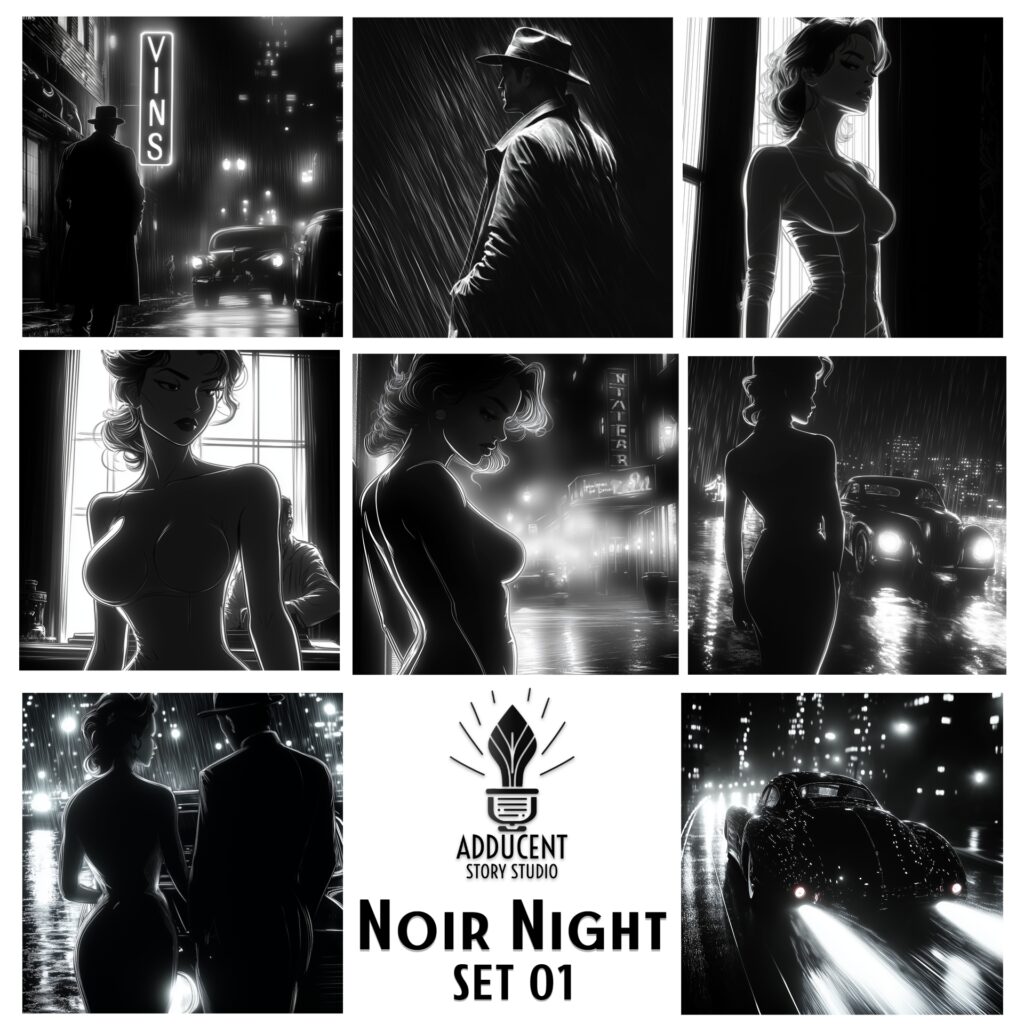
Following is an initial gallery. While these first images are primarily intended for fiction, we’re developing imagery that complements nonfiction and will add it to our portfolio.
STORY ART Set 06 from Adducent Creative – 1NEW GHOSTWRITING PROJECT (Medical-Legal Suspense) Adducent Creative (Instagram Post) – 1Upcoming TitleService Brand Image AssetService Brand Image AssetStory Location [WYCHAVEN] Town LogoHOLIDAY STORY ART Set 01 from Adducent Creative – 1
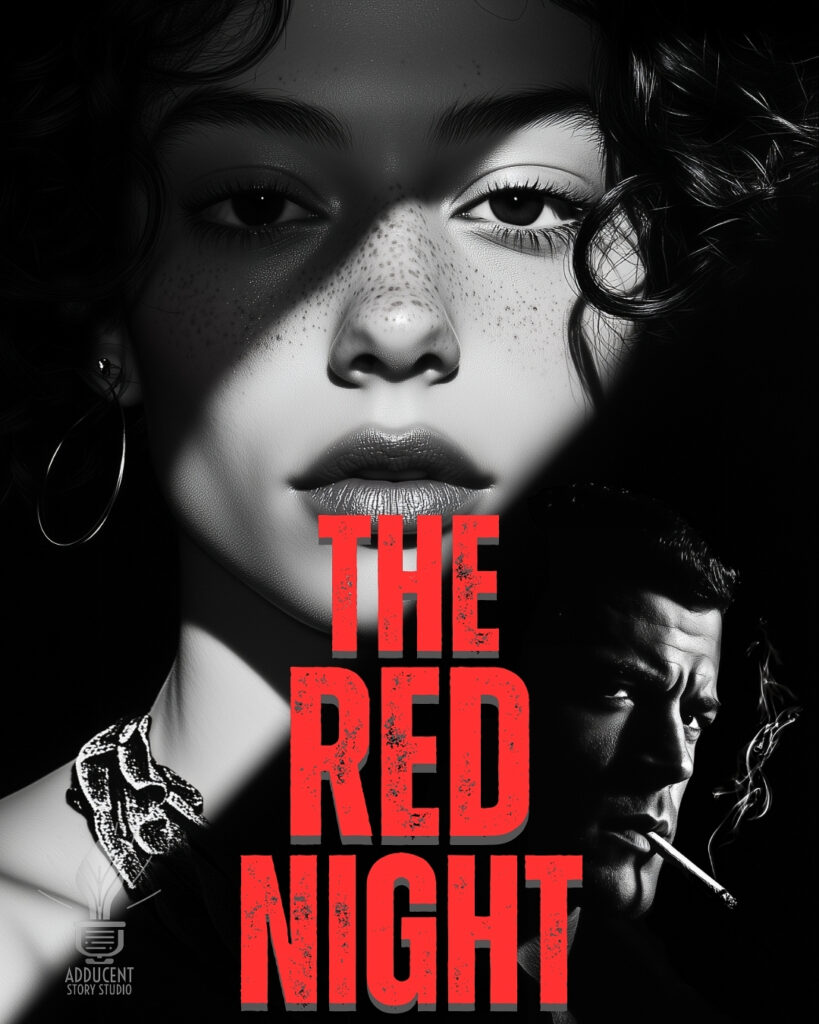
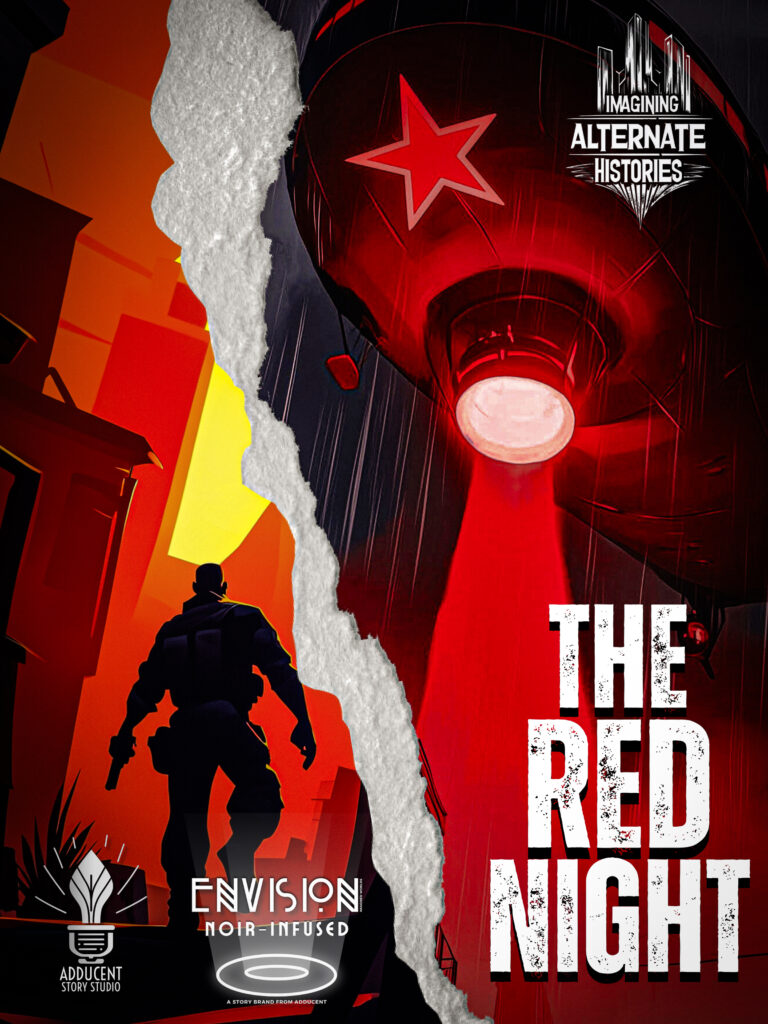
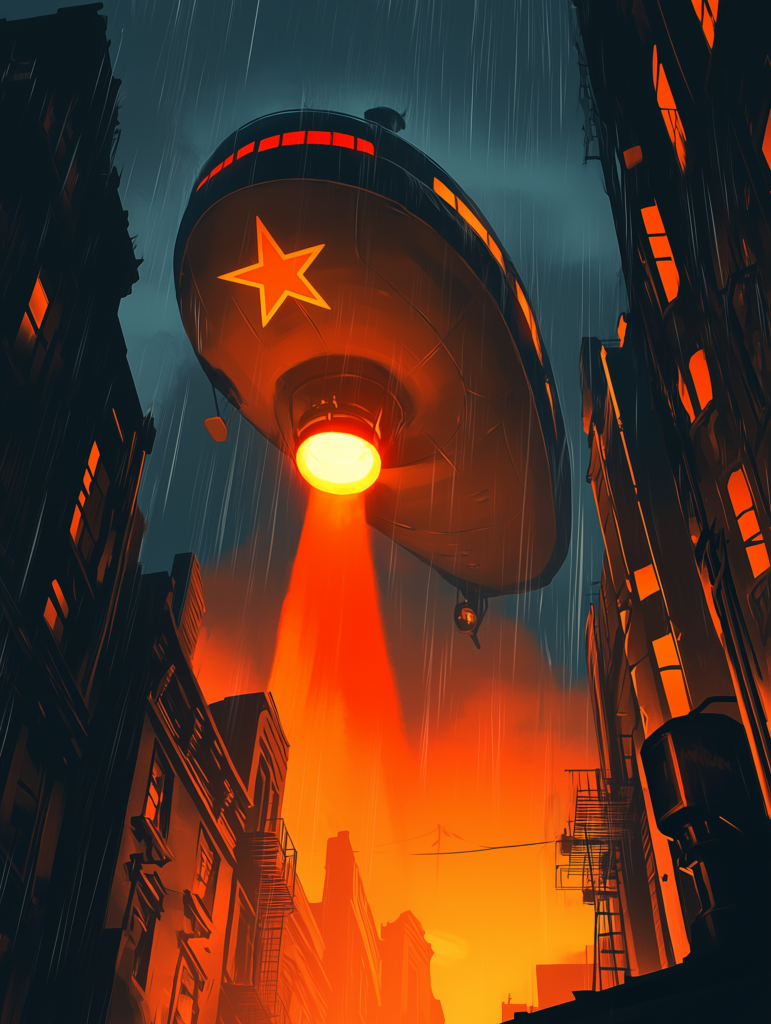
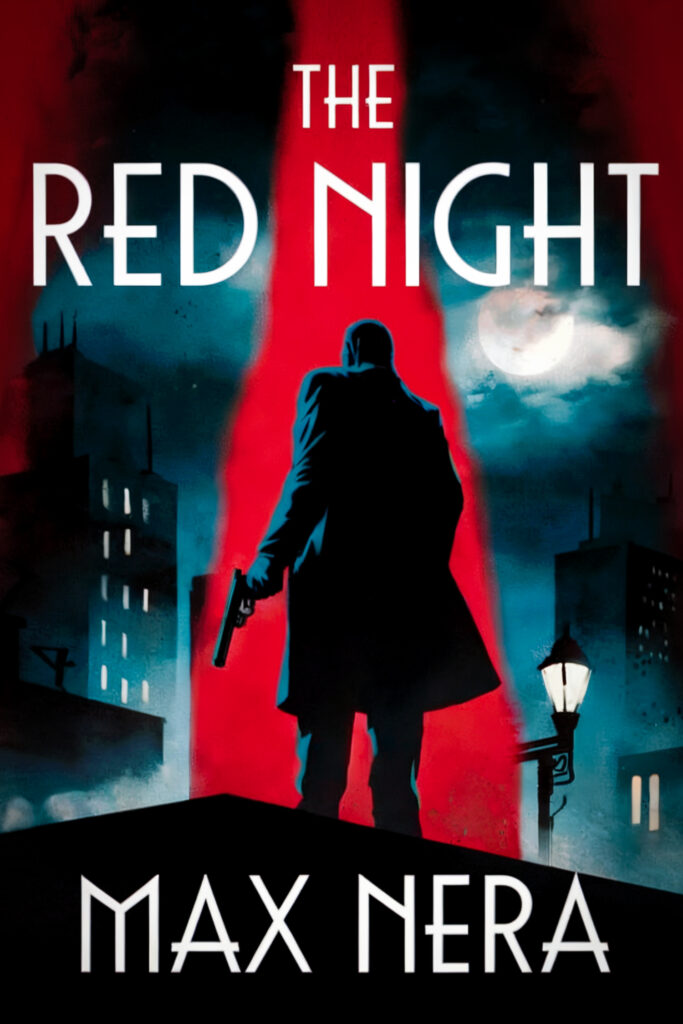
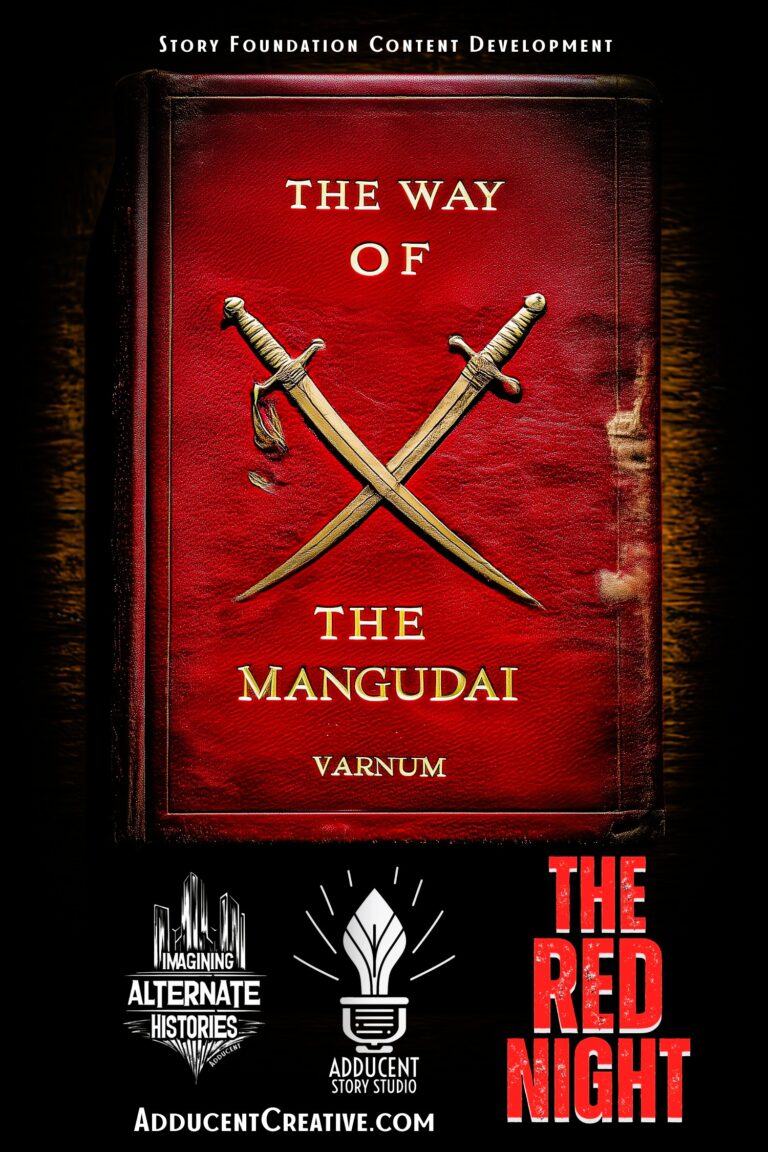
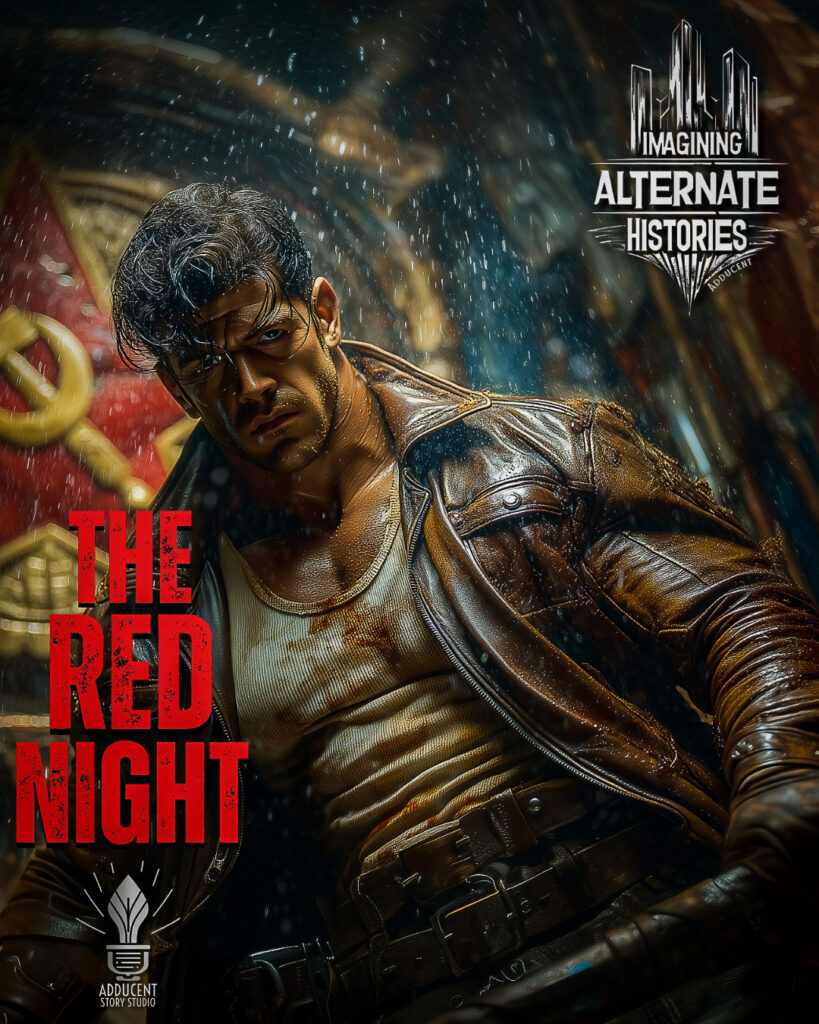
Worldbuilding is an essential aspect of story development, and we use a disciplined approach to our stories and the work we do for clients. We draw on historical documents, reports, information, and cultural research to fashion background, settings, and foundational lore that fit our work. And this foundational piece—a fictitious book we’re creating—perfectly fits THE RED NIGHT, one of our stories in development.
We’ve taken what’s known of the historical Mangudai, the practices, and principles, and used them as the basis of a fictitious 1930s-era book read by a young U.S. soldier and OSS officer in 1945 in our story in development, THE RED NIGHT. The soldier is an avid reader and lover of history and found the book in an obscure, dusty, decrepit used bookstore in London.
A powerful and thematically rich narrative device, The Way of The Mangudai principles of adaptation, endurance, strength, and mobility of mind and body become a profound metaphor for John Devel’s—THE RED NIGHT’s protagonist’s—transformation. We’ve created a detailed breakdown of this fictitious 1930s-era book to develop how it shapes John Devel’s mindset and tactics in THE RED NIGHT and how it threads through his journey from a wounded combat veteran to confronting a distorted postwar reality. —Dennis Lowery
What follows comes from the first stages of our worldbuilding (subject to further refinement).
Here’s the fictitious book blurb for:
THE WAY OF THE MANGUDAI A Treatise On A Warrior’s Mind And Movement
Colonel Aldric W. Varnum, D.S.O., O.B.E. (RET.), Late Of Her Majesty’s 4th Hussars Privately Printed For The Author ARDENT HOUSE, GLASGOW, 1931 ALL RIGHTS RESERVED
“True strength is not in the hand that strikes first, but in the will that endures—this is the path of the unyielding.”
The Way of The Mangudai is a powerful treatise on resilience and the indomitable will to win—drawn from the battlefield traditions of the Mongol Empire’s most obscure warriors. Written in 1931 by decorated British officer Colonel Aldric W. Varnum, this timeless work explores the tactical brilliance of the Mangudai, elite cavalry who specialized in outwitting larger, more powerful forces through maneuver, deception, and sheer endurance.
But this is more than a study of ancient warfare—it’s a guide for those who have been wounded, outnumbered, or underestimated. Varnum distills centuries of hard-won battlefield insight into strategies for prevailing not with brute force but through adaptability, precision, and resolve.
Whether facing an army or the aftermath of personal loss, The Way of the Mangudai shows how the greatest victories are earned not by those who appear strongest—but by those who can endure and adapt.
For leaders, soldiers, strategists, and survivors… this is the art of turning adversity into advantage and setback into supremacy.
A Contemporary Overview
Conceptual Adoption: ‘Mangudai’ as Training Terminology (1980s–Present)
Origin of the Term’s Use in U.S. Training:
The first appearance of Mangudai in U.S. military culture came not as a combat unit but as a leadership development exercise, originating within elite units, particularly in the U.S. Army’s Special Operations Forces. ‘Mangudai Exercises’ were designed to push officers and NCOs emotionally, intellectually, and physically beyond their limits in scenarios simulating battlefield chaos and ambiguity.
The first documented uses were in the 82nd Airborne, Special Forces Groups, and Ranger units, where senior leaders devised multi-day, nonstop tactical simulations intended to exhaust and disorient participants, forcing them to adapt, make rapid decisions, and function while depleted.
The Mangudai Legacy in American Military Thought:
While the original Mongol Mangudai were warriors of the steppes, their principles found a second life in the 20th and 21st-century United States military not through direct emulation but through ideological inheritance:
• Mobility over mass. • Mental agility over brute strength. • Disruption over confrontation. • Leadership under stress.
In American use, the Mangudai has become more than a training label—it is a symbolic rite of passage for those seeking to prove their mettle and ability to lead under extreme adversity.
Nine Hungry Souls | One Way Out | One Reason To Stay
“A captivating tale that blends elements of horror, romance, and folklore. It delves into themes of immortality, morality, and the power of connection amidst darkness. Lowery’s descriptive writing style and the story’s intriguing premise make it a compelling read.”
SOME READER COMMENTS
“Fantastic story. Kind of in the O. Henry vein.” –Jim Zumwalt
“Wow! A spooky but awesome provenance…” –Fay Handstock, Great Britain
“As with all of your stories, once I started reading it, I couldn’t put it down til I finished.” –Regina Castleberry
“Well that story just gave me a lovely chill up the back of my neck. Perfect.” –Dan Syes
“If you haven’t read it, here’s another great story. I love it.” –Sarah Odendahl
“Like an unpardonable sin your words read so sweet. I like this very much; Very nicely written.” –Michael Koontz, Sweden
“Fantastic!!!! Love it. Really good and the chills went all the way to me in Norway.” –Sylvia Sotuyo
“This definitely was felt in Colorado, too. Intriguing and intense.” –Margie Casados
THE STORY…
Approaching from the sea, you witness traces of history in the fragments of carved stone and columns in 14th-century sandstone. Double lancet windows hint at a renaissance style, and other decorations adorn the crumbling portals of palaces once belonging to ruling families and princes.
It is a land of ancient city-states, morto e sepolto… the dead and gone. Remnants of forgotten and abandoned houses and estates sprinkle the countryside. Once thriving and vital, now no one lives in them, and the keening of the winds through the ruins is their only sound. Even in towns and cities that live, in almost all, there is a legend sometimes distorted far from its origin of a casa stregata… a haunted house. Some are deathly still, lonely cenotaphs, mere empty markers of a tragic past. Others contain souls that sleep awhile and awake… hungry.
Anime maledette bruciano… eppure non emettono luce. Una canzone di fiamme danzanti… la loro musica geme nel vento. Ascolta i lamenti dalle donne dei dolori. Le signore del dolore…
Cursed souls burn…
yet shed no light.
A song of dancing flames…
their music moans on the wind.
Listen to the cries
from the women of the sorrows.
The ladies of the pain…
~ ~ ~
The ship cleared Portovenere, entered the gulf’s head, and approached Spèza, a small city on the Ligurian coast. Within two hours, its sailors invaded the town in clusters of two, three, or more. But one man, Jack, went alone; it was his way. He didn’t need companions and was used to being on his own; he had been for most of his life.
* * *
“They follow the ships.” The voice came from farther back in the shadows at the leaf-laden trees’ fringe where light ended and pitch-dark began.
“Excuse me?”
“You know,” the voice paused as the clouds in the night sky scudded to the north, disclosing a brilliant moon riding high above. In its light, a woman’s pale arm extended a long-fingered hand that pointed behind me. I turned toward several young men, my shipmates, who were surrounded and outnumbered by women at the outdoor bar under the street lights. “Those women,” the voice paused again, continued, “follow the ships.” The hand made a dismissive gesture and drew back into the dark of the moon’s shadow.
“Is that bad?” I asked, wondering how she’d sat so near without me noticing. A face came out of the darkness, like clouds parting to reveal a half-moon in a starless sky. Lovely. An almond-shaped eye under a sculpted brow, long lashes, and sharp lines of cheek and nose down to what must be a set of sweet lips.
“They’re not local.” The lips were a dark plum color in the dim light. Behind them, the pearl-glint edge of teeth. “They are not local,” she repeated as if an unpardonable sin, “they go from port to port.”
As she leaned forward, shifting in the chair, her face came into the light from the streetlamp. For that moment, she seemed plain, not unpleasant, but not beautiful. She sat back, and again only the moonlight graced her. That quick change in posture had revealed more. A blouse cut square and low in front. The fullness of breasts caught moonbeams and trapped them in the cleft between. They drew my eyes like the headlights of an oncoming car you knew had come over into your lane. My heart trip-hammered a double thump. Blinking away that second of fear and uncertainty, I thought she was exquisite. The woman you dream of or read about in stories and legends… who caused men to fight and die. Her eyes pored over me as she sat in the pale wash of a now clear full-moon-bright night. Stirred, my gaze moved to her lips and lingered. I wanted them on mine more than I needed my next breath. “You speak English well. Where did you learn?”
“During the war… we all did.”
I wasn’t clear on what that meant. What war… and what did she mean by we? Basics first, though. “What’s your name?”
“Nerezza.” I expected her to ask mine, but she said, “The night is sublime.” She gazed up at a moon that reflected in her eyes. “This,” and she flicked her hand toward the people at the bar and widened the gesture to encompass the streetlights, “is not the place to enjoy it.” She leaned forward, and her deep breath brought the arc of heavy breasts and crevice of cleavage into view. Her tongue swept those lips—eyes closed, she shivered—and their sheen beckoned. She sighed, “Will you come with me?” She stood, and the breeze strengthened, flattening her long, thin skirt against muscular calves and thighs; the swell of hips and curve of her ass distinct as she turned.
“Where?”
“A place,” she motioned toward the foothills to the north and east. Too dark to view now, but I’d seen them earlier on my ride. “About thirty kilometers from here.”
“Do you have a car?”
The glimmer again behind those lips. “No,” Nerezza smiled, “I travel differently.” She stepped away from the table and the lights. “You have this… yes?” she pointed to the Vespa P100 parked under a tree near us, which I’d rented after leaving my ship. At my nod, she walked over, pulled up her skirt with a flash of white thighs, and straddled it. Her legs extended, thigh muscles taut, to balance off its kickstand. I followed their lines from the ground to where they were palest under the moonlight. My eyes went to her chest—offered respects—and passed over those lips to her eyes. She locked on mine as she ran a hand over what I’d reviewed, following the same path my eyes had traveled. “Shall we go?”
I mounted in front, and her thighs clenched my hips. Her arms were around me, her breasts flattened on my back, and her hands splayed across my chest. The points of her fingernails dug through my shirt, and a primal scent came from her as I kicked the Vespa to life. Intended for city driving, the scooter would only do about 45kph, maybe less carrying two. We had a ride ahead of us, but I had time.
* * *
Nerezza’s directions brought us to where the hills grew into mountains. The Vespa’s feeble headlight shone through a gate onto a three-story structure several decades, if not a hundred years old. Cracks and creepers—thick twists of vines—ran up the sides of crumbling walls and overgrew the balconies. I shifted to ask her, “Is this it?” I doubted. She reached around me and turned the motor off, the headlight with it. My eyes adjusted to the dark. Different in the moon’s light, the old estate still seemed poorly maintained but wasn’t the ruin it had appeared at first. At the entry to the courtyard, she took a key from her pocket. She reached through the bars and turned the largest padlock I had ever seen around to face her. With a twist and click, she swung the rusted wrought-iron gate open.
“Here,” she signaled me to wheel the Vespa into the courtyard, holding the key, planning to lock up again once we were inside.
I eyed the wall and knew I could get over it. “I’ll leave it outside,” and pulled a coiled steel cable with two eye connectors and lock from one of the side pouches to secure the Vespa to the tree closest to the gate. “I don’t like having my ride where I can’t get going when I need to.”
Something flashed in her eyes: anger, derision, I wasn’t sure which. It vanished like that first glimpse of the house. So fast, I wasn’t sure it had happened. I walked through the gate and scanned the area and the enormous house. “What is this place?” I asked her as she locked it again.
“It’s been in my family for generations.” There was pride in her voice and something else, something unsaid. “My sisters, we… and others work and live here. Inside,” she nodded at the house, “it will be darker than you are used to. We use candles and oil lamps. It’s so much more… enchanting.” We walked on broken flagstones past beds of withered stalks and weeds. At a large circular fountain, she stopped and sat.
“Sit for a moment,” she patted the stone rim that encircled a basin with a surprising amount of water still within. Though the surface was covered with scum moss and bits of floating wood, the clear areas reflected the full moon. She turned her delicate face up. “I have something for you,” she said. Empty, long-nailed hands rested in her lap, then stroked her inner thighs.
I didn’t ask what; didn’t speak as I watched, and wanted to replace her fingers with mine. Something was going to happen; I knew it from that moment at the outdoor café. My skin burned and then chilled as she reached up and placed her hand high on my leg.
“Sit.”
As I did, the moon brightened. I could tell by her face alight with its beams. It drank in the rays as she smiled into them. The lips I’d seen as crisp red under streetlight were dark-rimmed now. Fangs grew in the moonlight, and her grip tightened on my thigh. She leaned to nuzzle at my neck, her voice muffled, “We have so much pleasure to bring you… once the pain is done.” Teeth sank into my neck, and the quickening of an orgasm began and soured in exquisite agony, and then… came darkness.
* * *
I shuddered and raised my watch; thirty minutes had passed. Still seated on the edge of the fountain, I touched my neck and felt the stickiness of drying blood. That did not bother me, but the piercing ache did. She had drawn something vital from me. I couldn’t hold my thoughts, couldn’t concentrate.
Nerezza took my bloody hand and said, “Come with me.” I followed. We entered the house. Just as she’d described, light danced from lanterns hung from the ceiling. As she took me through the foyer, circles of light-to-dark-to-light were everywhere. Music played, some classical piece, and there were voices. Entering a large room to the right, eight women lounged in a sitting room or parlor. Each, but one, was radiant and voluptuous, with long lustrous hair that ran from blonde to dark red to a thick ebony mass of hair on three, including Nerezza, next to me. A pale lady in a maroon gown off to one side also had dark hair but was a slighter build. Leaner with smaller breasts; apples compared to melons. But the stems, like the other ladies, were erect and prominent beneath thin, gauze-like dresses that covered them from shoulder to ankle.
“My sisters, Malvola,” she pointed to the largest of them, as big as me, with an intense, feral look about her. “And Chiara,” the smallest and seemingly youngest, nothing like her sisters except for the dark hair. And in bearing, nothing like the others in the room.
I sensed hunger emanate from them with their smiles of sharp teeth and red-tinged eyes full of rage or sorrow, tears unshed or that had cried too many. Chiara’s look was of abject loneliness. The kind I recognized buried deep inside even when you’re surrounded by others.
“In my room,” Nerezza pulled me toward the stairs, “we can be alone.” Her dark-wine lips twitched, showing that thin line of sharp teeth gleaming with a light of their own. “Away from the others.”
The stairs moaned with each step higher. A tall, clear window rose to the third floor at the turn and landing to go further up. The moon poured through, washing us with its pale beams. Smiling at me, Nerezza paused on the landing and pirouetted as if showering under the watery rays. She was the most alluring woman I had ever seen. I shivered.
Upstairs, the hallway was open to the floors below on one side but bound by a balustrade. I stared down at what appeared to be a small ballroom. At an even level, hanging from the high ceiling, there were three huge lanterns surrounded by six smaller ones. Each glowed with a golden lambent light of reddish tint. Six doors lined the side opposite the railing. At the end was a broad set of closed doors. Nerezza led me there and swung them open.
Inside the room was a central sitting area, lighted by clusters of candles on tables and sideboards, leather chairs, and a sofa facing a bank of windows. A set of French doors led onto a balcony that spanned the room. Stepping further in, the balcony overlooked a walled garden grown wild that had broken out and crept up the slope of the looming mountainside. Its thickets of tangled brambles resembled balls of barbed wire and concertina. A large bedroom was to the right of the sitting area; on the left were two smaller bedrooms. The room on the left, the inside one away from the outer balcony, had a massive dark wood door with thick metal hinges and a curious bar and lock arrangement on the outside. Walking over, I noticed it was ajar. Opening inside, I found gouges and rips in the wood. Stepping in, I ran my hands over them, feeling how ragged and deep they were, though they were still far from penetrating such a thick door. The metal bands that ran throughout the wood to strengthen it were also scratched and scored. Down at the bottom of the door were many smaller, shallower marks. Long scratches in the terrazzo floor and parallel grooves led from the door’s base to the massive bed in the corner.
Nerezza touched my neck, stroking it as she would a pet. “Malvola’s,” she said, leading me out and shutting the door. She passed the next door, the room closest to the balcony, without comment.
“Whose room is this?”
Her voice had the same disdain she’d used at the café. “Chiara’s.” On a table against the wall was an array of dusty bottles. “Cognac?” she asked me. My head was spinning; I should get out… run, but looking at her, I had no will to run away. She handed me a snifter with three fingers of amber liquid. With an odd compulsion, I made a gesture to offer the lady a drink first. Her smile broadened and showed the length and points of the teeth I’d felt earlier. “I do not drink… spirits.”
Without drinking, I set the glass on the table as Nerezza did something at her waist, and the skirt fell away. The moonlight from the window and the flickering candles played on alabaster skin. It defined the cords of muscle in her thighs and calves as she moved toward me. Slowly she unbuttoned her blouse, a curtain withdrawing from an elusive treasure. Recondite… then revealed before you. The sheer bra strained—straps dug into the flesh of her shoulders—and dark nipples stiffened. She moved closer and brushed against me. My hands twitched, left wanting, as she stepped away. In lace and flickering shadows, she crossed to the largest bedroom. I followed.
In the room there were fewer candles. Her face shrouded by the fall of raven hair that draped her shoulders, the smooth expanse of her chest a field to plant kisses. Two prominent dusky-tea-rose crested hills, and from the valley between—a teasing fragrance when she had been so close—a subtle perfume that wafted on the gentle wind from an open window that caressed our skin. Her hands cupped and offered soft round flesh to taste as she removed the last bits of cloth covering what I ached to bury myself in. Something drew me to look through the window at the sky. The scent of the moon’s beams, splendid in radiance, she, too, was exquisite in the night. Moonglow poured into the room, lapped, and flowed over the edges of the bed. The rustling of sheets, the most pleasant night sounds, was an inviting sigh of anticipation.
“Come,” she said, and her body beckoned. As I lay next to her, the tide of moonlight rose higher, and its ebb and flow ran through me as we rode satin-sheeted waves from there to eternity.
* * *
I awoke near sundown. I had been unconscious most of the day; what I’d experienced could not be called sleep. Nerezza had left me in the early hours of the falling moon, yet someone was in the room. The petite woman I’d seen the evening before stood in the shadow of the now-shuttered window.
“You must leave now!”
Groggily, I sat up and wished I hadn’t. The room reeled, and the emptiness inside me grew. I tried to stand and staggered. She caught me, her touch a static discharge that straightened me. Her eyes were not like the other ladies; they were as desolate in her pallid face but not threaded with skeins of scarlet or red-rimmed.
“You’re Chiara, right?”
“Yes. Hurry, Malvola is coming!” She gathered the length of her crimson gown in her arms.
“What?” I found my pants and pulled them on.
“She slept with Arianna last night. Nerezza was first with you… she is always first.” She bent, picked up something from the floor, and handed me my shirt. “It’s Malvola’s turn.”
I pulled my shirt on and searched for my boots. “Turn?”
“With you,” she kicked the shoes over, “hurry.”
“I can go over the balcony and get out that way,” I went over to the window.
Chiara glanced at me and away. “A long time ago, I climbed down to smell the roses that bloomed below my window at night.” She shook her head, and her eyes locked on mine, “No longer. There’s no way to make your way through. Others have tried. I must take you back the way you came in.” Her eyes filled with profound regret. “If I can.”
“What if you can’t?”
“You die,” she glanced through the door across to Malvola’s room, “in pieces.”
I followed her into the sitting room. The sunlight had faded, and the stirring of sounds and voices grew louder. A crazed cackle of laughter as lights came on and music played. The sound of steps on the stair announced someone as heavy as me coming back up. I heard their approach.
“We won’t make it,” Chiara warned me, “she’s here.”
Weak with bitter exhaustion, I didn’t reply, and she left my side to run to her room as a shadow filled the doorway.
“Have you the strength to play with me?” Malvola leered.
A splintering sound came from Chiara’s room, and I turned from Malvola to rush past her toward the balcony. Chiara came out holding an old double-barreled shotgun, 10- or 12-gauge, and a box of shells. The gun and box were ancient. The carton had gotten wet at some point; the cardboard still damp, smeared with old dirt and new dust. “Years ago, I kept this from a man they took,” she seemed contrite, “and hid inside a wall.” She handed me the gun and shells.
Malvola had entered the room but stopped in the center. “Half-sister or not, little bitch, I’ll settle with you afterward.”
I had broken the shotgun open over my knee and loaded two shells. It was stiff but loosened as I snapped it shut. “Can I kill her with this?” I leveled the gun at Malvola, who had taken a step closer.
“No, but you can slow her down, and maybe we can get by her.”
The blast rocked me back one step, but it blew Malvola three times that toward the door. For some crazy reason, that Lynyrd Skynyrd song, ‘give me three steps,’ played in my head. I braced and fired… boom again… and hit her square in center body mass again, obliterating her broad chest. As she staggered back through the doorway, the mangled flesh reformed but without cloth to cover it. I broke the gun open, reloaded, and followed. With both barrels this time. BOOM! I blew Malvola over the railing to crash two floors below.
Chiara grabbed my arm, pointing at the nine lanterns hanging from the ceiling. “There are eight you must hit.”
“What?”
“Shoot, destroy them, and it is a real death!”
I stepped closer to the balustrade and took aim, “Why only eight?”
“If you shoot that one,” she pointed at the closest large one. “I die!”
Click. Dammit… reload. Shit, only eight shells left! I shot the smaller lanterns first to clear them from shielding the three largest. A shriek from below accompanied each one. Glancing over the railing, Malvola was already moving, and Nerezza had joined her. Both headed for the stairs. I fired at the farthest big lantern—shattered it—and a scream raked my spine.
“That’s Malvola’s,” Chiara said behind me, “she’s gone.”
I lined up on the lantern that must be Nerezza’s. So focused I didn’t realize she was rushing toward us, a storm front about to break. She hit and drove me into the wall. Large chunks of plaster fell, but I held on to the shotgun and kept my feet. No time to aim, I whipped the gun up and fired. Missed, and no more shells. She grabbed me by the neck and pounded me into the wall like her hammer for a dozen nails. Twisting backward and lifting, she threw me over the banister.
Far enough for me to grab one of the remaining lanterns. Chiara’s. As I dangled, trying to get a better grip, another shriek—its bite, razor blade cuts in my ears—undulated. Chiara had jumped on Nerezza’s back, who ripped at her arms, legs, and face. She tore away ribbons of flesh from Chiara; that anguish showed in her bloody grimace. I brought my legs up and kicked at Nerezza’s lantern. It loosened. Kick. Kick and kick again. Chiara’s wobbled. One more kick would bring either one or both down. I darted a glance at Chiara.
“Do it,” she screamed, and with more strength in her slight frame than I could comprehend, she lifted Nerezza and threw her over the railing. I kicked again, and the second large lantern dropped free. Nerezza was rising as it crashed down, driving her to the floor. Her lamp—its glass shattered, housing bent, and the light extinguished—lay beside a now still body. A second later, Chiara’s came loose, and I fell. Cradling it and turning, I hit hard but on something other than the floor. Still, the ribs on my right side flexed, and one, maybe, two, broke with a stabbing pain. With a gasp, I got to my feet with Chiara’s lantern intact in my arms, and something semi-soft moved under me. I had landed on Nerezza… across her chest. A hug from behind made my ribs spasm.
“Chiara!” She held me tight as I turned and studied her, wincing at the sight of the flayed skin of her face. “Are you okay?”
“I will be. I’m not like my sisters. I don’t feed like them—never like them—and don’t heal as fast.”
“Why me?”
“The local men are old; the young move away,” On my face, she must have seen the question remained. “You can feed on the young ones longer,” she said in a quiet voice and let go of me to step away.
“No… why did you help me?”
“It’s been too long,” her face tilted up to mine. “The pain… the suffering… we had no right to take ours and inflict it on others just to live,” she spat. “As if this curse… was any kind of life.” She came closer again and touched my face, a soft brush of fingers. And though I hadn’t realized, there were tears she wiped away.
“What happens now?”
“You will go.”
“I mean with you.”
“I’ll die,” she pointed at Nerezza, whose body was crumbling, “like them.”
“I’ll stay with you as long as I can.” She smiled at me as if I had given her a great gift, and I realized what natural beauty was.
* * *
It was time, and she walked me through the courtyard. At the gate, she stopped and handed me the key taken from Nerezza’s body. I unlocked the padlock, threw it and the key as far as possible into the nearby tangled field, and grabbed her hand. But she wouldn’t move.
“I can’t.”
“Please, Chiara!”
“Out there, the hunger will be stronger—and I can’t—won’t become what my sisters were.”
“You’ll die.”
“Yes,” and there was no sadness in her eyes, “that’s as it should be.”
“I can’t leave. There must be something. There–”
“Is nothing out there for me,” she cried. “Go!”
I wanted to touch and hold her. I reached for her.
“Go,” she screamed again and ran toward the house and was quickly hidden from sight in the darkness of its decaying walls.
The moon was low in the sky, but I climbed the wall and unchained my Vespa. I had to be back onboard my ship in two hours and barely had time.
* * *
The sputtering sound returned with the dawn. It entered the courtyard, and the engine cut off. Moments later, she heard his steps on the stair. Chiara met him at the door.
“Why did you come back?”
Her wounds had healed, and she’d dressed. “How long can you live with just me?” he asked.
“What… what do you mean?”
“If I give you… me, my soul. How long can you live?”
“You can’t do tha–”
“You said I was young and strong. I am. So yes… I can. How long?”
“Months, maybe a year. I don’t know.”
“Then we’ll have that.”
“What about after?”
* * *
Onboard the long gray ship, the executive officer approached the captain with a clipboard in his hand. “Muster complete, Captain, one man missing.”
“Who. What division?”
“OI,” he tapped a line on the sheet marked Operations Intelligence.
The captain studied the man’s name with regret. “Never would’ve thought he’d go UA. Any police report?”
“No, sir.”
“Well, advise the embassy we have a man missing. An Unauthorized Absence. Send details from his personnel file and have the Master at Arms secure his personal possessions.”
“Aye, sir.”
“XO?”
“Yes, sir?”
“I recall he doesn’t have any family, right?”
“Correct, sir. No family.”
The captain shook his head. “Set the sea and anchor detail; we sail on time.”
“Yes, sir.”
* * *
He checked his watch; his ship must be leaving now. That sense of duty—the obligation—driving a vestige of need to return to his past faded as Chiara took his hand. With her, he knew he would never be alone again. The sky had passed from ashen with purple tints, shading to crimson, then saffron to birth-of-morning cerulean. It was daybreak, and soon they would sleep. And so it would be, day in and day out—they would go on—until he was spent. And then they would rest together forever.
* * *
LATER…
The house had stood empty for decades—alone and untouched—decaying as things built by Man are wont to do when uninhabited. No one knew who owned it nor cared. The voices and rumors of missing men had kept even the brave away. Then that stopped, and stone by stone, the ruins were cleared, taken by locals no longer afraid, and used for building materials. The site became as overgrown as the surrounding land except in one spot. A small square of land at the base of the sloping mountain with a patch of perfect grass and a single rose bush at its center. Each year, in season, two roses bloomed to die and flourish again.
One of my followers/readers on social media (Sarah) posted a photo of a purportedly haunted house and asked: “Would any of you spend the night in that house?” And that made me think of an experience I had….
Many years ago I was in northern Italy. Night had fallen, and I sat at an outdoor café drinking wine and getting buzzed when a voice behind me said: “They follow the ships.….”
I turned, and it was a woman. The scene I describe in the story about what she said in disdain about the other woman, how she looked—oh, how she looked; I can still remember—and her invitation… is (was then) real. I was half drunk from the wine, then even more on how she looked at me. We climbed on my rented Vespa, and I followed her directions miles out of town until she motioned me to take a side road that ended at the entrance of an old house (as depicted in the story). Pulling the gate open, we entered a large courtyard and sat at an old fountain for a while…
She told me the house had been a brothel, abandoned for years but believed haunted. And about what she called the ‘ladies of the sorrows and pain’ who worked there. We walked to the front entry, and she stepped inside and beckoned. I saw what had once been a beautiful foyer and grand stairway. I walked to it and took six or seven steps up. Each one moaned… creeping the shit out of me. I turned to look for the girl to see if she was following, and she wasn’t there. My back turned to the higher steps, and something or someone ran an icy hand down the back of my neck and across my shoulder. A caress. I jumped down the steps and headed out the door.
Outside, I looked for the girl but never saw her again.
I got on my Vespa and headed back to town. At the café where I’d been drinking, I asked about the place and learned it had been a brothel that catered to Nazi officers in World War II and then switched to welcome Americans as they kicked out the Nazis. One night in October 1948, someone killed all nine women working there. The bartender talked about the many men that had gone missing in that area since 1949.
That dormant memory stuck in my mind for years, and Sarah’s question woke it. And so, a story was born.
The Story Studio process transforms great ideas into compelling narratives through structured expertise.
Professionals, business leaders, and aspiring authors benefit from this systematic approach to story development.
The process includes ideation, market analysis, professional planning, and disciplined execution.
Clients experience transformation from undeveloped concepts to engaging stories with multidimensional characters.
Schedule a complimentary consultation to explore how the Story Studio can bring your idea to life.
IDEA → DEVELOPMENT → COMPLETION: THE STORY STUDIO TRANSFORMATION PROCESS
Do you have a story idea that deserves to be brought to life, but are unsure how to develop it into something truly compelling?
Many great ideas and concepts never reach their full potential because the journey from the initial spark to the finished story requires specialized expertise.
Who Benefits Most From The Story Studio Process?
Professionals with extensive experience but who lack specific writing expertise and time.
Business Leaders seeking compelling brand narratives, origin stories, or case studies.
Subject Matter Experts with valuable knowledge but need help with narrative structure.
Creative Professionals seeking collaborative development and writing partnership.
Authors planning a multi-book series that requires consistency across a series or universe.
Aspiring Authors with brilliant concepts but limited time or professional storytelling experience.
Dennis Lowery worked for me as a ghostwriter on a four-book historical fiction project for over five years. I never once regretted hiring him. He answered every single one of my emails over that period—even just acknowledging he had received a comment. He delivered top-quality fiction writing in a very consistent and punctual manner. He met every one of the hundreds of milestones we set for writing these books. The book series has received very good reviews and is being marketed to film and TV producers by a film media company. Dennis also helps his clients get their books into publishable format and navigate publication, something that is harder than it sounds. His graphics team also helped develop some very professional-looking book covers. I give Dennis Lowery and Adducent five stars out of five.
—Dr. Ward Sanford
One of the reviews of the above project: “…vividly and intelligently depicted… the plot is as gripping as it is historically edifying, remarkably authentic, and rigorously researched. An impressive blend of historical portrayal and dramatic fiction.”—Kirkus Reviews
Before and After: The Transformation Journey
Common Storytelling Challenges We Solve
Many writers and organizations face these obstacles in story development:
Structure Uncertainty → Not knowing how to organize your narrative for maximum impact.
Character Flatness → Creating memorable, three-dimensional personalities that drive the story.
Market Misalignment → Understanding what readers in your genre actually want and expect.
Description Balance → Finding the sweet spot between too much detail and not enough.
Time Management → Breaking the writing process into manageable milestones.
BEFORE: A promising but undeveloped concept. Perhaps you have fascinating characters in mind or a compelling situation but struggle with structure, dialogue, or creating a narrative that truly resonates with readers.
AFTER: A professionally crafted story with dimensional characters, engaging plot, market-appropriate structure, and vivid writing that transports readers into your world.
Your words are so colorful that I was actually able to ‘see’ the memories as you painted them on the page. I could hear the laughter of the girls as they were running around and having fun in your backyard. You do know how to put words on paper in such a way as to help a person to be able to see what you want them to see.
—Brenda Church
Well, I read it… and all I have to say is “DAMMIT!”… you had me all sucked in with it. 😀 Really it was like a movie in the pace it’s to be read at. A lot going on. Excellent short story Dennis Lowery. I really enjoyed it, and there is definitely room to make it into a longer story. Not to stroke your ego, but you do a wonderful job of immediately pulling someone into a story. I had been reading a long novel by Gore Vidal called Creation. It’s an excellent book, but it takes a bit to get into it. To compare the two (which really isn’t fair to either of you) it’s like taking a pleasant drive in a mild convertible (the book I was reading), then suddenly, you round the corner and you’re in a 1000hp beast pushing the corners hanging on tight to the steering wheel. 😀 That was what it felt like when I mentally shifted gears and got pulled into your story. Well done, well done.
—Dan Syes
Thanks, this is really interesting. Beautiful descriptive prose.
—Doug [Douglas Preston is the New York Times bestselling author of 26 novels and several nonfiction books]
We’ve developed a comprehensive process that addresses these challenges through a systematic, data-informed approach to storytelling that retains and empowers imagination and creativity. It’s how we write original stories for ourselves and clients.
Our Story Studio Process: Expertise Meets Creativity
IDEATION: Story Ideation & Concept Development
We begin by exploring an idea’s full potential, whether fiction or nonfiction. Through targeted brainstorming sessions, we add depth and substance, transforming simple concepts into narratives with real promise.
From idea to detailed concept: For one client, a simple premise about a combat veteran and a rescue dog evolved into a rich, emotionally resonant story about mutual healing and redemption, with plot points, character arcs, and thematic depth that exceeded the original vision.
You never fail to amaze me with your interpretations. You’re really good at what you do. You’re a really good creative thinker and writer.
—Adna
You have a wonderful way with words. Damn.
—Sam Hetchler
It’s been a while since I’ve last read something original. These days, most fiction you find has something to do with vampires. I’m not saying that’s a bad thing but it’s quite refreshing to read something different. Really hits the spot! Also there’s a very fine line of fact and fiction in here. By the time you’re done reading, you’re gonna be looking for more books of this genre.
—Marc Daniels
This story grabbed me and held me captive from the moment I read, Part 1. Each morning, I have looked forward to each new episode posted. Morning coffee is even better! I love reading your stories and this is absolutely one book I will not be able to put down.
—Susan Gabriel
DEVELOPMENT: Write-to-Market Analysis
Unlike traditional creative approaches that hope for market fit, we ensure it. Using proprietary Write-to-Market reports built from comprehensive data analysis, we optimize stories for proven commercial viability. Our research synthesizes:
Comparative title analysis with revenue assessments.
Market intelligence on genre trends and reader demographics.
Audience feedback analysis identifying specific reader desires.
Critical success factors for your target market.
Read Dennis Lowery’s stories to enjoy well-crafted, imaginative and suspenseful stories at the needs-an-award end of the spectrum of contemporary fiction. If you like Stephen King or O’Henry, you now have another choice at the same level.
—Jyoti Dahiya
A story from Dennis Lowery, do take a couple of minutes to read his wonderful words. For me they always conjure perfect images of the story as if I were running a movie clip in my head. I highly recommend checking out more of his excellent work.
—Fay Handstock
Just beautiful! I cried a few tears as I read this… Every time I think Dennis Lowery can’t write any better, he does. This story gave my wings a much-needed pick me up… I love that each story he writes, I find myself in it. This story is the perfect focus on the woman with kindness from the man, tragedy, pride, vulnerability, joy, and peace.
—Sarah Odendahl
DEVELOPMENT: Professional Planning & Structure
With market-validated direction, we develop comprehensive writing plans using proven frameworks, such as Blake Snyder’s ‘Save the Cat’ and Eric Edson’s ‘The Story Solution.’ For complex fiction, we create detailed story universes and codices that serve as the foundation for exceptional narrative architecture.
LOVE this! The dialogue is fantastic. Noir-like. Very good read.
—E.K. Cozy
I love those moments when truth slides up next to you and makes her presence known. This bit of fiction from Dennis Lowery gave me a deeper insight that I appreciate. I hope you enjoy it, too.
—Cilla C.
I love how defined you have made each time period. And, how relatable the characters especially in relationship of one to another. I held my breath, cheered for the heroes and applauded their courage. This takes the reader on a rollercoaster of emotions… pain, sorrow, brewing love and more. Bravo Dennis!
—James G. Zumwalt, Lt. Col. USMC (Ret.), author BARE FEET – IRON WILL Stories from the Other Side of Vietnam’s Battlefields
I was plowing through a really bad book and finally gave up. I loaded this book that I had downloaded a little while back, and thank you, Dennis Lowery for saving me from the reading blues! Excellent job! Loved the work! It was a really great read. I’m still thinking about it. And the end with the SPOILER REMOVED really hit home with the perspective of what one’s feelings, experiences, and sometimes tragedies might be to others.
—Mike M. Jensen
COMPLETION: Disciplined Writing & Execution
When writing begins, we establish clear word count targets and milestone schedules. For client projects, these become contractual deliverables, ensuring their story progresses on a defined timeline from the rough draft stages through the final manuscript.
Dennis Lowery never disappoints. Spellbinding and breathtaking, I never wanted to put this one down.
—Bobbie Today
I didn’t want the story to end either. You’ve got a great talent, Dennis, to make the reader visualize what you are describing.
—Jim Zumwalt, Lt. Col. USMC (Ret.)
This is the first story I read that you wrote. I’m sooo grateful because I have been introduced to the most amazing talent. I can read a story from you every day and never get tired, or I can read the same stories over and over again and never get bored… you must blow your own mind to be able to sit down with pen, paper and write such stories… so much greatness inside of you. That’s when you know a great writer when they can write a short story and captivate their audience.
—Bernice Joe
The Art of Professional Storytelling: Creativity Within Structure
While our process is methodical, the resulting stories are anything but formulaic. Our writing captures imaginations by engaging all the senses and creating immersive experiences:
Rare getting wordsmithing like this these days. Where figurative storytelling isn’t CGI hand-holding. The mark of a great writer is pulling you into his/her fantasy, yet also letting your imagination fill in the missing pieces. Why books are still the best medium for storytelling (not movies/videos).
—Kevyne Shandris
I just finished reading it. Love the twist..hehe …in the story. You always have the best surprises!
—Debra Dayton
Oh man! You really got me with this one. Could not stop reading and had no clue about the twists and turns of the story.
—Susan Lewis
As with all of your stories Dennis Lowery, once I started reading it, I couldn’t put it down til I finished.
—Regina Dollar Castleberry
This poignant story reminds me of all the beautiful people who stay abandoned; for many reasons… they lost their illusions.
—Jean-Michel Dumay
The way you describe details… I can’t tell you how special that is. Details that I think no one else would ever notice. You paint a picture with your words like no one else.Full color with sound and smell! Every time, it’s like I’m there!
—Nina Anthonijsz
Dennis, it doesn’t matter what you are writing about, your descriptions of the scene or the feelings inside of a character, the reader feels like they are there watching it all unfold before them. Everything is so vivid. Thank you for this sweet story.
—Janet Mix
I loved this! But then again, I do love your writing. I had to put it down the first few times I started to read it because I was at work and couldn’t keep reading. A wonderful thing to have as a reader. It’s a great story, moves at a nice clip and all the characters are interesting and beautifully written. It’s like I’m right there with them.
—Susan Lewis
Success Stories: Ideas Transformed into Compelling Narratives
Our clients range from first-time authors to experienced professionals, and all benefit from our structured approach to storytelling:
This novel will grab you like a football cleat grabs turf on page one and keep you guessing until the final page. The author is concerned with how the choices we make define our lives and the lives of those we love. What the author describes as “unpredictable fate” that can turn on a dime and take our greatest dreams and aspirations to places unimaginable in our worst hours. An ability to create jaw-dropping, dramatic scenes spanning 1988 to 1993, allow the author to maintain an authenticity that resonates and never feels contrived. He also has a sharp ear for the kind of dialogue that keeps the overall narrative rushing toward what is inevitably more hard knocks and defeats for the four friends who once swore solidarity and are now separated geographically. In the end, the author brings it all back home… with this cautionary, heartbreaking novel.
—Amazon Review of a novel ghostwritten for a medical doctor
Dennis Lowery is a consummate professional who has a unique talent for being able to help you help yourself in developing your story, whether fiction or nonfiction. Blessed with great patience, he is a good listener who gently leads you as your project progresses, while at the same time making sage and valued comments for consideration.
—General Richard ‘Butch’ Neal, USMC (Ret.), Former Assistant Commandant of the U.S. Marine Corps
Dennis helped me understand the demands of story creation, how to structure my work, and how to work within that structure while remaining a positive and dependable mentor at every turn. To say that he went above and beyond for me as an author and student is saying too little. I cannot recommend Dennis highly enough. He is a true craftsman.
—Jon N., Former Army Officer and National Security Official
It’s not easy for me to be brief because there’s a lot I can say about him. But I’ll try: I first contacted Mr. Dennis Lowery in 2014 to discuss my story about the Vietnam war. Now, years later, we have completed three book projects—novels—together. Dennis provided me with tremendous assistance in developing the plots, structuring the books, editing and proofreading the final drafts.
—Duyen Nguyen, Esq.
I’m halfway through, Dennis. It’s wonderful. Hard to put it down. Great read!” [when she finished] “Best I’ve read in a long time. I finished it late last night and even dreamt about it. I woke this morning, and it’s still with me… I cannot tell you how deeply this story affected me. I was drawn in from the very first song lyrics. I found myself singing each familiar tune along in my head, and as it always does, allowing the music to work as a time machine. In so many ways, I related to this tale. I loved how you wove now and then together through wakening and dreaming happenings. I loved the premise of light and dark, and the lens we all use to focus on what matters most to us… love, understanding, even forgiveness reaching back to heal the misunderstandings of the past.
—Bobbie T.
I love the different personalities of each character and how the writer bridged them together. The story was a straight forward easy read. It had everything that I needed in a good book: lies, murder, drugs, secrets, and deceit.
—Amazon Review of a novel ghostwritten for a retired surgeon
Next Steps in Your Story Journey
If you have an idea you believe deserves professional development, we invite you to explore how our Story Studio process might bring it to life.
Share insights about your story’s genre or category.
Provide a general sense of timeline and approach.
Answer your questions about our collaborative process.
Offer a proposal for our assistance with your project.
Our consultations are purely informational and without obligation. We only proceed with projects where we can add significant value to your story concept.
“CHIVALRY AIN’T DEAD… BUT IN THIS CITY, IT’S UGLY, MEAN… AND BLEEDING OUT IN A BACK ALLEY.”
In 1948, the world’s gone to hell. The Soviets own Europe, and America’s a puppet state, its cities crawling with corruption, fear, and a few still clinging to a lost world.
John Devel’s a man out of place—too broken by war to fit in, too stubborn to give up. A cane-wielding ex-soldier turned detective, he’s stuck working dead-end cases in a city that’s long forgotten what justice looks like.
When a woman turns up dead near an outlawed dockside nightclub, it seems like just another casualty in the war for the scraps of the old world. But something doesn’t sit right when John talks to Ava Hammond, the club’s singer and bartender. Ava didn’t just witness the murder—she was supposed to be the one in the morgue.
Someone powerful wants her dead. And they’ll make sure John pays if he gets in their way.
Now, he’s in the thick of a conspiracy that runs deeper than the city’s muck. With the Reds breathing down his neck and enemies on every corner, John’s got one shot at survival: protect Ava, get answers, and pray he doesn’t end up just another body in the street.
In a city where trust is a dying thing and every alley’s a dead end, survival’s a game—and in this world, everyone’s got something to lose.
Planning is essential when developing a nonfiction outline, as it guides your structure and storytelling.
Define your purpose and audience to create content that resonates with readers and enhances efficacy.
Conduct preliminary research to identify gaps in literature, helping to position your work uniquely in the market.
Create a thesis statement to provide focus and direction, supporting it with key arguments and examples.
Utilize the chunking technique to structure your outline and ensure logical flow throughout your writing.
Even the best ideas profit from planning and a thought-out approach to the proper structure before you write. Developing a nonfiction idea requires a slightly different method than fiction, as you’re dealing with actual events, facts, or existing bodies of knowledge. But storytelling remains a crucial element, especially in creative nonfiction.
Below is a plan tailored to take your nonfiction idea from inception to a robust (solid-story-structure) outline that your writing will benefit from. Included are references to books on popular methods and frameworks for additional study, research, and consideration for use.
Step 1: Identifying Purpose and Audience
By clearly defining your purpose and target audience, you set the foundational layer upon which all other aspects of your book, essay, article, or post (your work) will be built. This helps in creating content that resonates with the reader, thus enhancing its efficacy and reach.
Action:
Define the Primary Purpose: Are you looking to inform, persuade, entertain, or inspire?
Identify the Target Audience: Knowing your reader demographic can help you tailor content and tone.
Reference/Additional Reading:
‘Made to Stick’ by Chip Heath and Dan Heath for understanding how to make your message resonate.
Step 2: Methodology and Ethical Considerations
Being transparent about your research methods and ethical considerations enhances your credibility. In a genre where credibility is everything, this step is crucial for building trust with your reader and peer community.
Action:
Methodology: Detail how you’ll conduct research or gather information.
Ethical Considerations: If applicable, ensure you’re considering the ethical implications of your research and writing.
Research is fundamental in nonfiction. By identifying gaps in existing literature, you not only validate the necessity for your work but also find unique angles that make it distinctive. This increases the likelihood of your work garnering attention and fulfilling a specific need in the market.
Action:
Scope the Field: Before delving deep, get a broad overview of existing work in the topic or area.
Gap Analysis: Identify what’s missing in existing literature and how what you plan to write will fill that gap.
Reference/Additional Reading:
‘The Craft of Research’ by Wayne C. Booth, Gregory G. Colomb, and Joseph M. Williams.
Step 4: Proposition Development
A strong thesis statement gives your work focus and direction. It acts as a navigational aid, ensuring that you don’t stray off course, leading to a more tightly woven narrative or argument. This focus makes your content compelling and ensures every element serves the ultimate goal.
Action:
Craft a Core Statement: This serves as your central argument or premise (your idea or critical elements of it further expanded).
Supporting Arguments: List the key points that support your proposition.
Even in nonfiction, storytelling elements like character arcs, setting, and imagery can captivate readers. By applying these techniques, you turn a potentially dry exposition into an engaging narrative, making complex or abstract concepts more relatable and digestible.
Action:
Character Arcs: Even in nonfiction, individuals’ growth or transformation can drive the narrative.
Setting and Imagery: Rich descriptions can make abstract concepts more relatable.
Breaking down your content into manageable ‘chunks’ or subtopics can make the writing process less daunting and more organized. It helps ensure that each part is given adequate attention, which contributes to a more balanced and thorough piece of work.
Action:
Break Down Into Subtopics: Divide main points into smaller, manageable topics or sections.
Arrange and Rearrange: Use index cards or digital apps to move chunks around to improve logical flow and determine the final sequence or arrangement.
Drafting a conclusion that echoes and solidifies your thesis while providing closure gives a sense of completeness. It helps in summarizing the key takeaways and leaves the reader pondering on the broader implications, thereby increasing the lasting impact of your work.
Action:
Draft a Conclusion: Again, this should echo and solidify your idea while providing some closure on the topic.
Questions for Further Research: Pose queries or challenges that can lead to future research, writing, or sequels.
Step 8: Structural Design
Choosing an appropriate structure is akin to building a solid skeleton for your work. Whether it’s sequential, modular, or comparative, a well-thought-out structure ensures that your arguments or narratives are presented in a logical, easy-to-follow manner, thereby improving reader engagement and comprehension. Choose the structure you feel most comfortable with for your purpose (but keep in mind part of the revision process could mean re-thinking and revising your structure).
Action (Choose):
Sequential Structure: Events or arguments are laid out in a logical, chronological sequence.
Modular Structure: Each chapter or section can stand alone but collectively supports the idea.
Comparative Structure: Two or more ideas, events, or viewpoints are compared and contrasted.
Step 9: Create Detailed Chapter or Section Outlines
Creating detailed chapter or section outlines ensures that you don’t miss any critical points or arguments that support your thesis. This can significantly improve the logical flow of your work, making it easier for the reader to follow your line of thought, which in turn makes for more compelling engagement.
Action:
Point-by-Point Breakdown: For each chapter or section, detail the points you want to cover.
Real-Life Examples: Identify anecdotes, case studies, or interviews to add that will bring the text to life.
Reference/Additional Reading:
‘Storycraft’ by Jack Hart for understanding how storytelling enhances nonfiction.
Step 10: Review and Revise the Outline
This step ensures that you catch logical gaps, inconsistencies, or points that need elaboration before you dive into writing. Peer review can provide external validation and catch issues you may have missed, contributing to a polished, coherent final outline and, ultimately, a more refined work.
Action:
Self-Assessment: Review for logical inconsistencies or gaps.
Peer Review: Have someone knowledgeable in the field review your outline.
Reference/Additional Reading:
‘The Artful Edit’ by Susan Bell for understanding the importance of revisions.
Step 11 (Optional): Proposal and Additional Feedback
If you’re planning to get a book-length work traditionally published, you’ll likely need to prepare a book proposal. This can be done even at the earliest stages of nonfiction writing.
Each step in this plan contributes to refining your idea, honing your argument or narrative, and producing a well-structured, impactful nonfiction work. The steps collectively aid in aligning your content with its purpose and audience, enhancing its logical coherence, ethical soundness, and emotional resonance. This comprehensive approach significantly boosts your chances of producing a best-selling or highly impactful nonfiction work. In our experience, this level of proper planning and preparation helps craft un-put-downable writing. But each writer’s process can be unique, so feel free to adapt these suggestions to better suit your needs.
* * *
Watch for an upcoming post that takes fiction ideas from a simple thought (typically a question) to an outline that further develops the story.
Need help with developing your idea into a solid writing outline? Contact us for a free call to discuss our Development and Planning Assistance or even Ghostwriting or Re-writing services. See the types of projects we’ve worked on here.
![One of Those–Hot Texas–Nights [Creative Nonfiction]](https://adducentcreative.com/wp-content/uploads/ONE-of-Those-HOT-TEXAS-Nights-2026-A-Creative-Nonfiction-Vignette-from-Dennis-Lowery-2-768x1152.jpg "One of Those–Hot Texas–Nights [Creative Nonfiction]")

![Story Cover Animation [Examples]](https://adducentcreative.com/wp-content/uploads/ADDUCENT-STORY-STUDIO-Cover-Animation-Clips-260126-cropped-768x863.jpg "Story Cover Animation [Examples]")